
Canada’s Nobel Moment and Budget 2026: Inspiring an Innovation Agenda
 Shutterstock
By Kevin Page with Adam Parwana and Hao Tian Shen
December 10, 2025
On November 4th, Budget 2025 shifted the Carney government’s policy priorities to economic growth and national defence in response to a rupture in Canada-US trade relations and new NATO commitments.
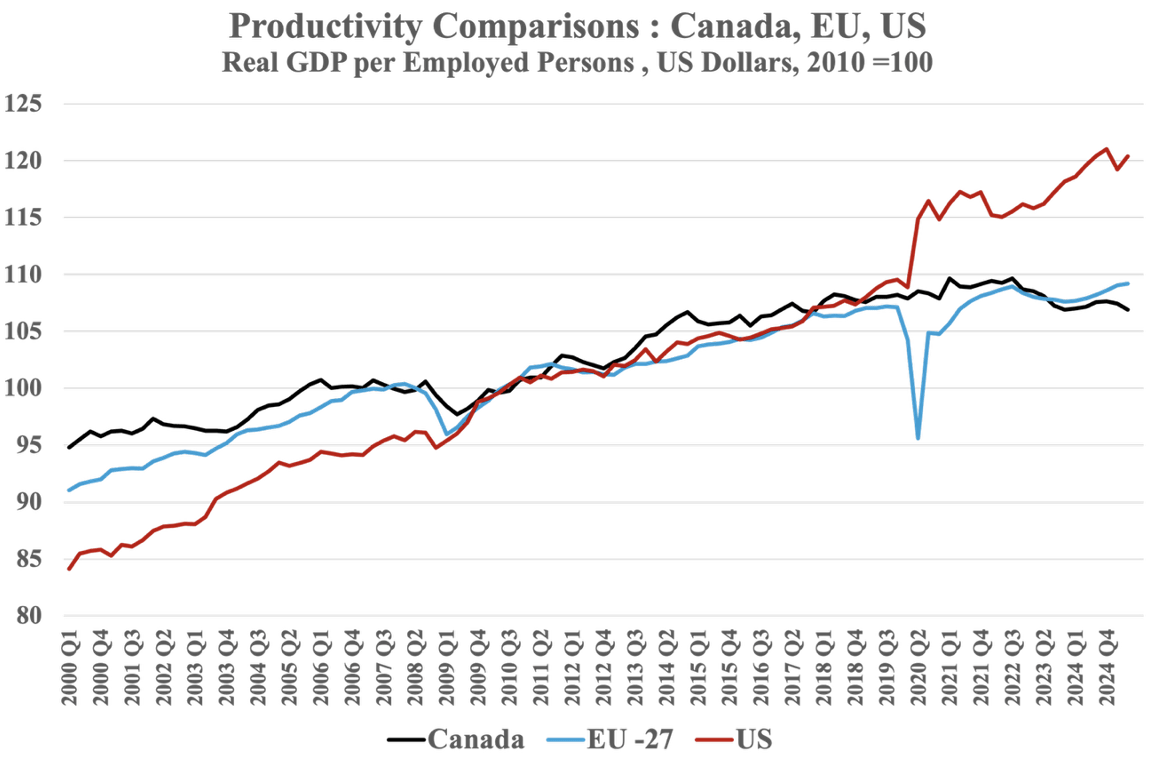
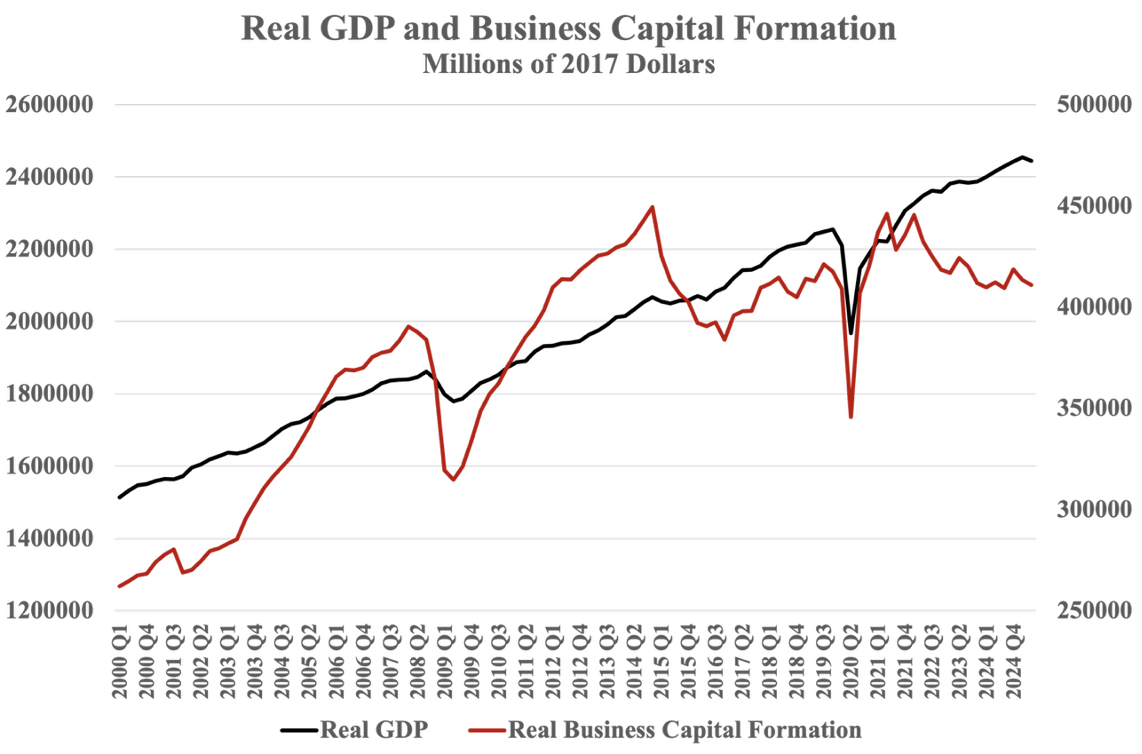
Public finance with a focus on capital investment is the principal instrument of change. In line with this strategy, a closer look at Canada’s sagging productivity suggests the next budget must take tangible steps to strengthen innovation performance.
Canada needs to raise its game on innovation.
Chart 1: Productivity
Source: Havers Analytics
Chart 2: Capital Formation
Source: Havers Analytics
Albert Einstein once said, “If I had an hour to solve a problem, I’d spend 55 minutes thinking about the problem and five minutes thinking about solutions.” While the ink is drying on Budget 2025 and much heavy lifting is required to get implementation acts and spending bills through Parliament, can we use the yearlong runway to Budget 2026 to think about Canada’s underperformance on innovation and develop course corrections, as required?
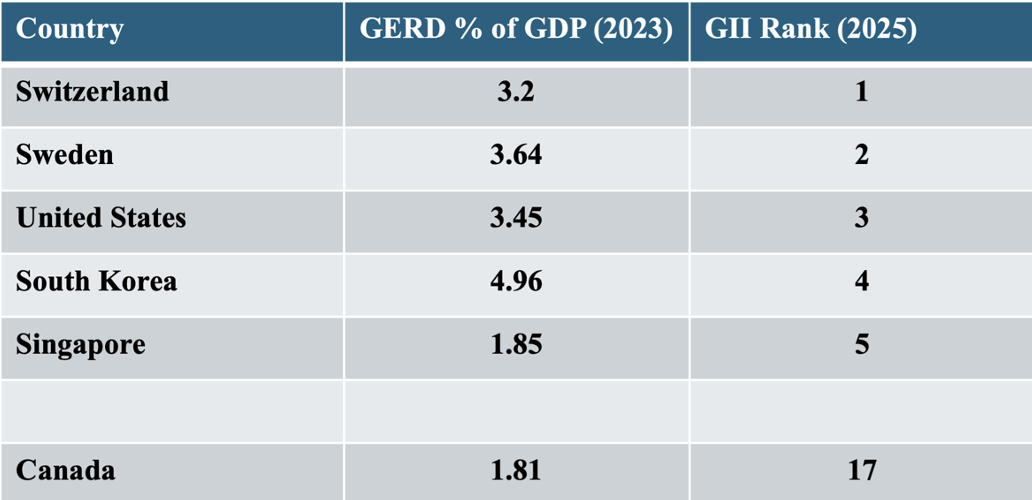
For the past 18 years, a United Nations agency has tracked innovation performance for nearly 140 countries. The Global Innovation Index (GII) ranks countries across seven pillars (institutions, human capital, infrastructure, markets, business, knowledge and technology and creativity). Canada ranks 17th. Not great. In recent years, notwithstanding investments by successive governments, Canada has not moved up the list, in fact, we are slipping.
While we have some relative strengths in human capital and research capacity, we have a long list of under-performers across more the 70 indicators – demographics, energy use, productivity, industry design, quality assurance, trademarks, information technology use, foreign direct investment, and capital formation. Addressing our innovation challenges is complex. There are likely no singular or simple answers that will be easy to implement.
A Nobel Moment for Canada
In 2025, Peter Howitt, a Canadian economist educated at McGill and Western, was awarded the Nobel Prize in Economics for his work on growth theory. This recognition is not just a celebration of academic excellence; it’s a moment of national reflection. Canada now has a Nobel voice on innovation and growth; one whose ideas speak directly to our economic challenges. Can we apply the insights of our own Nobel laureate to our policy choices?
Professor Howitt is perhaps best known for his 1992 paper with Philippe Aghion, A Model of Growth Through Creative Destruction, which introduced a dynamic model of economic growth driven by innovation and creative destruction.
The model builds on Joseph Schumpeter’s original idea that capitalism evolves through cycles of innovation that disrupt existing structures. Aghion and Howitt show that long-run growth stems from the continual replacement of old technologies by new ones. This process is not smooth. It involves firm turnover, sectoral shifts, and reallocation of resources. Crucially, it highlights that innovation is inherently disruptive, and that economic progress depends on institutions that allow this disruption to occur productively.
Endogenous Growth – Wealth, Innovation and Productivity
Disruption is coming. The forces of change from advances in artificial intelligence (AI), biotechnology and clean energy will transform the global economic landscape in the years ahead. Economic success will depend in part on how countries capture and distribute the opportunities that will flow from that churn.
In endogenous growth models, like the kind envisioned by Professor Howitt, long-term economic growth is driven by largely ‘internal’ factors like human capital, innovation (research and development-R&D) and knowledge creation. Innovation generates the increasing returns to scale (i.e., productivity). Wealth creation helps fund innovation and technological advancement. Will the wealth created by the Carney government’s big, bold projects provide the pay-off to fund the research and development necessary to drive innovation and productivity?
Chart 3: Wealth and Growth

Source: IFSD
Canada’s Evolving Innovation Policy
The last formal statement by the government of Canada on Canada’s innovation policy agenda was almost ten years ago in Budget 2016. There are 4 pillars. All are important and make intuitive sense – creative and entrepreneurial citizens (skills), science and technology (discovery), innovation infrastructure (commercialization) and supportive business environment (capital formation).
There was no formal review of programs in Budget 2016, or since. (Senator Colin Deacon did undertake an evaluation of business innovation programs in 2024). There was no bottom-up tabulation and overview of government programs and performance indicators. At the time, IFSD estimated the government was spending about $22 billion annually in the aforementioned policy space – about $8 billion on innovation and $14 billion on skills development and training. At the time, there were some 147 different spending and tax-expenditure programs.
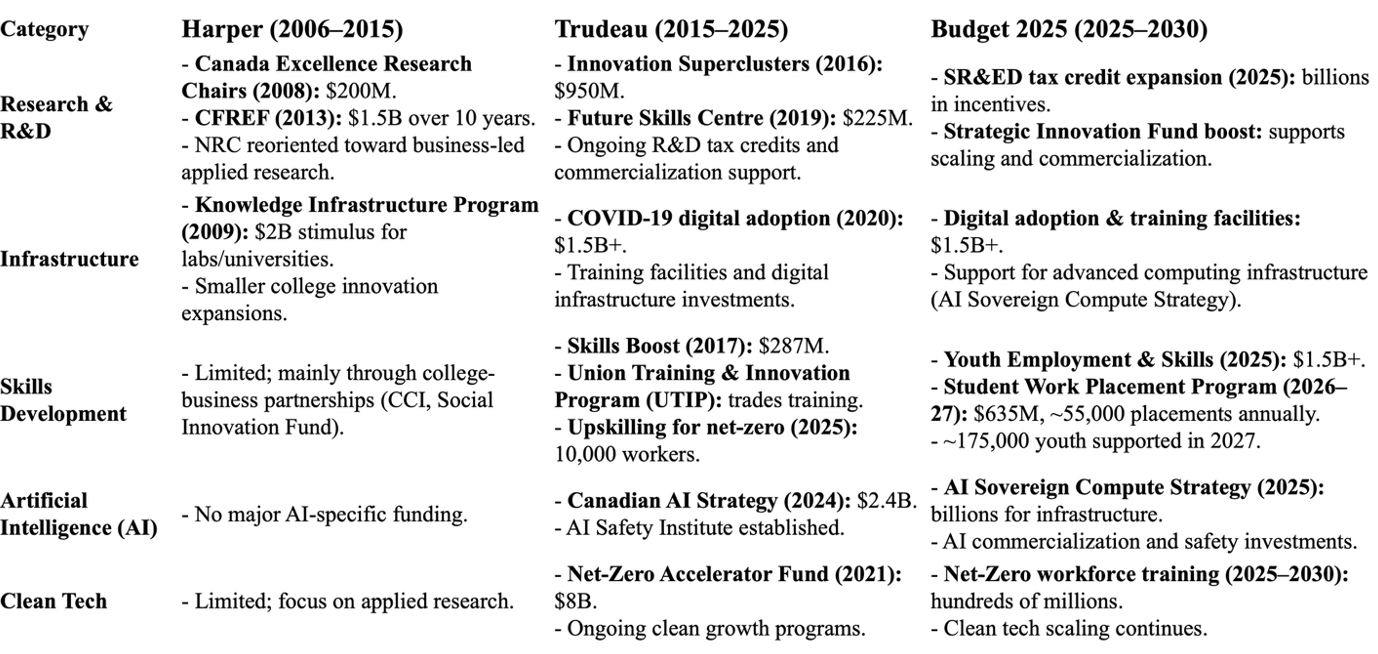
Prime Ministers Harper, Trudeau and Carney (Budget 2025) have made spending enhancements in innovation.
Table 1: Federal Announcements in Innovation Policy (Harper, Trudeau, Carney)
 Notes : CFREF = Canada First Research Excellence Fund
Source: Generated by Microsoft Co-Pilot from budget documents
Harper’s government gave policy priority to business-driven innovation. There were modest investments to research and infrastructure. Trudeau’s government made more significant investments across a range of policy priorities including AI, clean technology and R&D. The policy shift was more towards transformative sectors and work force reskilling to prepare Canadians for future industries. Budget 2025 focused on economic growth and made significant investments in innovation and skills across a range of policy areas – R&D, AI, clean technology and youth employment.
Spend Less, Invest More
OECD data show a strong correlation among spending on R&D, innovation standing and productivity. Countries that spend more on R&D (GERD = gross expenditure on research and development) tend to have better records on innovation (Chart 4). Note, Singapore is a country that stands out for high efficiency and effectiveness of spending. Countries that spend more on R&D also tend to generate higher levels of growth of productivity (Chart 5). More productivity translates to greater output, income and, eventually, wealth. More wealth permits more investment in innovation. A wealth feedback loop.
Chart 4: Spending on R&D and Innovation Standing
Notes: GERD = gross expenditure on research and development; GII = Global Innovation Index
Source: OECD Global Innovation Index
Chart 5: Spending on R&D and Productivity
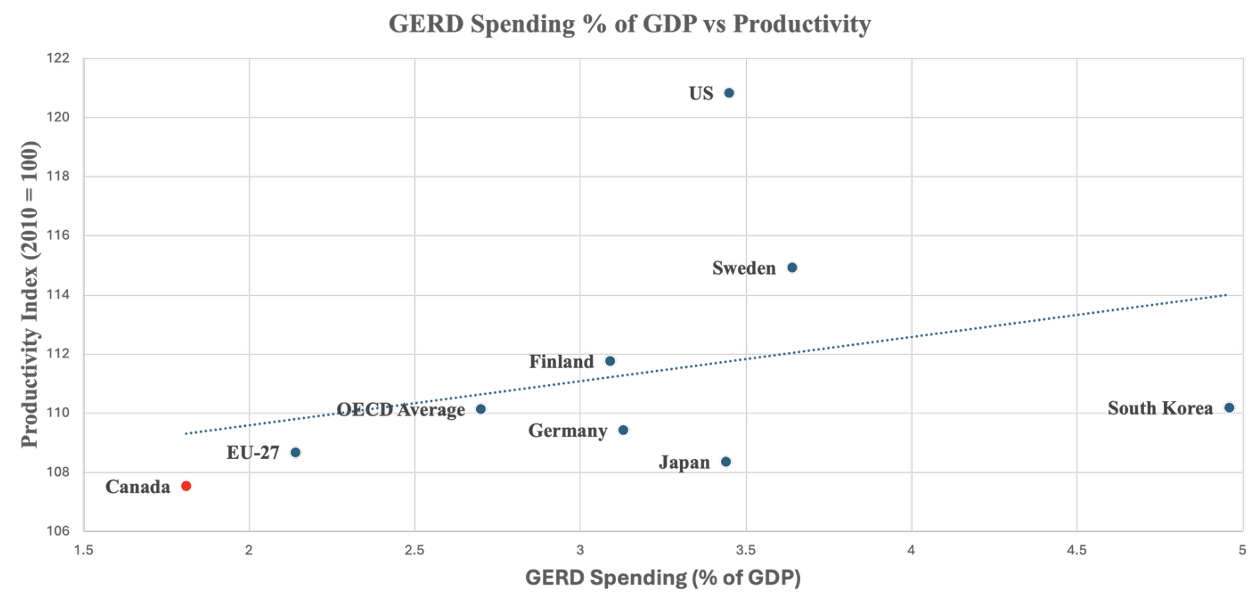
Source: OECD (2023 data)
The strategy in Budget 2025 is to spend less and invest more. The government is committed to an operating budget balance in 2028-29. This means spending on programs and services that will be consumed annually will be constrained over the next few years. The projected budgetary deficit in 2028-29 will be about $60 billion or 1.5 percent of GDP. In this fiscal environment, finding more fiscal room to invest will require spending review and reallocation.
Review, Reform, Reallocate
Government review exercises are underway. Under Budget 2025, innovation, science and industry departments must find targeted savings amounting to 15% of their operational and grants and contribution spending base by 2028-29. The Minister of Artificial Intelligence and Digital Innovation, Evan Solomon, has launched an AI Strategy Task Force.
Does Canada need a more comprehensive review of innovation policy and related programs? Something that can live up Professor Howitt’s vision of innovation and disruption that encompasses all elements and actors in the innovation process. Should Budget 2026 make innovation a key policy priority?
The case for larger review is strong. A weak global ranking signals systemic issues (i.e., discovery, commercialization, etc.) across private and public sectors. There is a lack of data and confidence that progress is being made to address the development of new skills. Has the time not come to address the efficiency and effectiveness of the 100-plus innovations and skills programs? Do we need to recalibrate spending on innovation (total R&D, discovery science, applied, etc) in the face of global competition?
It’s never too early to think ahead. That’s the essence of innovation.
Kevin Page is the President of the Institute of Fiscal Studies and Democracy (IFSD) at the University of Ottawa, former Parliamentary Budget Officer and a Contributing Writer for Policy Magazine.
Adam Parwana and Hao Tian Shen are undergraduate economics students at the University of Ottawa.