
‘Canadian Cool’ is Hot: This is a Soft Power Opportunity
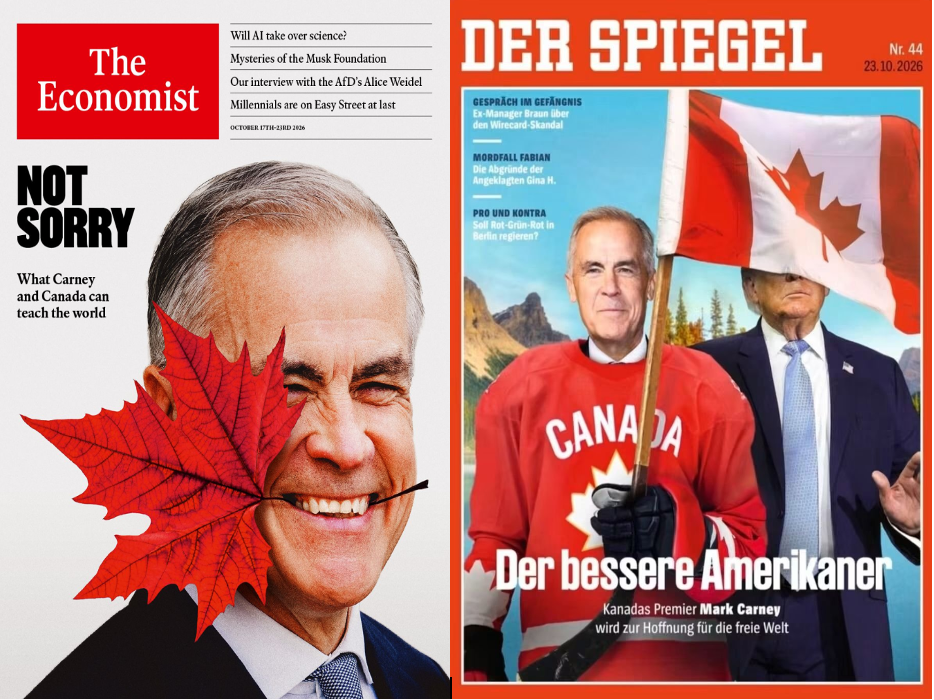 Prime Minister Mark Carney as October’s geopolitical cover boy/The Economist, Der Spiegel
November 1, 2026
On the one hand, it could be argued that it’s never been harder to be Canada. At the same time, the country is facing an unprecedented soft-power surge. The two are not unrelated.
By definition, middle powers cannot always get their way through hard power alone. So how can Canada aspire to achieve Mark Carney’s ambitious goals in a more competitive, ruptured world order, where the familiar patterns of multilateralism and US hegemony can no longer be relied upon to do the heavy lifting?
In important ways, it is that very conundrum that’s shifting Canada’s global brand based on how Carney has responded to the problem. Recent Canada covers of The Economist and Der Spiegel frame Canada as an attitude, in the case of the former with the headline “Not sorry” and of the latter with the headline “The better American and the hope of the free world”.
As global branding guru Simon Anholt might say, you can’t buy that kind of nation branding. Indeed, Anholt, explaining the leap in Canada’s standing in his Nations Brand Index 2025 from sixth place to third said that Canada’s stance against Donald Trump’s tariffs and threats prompted survey respondents to frequently express “admiration for the country’s courage, independence, and resolute position during trade and political conflicts.”
Call it “Canadian Cool” — per both Carney’s temperamental contrast with Trump and what may be a new era of trending Canadian soft power.
As the Carney government prepares to launch Canada’s first foreign policy strategy in 20 years, it is worth considering how a more strategic deployment of Canada’s burgeoning soft power could complement the new National Security Strategy unveiled last week to better support its security and prosperity.
When Carney stood up in Davos in January 2026, the world listened. Others have said similar things before – many times, in fact. But coming from a Canadian leader made the message more impactful. This is soft power in action.
Over many years, Canada has built a global brand that predisposes people around the world to trust Canada and Canadians, and to believe them to be honest, kind and true to their principles – if perhaps a little naïve or parochial, and somewhat inseparable from the US.
When the late Harvard scholar and foreign policy practitioner Joseph Nye coined the term “soft power” in 1990, he was referring to the United States’ ability to co-opt through force of attraction or persuasion, rather than simply coerce through military or economic pressure. Nye’s definition encompassed a country’s cultural exports, its political values and its policies.
In the modern context, where foreign policy outcomes pursued by states are ever broader, a country’s soft power tools can extend beyond its culture, political values and policies. They might also include how its scientific and technological contributions are perceived; how its companies behave abroad and how it invests overseas; how foreign tourists, students, immigrants and business travellers experience it; the impression that its citizens leave when travelling themselves; and how its media and social media output garners attention abroad.
For Canada, all of these tools matter, because they shape how others see the country, and how willing they are to work with Canadians, long before a politician, business leader or diplomat steps up to a podium or sits down at a negotiating table.
At a moment when it has never felt more vulnerable to the harder forms of power possessed by its hegemonic neighbour, there is a risk that Canada undervalues its soft power. I have always found it difficult to explain to Canadians just how well they are perceived overseas, particularly in Europe. The reception that Canadians enjoy abroad is simply far more positive than that afforded to almost everyone else.
Recent Canada-EU messaging is a case in point: a truly unprecedented narrative leap from the EU. The challenge – for both Canada-EU negotiations as well as for the broader use of soft power – is how to turn good feelings and strong convening power into concrete results. While soft power is not effective in isolation, nor an end in itself, it is much harder to achieve concrete results without good feelings or convening power.
So how can Canada make better use of its soft power as an instrument of statecraft? Because a country’s soft power boils down to how it is perceived by others, alignment with professed values matters. Canadian government action should therefore strive to stay on the right side of the line between supporting its independent soft power producers and directing or instrumentalizing them. It is a difficult line to draw.
There is plenty of grey area, and every action in this space can have unexpected second-order effects. But it is perfectly possible to do, particularly if Canada draws on examples from other countries and takes advice from its own soft power producers. Canada also shouldn’t shy away from particular tools just because others with different values use them – provided they can be used in a way that feels authentic to Canadian values.

Canada’s ‘Heated Rivalry’ on a Pride poster in Brno, Czech Republic,
June 6, 2026/Wikimedia
Music, Arts, and Film
Music, arts, and film are often deployed by governments in support of foreign policy, sometimes requiring significant long-term investment.
Since 1956, the US State Department has funded top musicians to tour the world – initially focusing on countries flirting with communism or the Soviet Union – to promote American values. Known initially as “Jazz Ambassadors” — a group whose early cohorts famously included Dizzy Gillespie, Louis Armstrong, and Quincy Jones — the program has evolved many times and continues in the form of American Music Abroad.
In 1997, faced with the Asian financial Crisis, South Korea began to actively promote its cultural industries through its Ministry of Culture, Sports and Tourism; a program that laid the groundwork for the global soft-power juggernaut of K-Pop.
For countries like Canada that already have globally marketable assets, promoting Canadian music, arts and film is low-hanging fruit. In many ways, Canada has already followed the South Korean model, but without the deliberate focus on internationalization.
Canada has a long tradition of mobilizing its domestic market in support of its cultural sector – for example, through requiring minimum Canadian content from domestic music broadcasters or through its highly sophisticated subsidy, public equity and tax credit system for film and TV production.
The focus to date has been on sustaining space for national storytelling and cultural identity which might otherwise be overwhelmed by the US creative sector. Many Canadian musicians, artists and cultural products have then gone on to enjoy strong international appeal, from Cirque du Soleil to Heated Rivalry. A new emphasis on cultural diplomacy and export at a time when Canadian values are defining themselves to the world on the political stage could amplify Canada’s soft power over the longer term.
Journalism as a Trust Amplifier
There are few soft power outcomes more desirable than having your international counterparts take in their news and information through the lens of your country’s media.
Canada’s reputation as an honest broker in the increasingly distrusted global information space, and the decline of funding for both the US and UK international broadcasters might offer an opportunity to promote its own international journalism.
During the Cold War, CBC’s Radio Canada International was one of the most-listened-to shortwave news sources in the world. But cutbacks over decades have left it far from a potent force in international media. Could this unique time of Canadian reinvention be the moment to reinvigorate the “Voice of Canada”? To do so would require sustained bipartisan support and significant long-term funding.
In the 21st century, of course, there are also more cost-effective options to help Canadian journalists reach greater international audiences. Those could include incentivizing key publications to remove paywalls for readers in particular countries, or returning to the Online News Act negotiating table with digital platform giants – this time with the broader goal of making Canadian journalism more globally accessible.
Successfully increasing Canada’s share of global news and information consumption could enable more people around the world to understand global issues through a Canadian lens, making it easier for Canadian leaders to persuade their counterparts to align on strategic priorities, such as supporting Ukraine or promoting free and fair market access.
Science, technology and higher education
The next phase of geopolitical competition will be decided, at least in part, by advances in science and technology. Whether in AI, quantum or other fields, an ever-growing proportion of government time is being spent on negotiating technological standards, vying for scientific know-how, wooing tech companies and burnishing domestic technological credentials. Canada, too, has a story to tell here and much to gain.
There is a broad range of tools available to promote a country’s scientific and technological prowess, from multi-decade scholarship programs to short-term advertising campaigns. Which tool is most effective depends on the objective and the target audience.
The countries that obtain the best results are clear-eyed about this. Singapore markets itself to tech companies and entrepreneurs worldwide looking for an Asia hub. Japan uses public funding to leverage its scientific research to build closer ties with its ASEAN neighbours, and to partner with developing countries. Estonia has advanced e-government to the point where it can now offer its learnings in digital governance to selected countries as its own form of soft power.
Though Canadian science, technology and innovation are impressive and enjoy a strong global reputation, recent reductions in international student visa quotas have damaged Canada’s international image as a welcoming destination for students and early-career researchers – particularly in markets such as India and China.
Nevertheless, given that strategic autonomy in technology is one of the core aims of Prime Minister Carney’s rebuilding of Canada’s economy and agency, there can and should be soft-power mileage to be made in the sector.
Putting Canada’s Soft Power to Work
These policy measures illustrate some of the many ways Canada can put one of its greatest international assets—its reputation—to work. As the government defines its foreign policy and rebuilds its hard power, it can’t lose sight of the relationships and credibility that help turn capability into influence.
As a middle power, Canada needs to invest in and deploy both soft and hard power effectively. Alone, neither is enough.
Thomas Codrington is the former British Consul General in Vancouver and a Senior Fellow of the Centre for Strategic Statecraft. This piece has been adapted for Policy from a longer CSS article.