
Carney in Davos: ‘The Old Order is Dead’… Long Live What, Exactly?
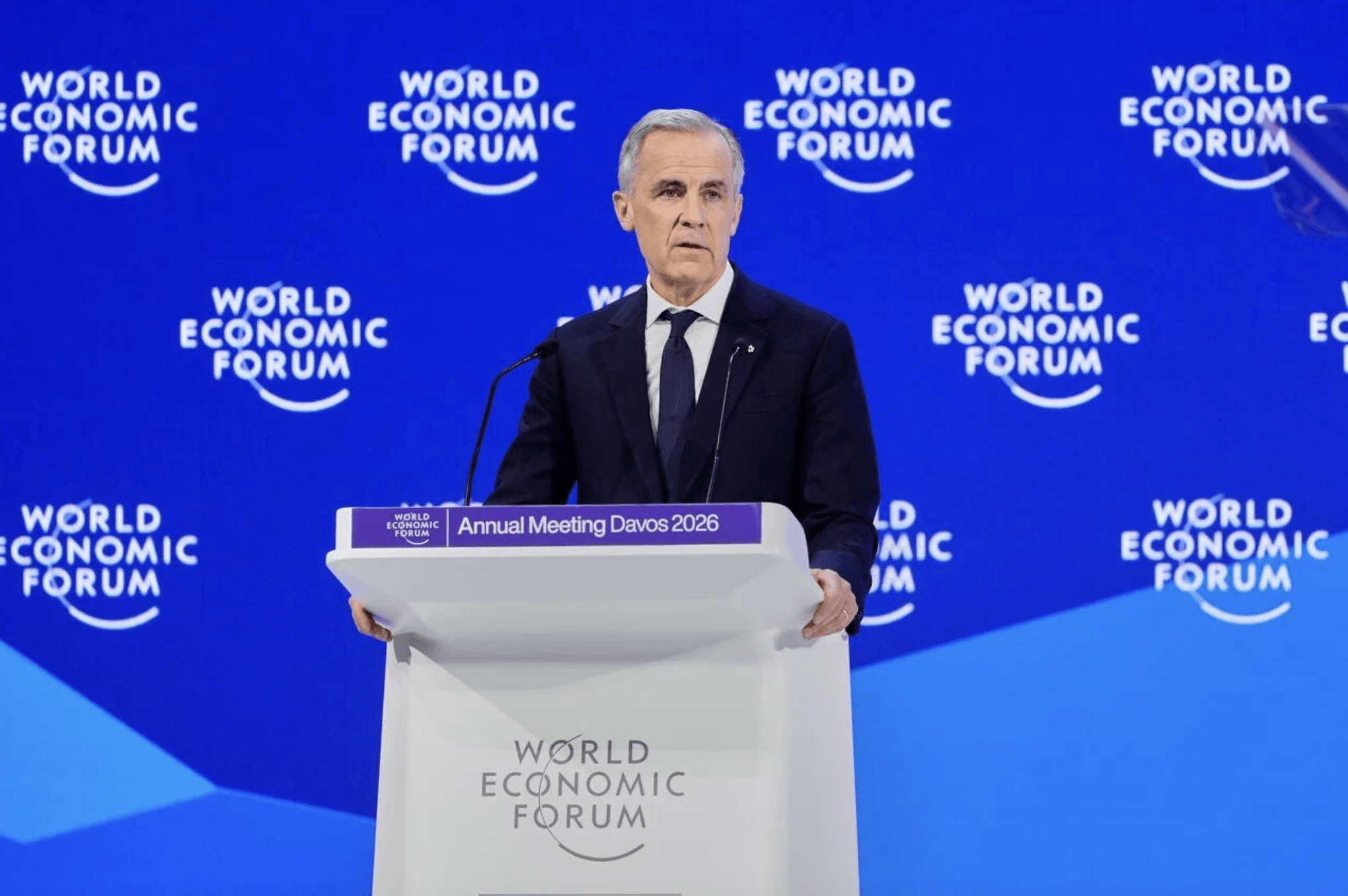 AP
AP
By Lisa Van Dusen
January 20, 2026
In Davos on Tuesday, Prime Minister Mark Carney made a triumphant return to the Glastonbury of his people.
After two decades of belonging to the global financial élite that gathers to solve the problems of the world (and sometimes has) in the Swiss Alps once a year, Carney returned to the World Economic Forum as a member of that most endangered political species of the New World Order — the elected leader of a democracy.
Because Carney is brilliant, fluent in the language of the planetary money moving that both makes Davos Davos and the world go round, and the very model of a modern technocrat — animate, eloquent, and a master of the Jesuitical argument unequalled in Canadian politics since the first Trudeau — he is less endangered than most.
While the speech is still being metabolized at this writing, it may be that the most enduring takeaway will be not the forensic pronouncement, “The old order is dead,” but the more prescriptive, “Stop invoking the ‘rules-based international order’ as though it still functions as advertised.”
As the leader of a multilateralist democracy, Carney officially represents the old order, or World Order Classic, as opposed to Donald Trump, who is — for all consequential purposes — the most productive status-quo pillager currently enabling the New World Order’s debut, rather than the leader of the old one, as were his predecessors. (We know this because, at the very least, no American president threatens to invade Greenland to win rules-based friends and influence sane people.)
But as a character in our ongoing systemic soap opera, Carney represents the future, and that’s how he was greeted at Davos. The speech wasn’t just Carney’s return to his old comfort zone as the world’s only binational central banker in a gathering of single-bank-governing slouches. It was his global coming out party as the anti-Trump he was elected to be in Canada, representing an alternative future to the nightmare next door.
But what will that future look like?
Carney’s message on Tuesday was that he has examined this problem from every possible angle, and he’s here to tell us that resistance to the New World Order is not only futile, but stupid. In other words, the Old World Order is what got us into so much trouble, and the most sagacious course of action now is to stake out a space in the new one while it is still under construction.
That brief was delivered with a combination of calmative framing using a communist-complicity allegory from the late Czech playwright and statesman Václav Havel to configure the Old World Order he was effectively self-ejecting from as The Big Lie that we all pretended to swallow out of fear — a “pleasant fiction” in Carney’s words — and can now bravely not only renounce but denounce.
The glitch in that framing is, of course, that Havel was, above all, a lover of — and tireless advocate for — democracy, who spent years being imprisoned both physically and by surveillance before democracy prevailed and he was elected the last president of Czechoslovakia, then the first president of the Czech Republic.
As a character in our ongoing systemic soap opera, Carney represents the future, and that’s how he was greeted at Davos. But what will that future look like?
The Old World Order arose from the human ashes of World War II amid a consensus on both the need to protect humanity from tyranny and the primacy of democracy as the system most capable of doing so.
The infrastructure of that consensus and collective responsibility — the United Nations and its key agencies, the International Criminal Court, the International Financial Institutions designed to respond to the needs of a human-centered society, among others — has been undermined by New World Order interests political, geopolitical and otherwise since before Donald Trump’s second presidency, or his first one for that matter.
And one key distinction between the old and new world orders is that the old one included democracy and the new one — to which Trump belongs as a democracy-discrediting clown and autocracy normalizer — pointedly does not.
As Carney pointed out in Davos, American hegemony “helped provide public goods: open sea lanes, a stable financial system, collective security, and support for frameworks for resolving disputes.”
More importantly, the weight of American power both hard and soft protected democracy — imperfectly, unevenly at home and abroad, and, for the past decade, far less efficiently based on the pummelling from its predators, hence Trump’s improbable, fateful return to the White House, which has made America the trophy mount of the systemic assault that has defined this century.
So, Mark Carney may be right that the damage of that assault to the longstanding status quo is too far advanced to reverse, and that Canada’s smartest response is to flee to a new geopolitical configuration.
But unless Carney’s variable geometry is an ingenious plan to hijack the autocracy-led New World Order on behalf of a disenfranchised humanity, a rhetorical tweak may be in order. Perhaps the Newer World Order?
And if the old, flawed, liberal world order that dissidents like Havel were willing to die to join is truly defunct, then Canadians should know exactly what will replace it, what that systemic organigram looks like, and what they will gain and lose in the process.
In other words, they should know where the values of Václav Havel will fit in the grand scheme of things.
Policy Editor and Publisher Lisa Van Dusen has served as Washington bureau chief for Sun Media, Washington Columnist for the Ottawa Citizen, international writer for Peter Jennings at ABC News, and as an editor at AP National in New York and UPI in Washington.