
Carney in Munich: The Prime Minister Wasn’t there, but his Davos Speech Was
February 18, 2026
While the terrible tragedy at Tumbler Ridge prevented Prime Minister Mark Carney from attending this year’s Munich Security Conference, echoes of his recent Davos speech could be heard throughout the meeting halls, hallways, and bars of the Bayerischer Hof Hotel.
I was there again this year as a Canadian parliamentarian and Senate committee chair, so some of those conversations were mine, both with longtime colleagues and new contacts, who, at the mention of “Canada” or “Canadian” reflexively raised Mr. Carney’s Davos doctrine.
Canada had its largest representation ever at the conference, including Foreign Affairs Minister Anita Anand, National Defence Minister David McGuinty, and Artificial Intelligence Minister Evan Solomon. All were active participants on panels, in bilateral meetings, and in sideline agreements.
With respect to my own agenda, in the past I had often been the demandeur at the MSC, requesting bilateral meetings on the sophisticated MSC “speed dating” app. This year I had to turn requests down, something that I can attribute to the Canadian brand going from cool to hot.
In other words, the contrast of the Carney-Davos echo effect and the lingering flashbacks to the kalte dusche (cold shower) speech of U.S. Vice President JD Vance last year, ultimately replaced this year by the more lukewarm, rhetorically moderate effort on the part of Secretary of State Marco Rubio. More on that below.
The diplomatic speed-dating is everywhere; an exchange of views with anyone and everyone. This year, ‘Canadian’ was a calling card.
The scene at the MSC, which draws hundreds of foreign, security and defence specialists — including diplomats and journalists — from across major capitals, has evolved in recent years as the clash of world orders has lent the talking-shop proceedings all the urgency of breaking news.
The conference has now burst its physical infrastructure. The historic Bayerischer Hof (first opened in 1841, destroyed in an Allied air raid in 1944, reopened in 1961), can simply not supply large enough conference facilities to accommodate over 40 world leaders, 1000 delegates and their support teams, even with the addition of the neighbouring Rosewood Hotel and the Hypovereinsbank for bilateral and other meetings.
Security clearance lines are too long, the crush of delegates too great, particularly during the Darwinian struggles of trying to get a seat in the main hall for the headliner speeches (Merz, Rubio, Zelenskyy, Macron, Von der Leyen, Starmer etc.).
Yet, delegates have learned to cope with the tumult, and the MSC endures as the preeminent security/foreign policy global conference, although I would argue that our own Halifax International Security Forum does not fall far behind, even with smaller attendance.
Vera Alexander, our ambassador to Germany, together with her talented team, rose to the occasion in preparing and executing programs for three ministers and one for the absent prime minister. The diplomatic speed-dating is everywhere; an exchange of views with anyone and everyone. This year, “Canadian” was a calling card.
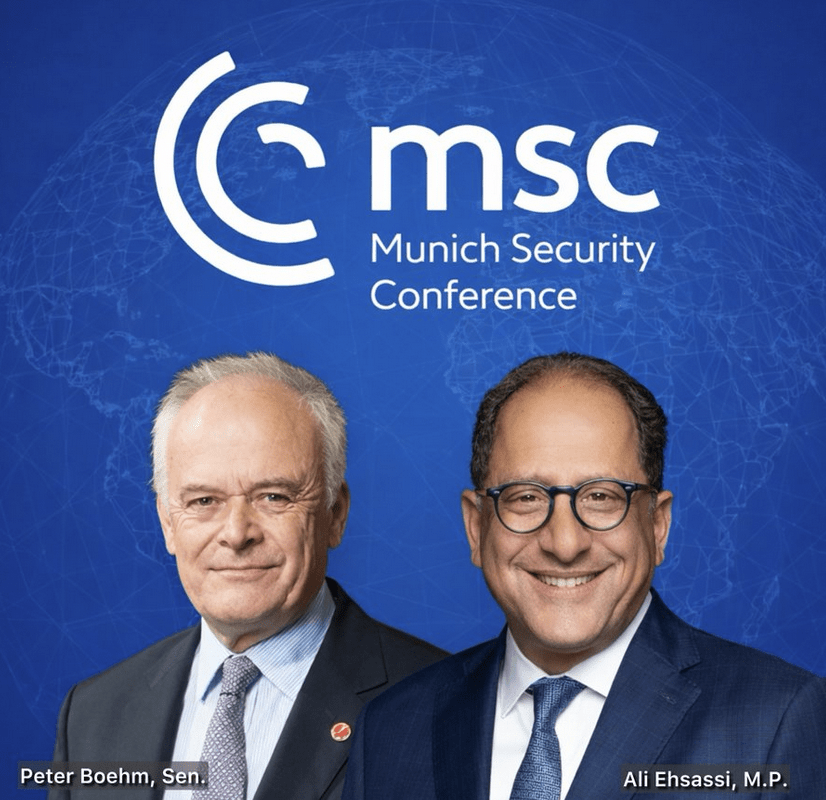
My House of Commons colleague Ali Ehsassi and I roamed the corridors, bumping into no end of American, European and especially German legislators and pundits (whom I had met during my years as our ambassador to Germany). This year, my sit-down bilateral meetings were more diverse.
I had more requests from private-sector actors looking for investment opportunities and partnerships with Canada, a response to our government’s trade diversification agenda. I met with bankers who wondered about the impact of Donald Trump’s tariff war, and the susceptibility of global bond markets to weaponization.
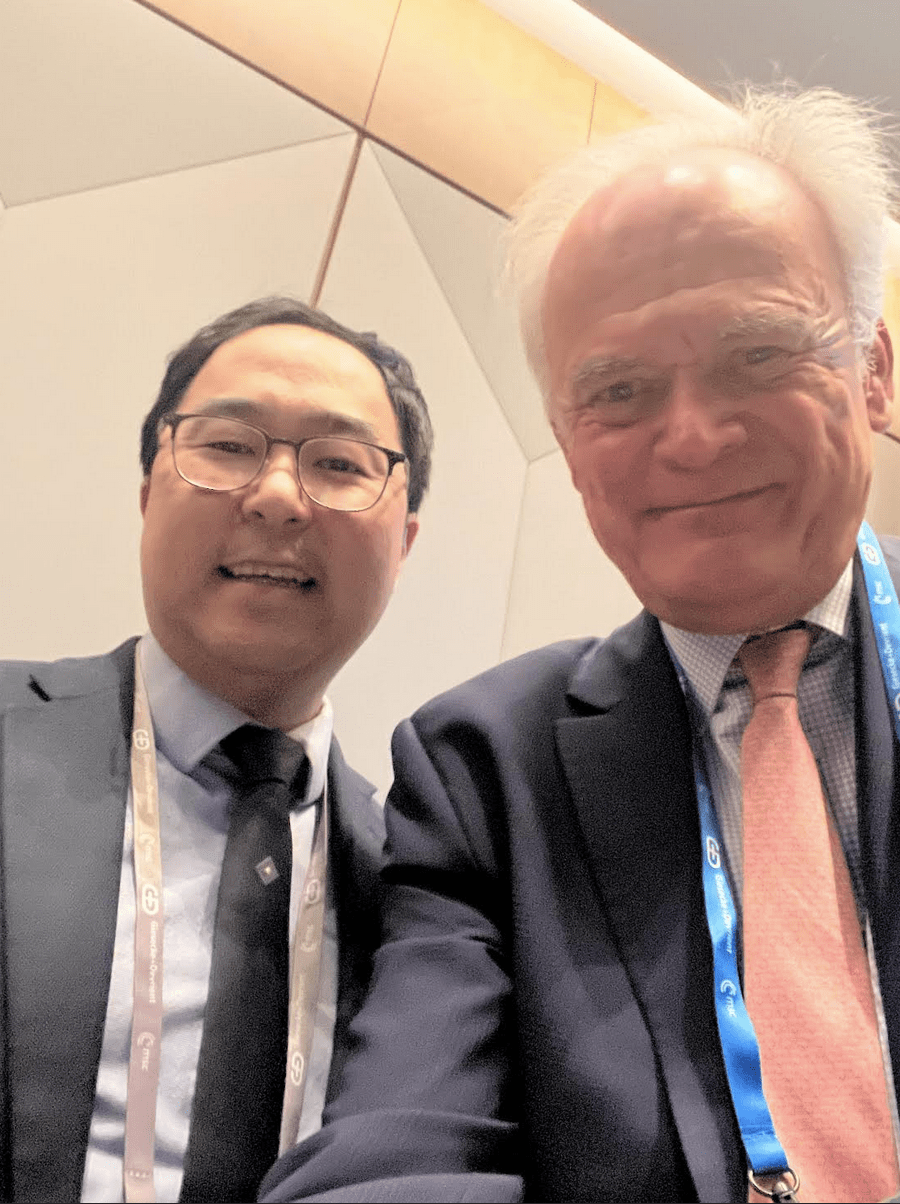
I joined Minister Anand at a high-level round table on the Arctic, discussions made more acute by the recent Trump-generated crisis over Greenland. Politico invited me to be on a live-stream panel with Democratic U.S. Senator Andy Kim (above), German Euro MP Hildegard Bentele and Matthias Berninger, Executive Vice-President of Bayer, to discuss critical minerals, which also afforded me an opportunity to address prospects regarding the review and potential renegotiation of the Canada/US/Mexico Free Trade Agreement (CUSMA).
I particularly enjoyed being one of three speakers (joining a leading German politician and a member of the first Trump administration) to discuss the state of the world at the exclusive Ewald von Kleist memorial dinner (all under Chatham House rules).
Baron von Kleist was the founder of the Munich Security Conference (originally “Internationale Wehrkundebegnung” first held in 1963) and a member of the Von Stauffenberg plot to kill Adolf Hitler for which his father was executed, and he imprisoned.
It was a privilege to meet with him before his death during my time in Germany and an honour to speak at an event bearing his name. At the dinner, we were — not surprisingly — unsuccessful in solving all the problems of the world, but had a lively time debating and gorging on wiener schnitzel.
Traditionally, global leaders have used the MSC as a key venue to set out policy direction. Vladimir Putin did so in 2007 when he decried the “unipolar world”, excoriated the United States for breaking international law and more or less said that following the collapse of the Soviet Union, he was determined to make Russia great again.
In 2009, then Vice President Joe Biden spoke of a reset in U.S. security policy, of both the need for a greater sense of cooperation with Europe and a requirement for Europe to do more. Biden was reflecting the American National Security Strategy (NSS) of the day.
Last year, Vice President JD Vance presaged the Trump Administration’s explosive December 2025 National Security Strategy, referring to the erosion of democratic norms within European countries and the suppression of dissent from populist voices.
This was “the woke threat from within.” Vance’s comments were later reformulated in the Trump Administration’s NSS as the problem of “civilizational erasure” in European countries— as condescending and racist a term as there ever was.
The U.S. has no interest in a decline of the West, according to Rubio, but wants to lead a Western-Civilization renaissance, which, when you ponder what ‘Make America Great Again’ has done for America, doesn’t bode well for Western Civilization.
Rubio’s comments this year were more soothing to the Europeans than the front-on assault by Vance last year, though civilizational erasure was back. The U.S. has no interest in a decline of the West, according to Rubio, but instead wants to lead a Western-Civilization renaissance, which, when you ponder what “Make America Great Again” has done for America, doesn’t bode well for Western Civilization.
It was the same message as Vance, a more sophisticated tone and the opening salvo of Rubio’s 2028 presidential campaign. He received a standing ovation, no doubt sparked by relief that he was not Vance.
While in Europe, Rubio stopped in Budapest to endorse Hungary’s strongman, Viktor Orbán — trailing badly in the polls for elections in April — as the kind of leader whose policies the U.S. would support. No doubt Putin would agree. Orbán’s latest campaign cry is the gaslighting gambit that the greatest enemy of Hungary is the EU, Hungary’s membership in which sustains its economy. The other Europeans are more than fed up.
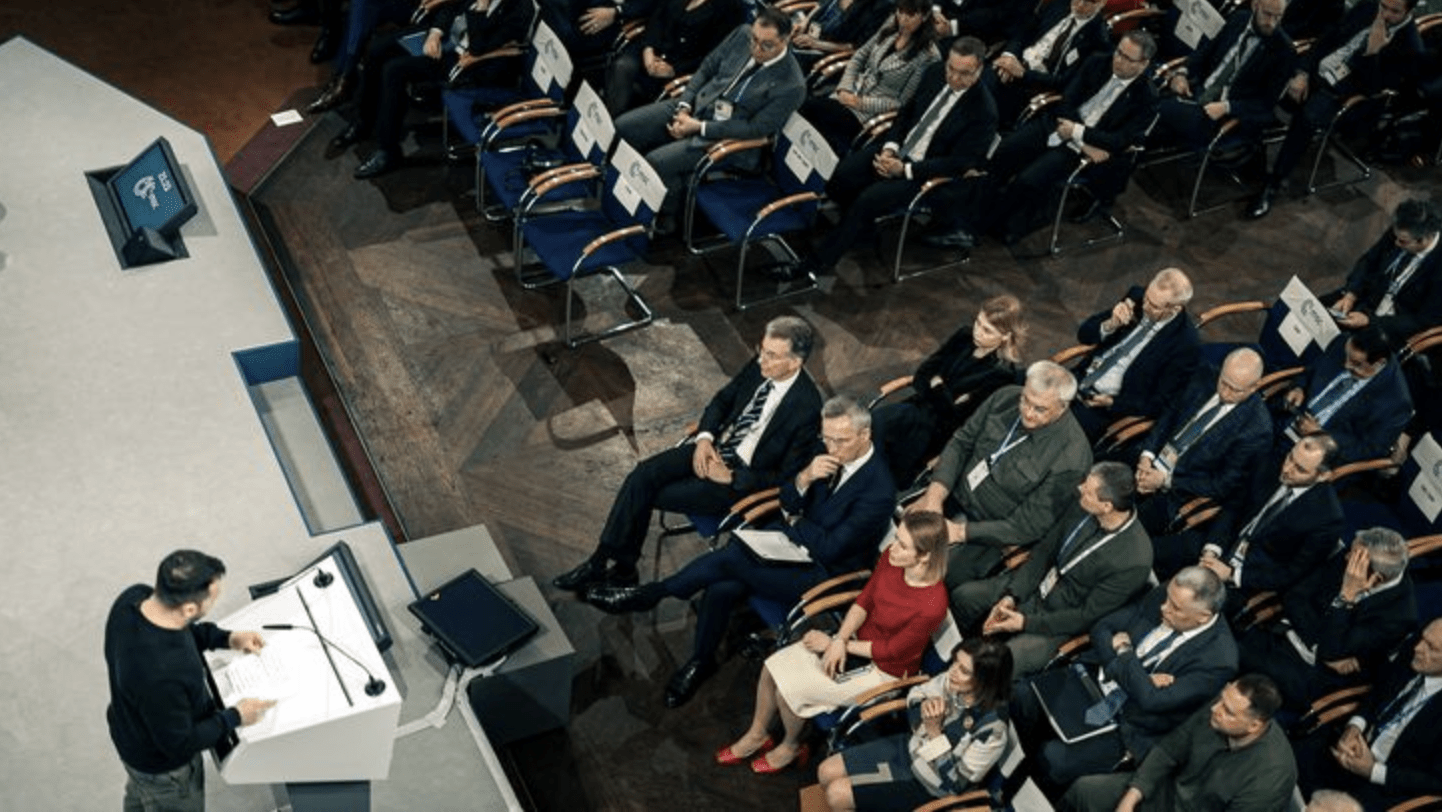
For the fourth year in a row, Russia’s war against Ukraine was also a focus. President Volodymyr Zelensky (above/MSC image) was both eloquent and precise in his remarks on the ongoing cost of the war to Ukraine, the extent of Russian losses, the need for European solidarity and, on the verge of another round of negotiations brokered by the US, the need for strong security guarantees.
I have been present for President Zelenskyy’s two addresses to our parliament and he has addressed countless others. He is the personification of the Ukrainian people’s resilience. His message, particularly to the Europeans, was more poignant, direct, and fiery this year. Stand with us, he said, we are defending Europe.
I am especially pleased that Canada turned out a strong delegation for this conference. In the past, including during my tenure in Berlin, we managed to have a minister of national defence or foreign affairs take part, usually on a panel. We were more numerous and consequential this time. Deals were made, agreements signed. Security in the Arctic loomed large.
Most of all, Canadian opinions were actively sought. Prime Minister Carney’s speech at Davos was more than the conversation starter than launched most of my meetings — not from me, but from the other parties — including members of the unusually large bipartisan U.S. Congressional delegation.
And the follow-up question was always, “What’s next?”
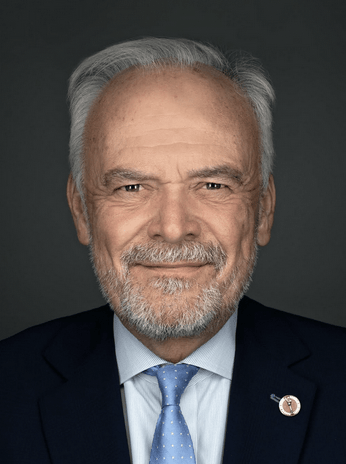
Policy Contributing Writer Sen. Peter M Boehm is Chair of the Senate Standing Committee on Foreign Affairs and International Trade and a former ambassador to Germany. He also served as Canada’s Sherpa for six G7s.