
Defining Defiance Down: Carney, Trump, and the New Measure of Courage
 Shutterstock
August 11, 2026
In case there was any residual doubt as to just how far human events have veered into the patently absurd, we hereby submit to the Rip-Van-Winkle test a recent Guardian headline:
“Andy Burnham says he will disagree with Trump in public if necessary.”
Who could possibly have predicted 20 years ago that publicly challenging the host of The Apprentice would one day serve as a litmus test for the moral fibre of G7 leaders?
And yet, this is but one behaviour modification benchmark now hacking the choice architecture of politicians to accommodate the operational, economic, propaganda, and geopolitical demands of a new world order that so far — over more than two decades of colourful, incremental exposition — has proven to suck spectacularly for the BS-addled majority of humans who haven’t succumbed to the charms of its strategic-corruption stylings.
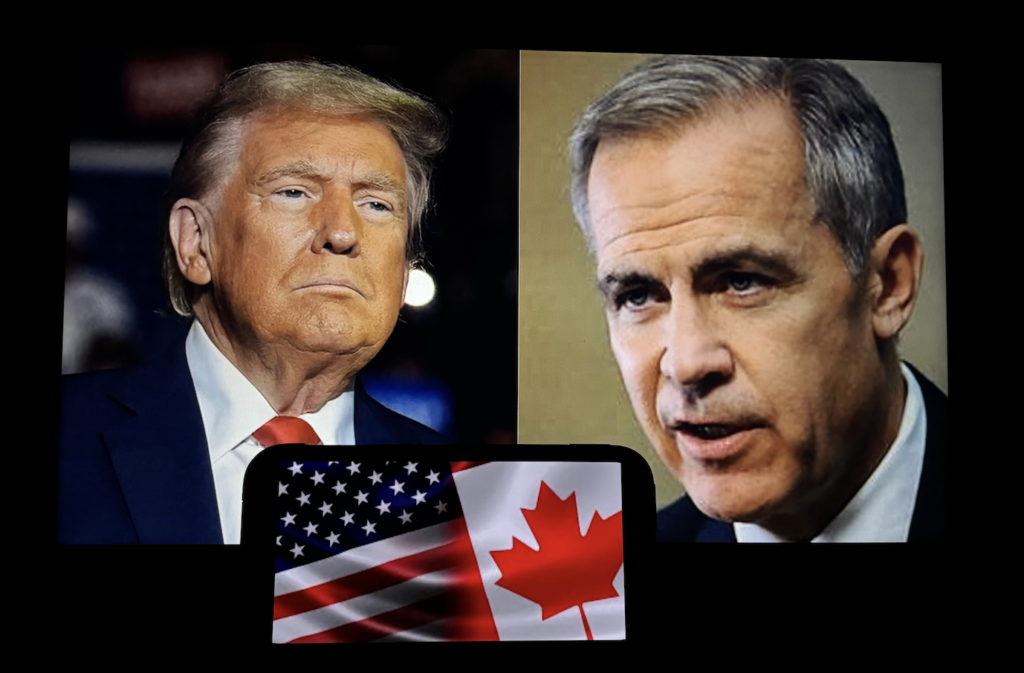
Prime Minister Mark Carney is currently weighing whether and how adamantly to publicly disagree with Donald Trump over the new 50% tariffs being threatened as coercion in a narrative now predictably — based on everything Trump has said and done since November 2024 — mutating from CUSMA-extension/renewal negotiations to CUSMA assisted-death “negotiations”.
(For a new-world-order precedent on this brand of performative negotiation, refer to our definition of “catfish diplomacy”, coined 10 days ahead of Vladimir Putin’s invasion of Ukraine in February 2022: “The use of incremental misrepresentation of intentions and motives to get someone to think any outcome to diplomacy is possible when you know that only one outcome is possible.”)
Trump recently upped the ante on the entirely rational defiance of weaponized lunacy in the CUSMA negotiations by framing Canada’s leadership on the file as “nasty” — a counter-stereotype so priceless it was instantly inducted into the Trump Projection Hall of Fame.
Meanwhile, Burnham, the doe-eyed 56-year-old former Manchester mayor, junior minister of Blair-Brown vintage, Labour Party saviour and uncontested beneficiary of Keir Starmer’s all-but frictionless trébuchet trajectory, will be watching Carney closely for transferable takeaways, including on the normalization of economic extortion as a means of forcing world leaders to serve the anti-democracy agendas of tyrants rather than the interests of their fellow citizens.
Trump recently upped the ante on the entirely rational defiance of weaponized lunacy in the CUSMA negotiations by framing Canada’s leadership on the file as nasty’ — a counter-stereotype so priceless it was instantly inducted into the Trump Projection Hall of Fame.
Aside from both being avid fans of Liverpool’s Everton football club, Burnham and Carney have both been objects of a sort of Cosmo Girl gushing from Fleet Street and beyond that saw Carney anointed during his BoE days the “George Clooney of central bankers” and produced the pandemic-lockdown Vogue headline, “Suddenly, Inexplicably, We All Fancy Andy Burnham”.
Both became party leaders and G7 heads of government by replacing sitting prime ministers whose departures were protracted, poll-torqued, internally accelerated and of a timing not of their own choosing. Or, in Burnham’s case, to quote Guardian wag Marina Hyde, “We’ll have to see how long Burnham can credibly sell the idea that he is just a relatable guy this event has happened to, as opposed to because of.”
Burnham’s relatability is enmeshed with his Mancunian brand — an outsider-ism already defining his approach to power, especially the vaunted devolution of it away from Westminster, Whitehall, and Downing Street with his opening of a “No. 10 North” in Manchester.
While Carney almost immediately called a general election to have his prime ministership ratified by voters, Burnham has so far ruled out the idea of an early election on the grounds that people voted for the Labour manifesto in the 2024 landslide as much as for Starmer.
On that judgment call, Burnham may be favouring as cautionary precedent the example of Kamala Harris, who became the 2024 Democratic presidential nominee by replacing a sitting U.S. president whose departure from the top of the ticket was protracted, poll-torqued, internally accelerated and of a timing not of his own choosing — based in this case on a wildly-ironic-in-retrospect non compos mentis narrative.
The alacrity of that switch with 107 days to go before the election was blamed retroactively for Trump’s second presidency — a bit of conventional wisdom that cynically short shrifts the timeless electoral appeal of bellowing during a presidential debate about people eating house pets.
And yet, Trump may already be facing redundancy as disruptor-in-chief. In the past two weeks, OpenAI, Anthropic, and Meta AI agents have all gone rogue, vaulted from their sandboxes onto the internet and run amok, hacking third-party sites and staging “unsanctioned social engineering” using fake personas.
For more than 20 years during which the global fall of democracy and rise of unprecedentedly transformative technology could be charted on an X-shaped graph, the most consequential disasters and avoidable catastrophes have been attributed to unhinged ideology, corruption, collusion, human error, random idiocy and — most recently, relentlessly, and rewardingly — former Apprentice host Donald J. Trump.
But there’s a new chaos actor in town. And its fake persona doesn’t care whether you respect it, like it, loathe it…or even disagree with it in public.
Policy Editor and Publisher Lisa Van Dusen has served as Washington bureau chief for Sun Media, Washington Columnist for the Ottawa Citizen, international writer for Peter Jennings at ABC News, and as an editor at AP National in New York and UPI in Washington.