
‘Encampment’: The Dismantling of Myths on a Path Toward Hope
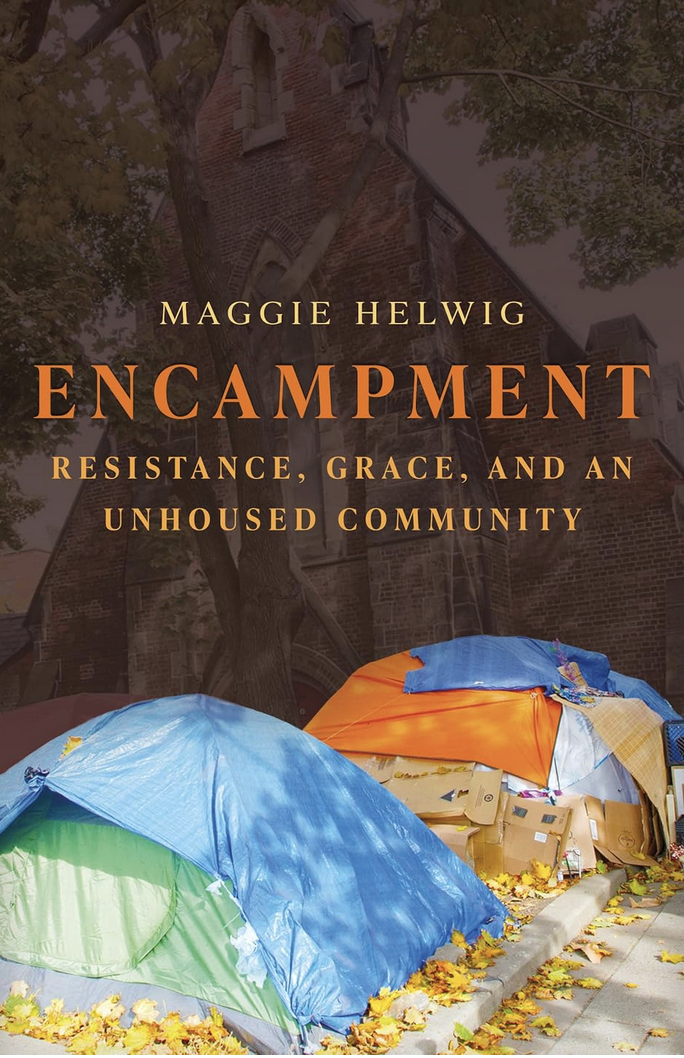
Encampment: Resistance, Grace, and an Unhoused Community
By Maggie Helwig
Coach House Books, May 2025/176 pages
Reviewed by Sen. Wanda Thomas Bernard
April 23, 2026
Maggie Helwig’s Encampment is a rare and necessary book. It is part memoir, part social commentary, part theological reflection, written from the heart of a community most of society refuses to see.
As the long‑time Anglican priest of Saint Stephen‑in‑the‑Fields in Toronto’s Kensington Market, Helwig writes not as an observer but as someone who has lived alongside the unhoused residents who built an encampment on the church grounds beginning in 2022.
Her opening words set the tone: “I’m writing this because I want you to understand my world… a world of real people who struggle and are kind… who are often special and beautiful in ways that most of our society cannot and does not try to understand.”
From the first pages, Helwig makes clear that this is not a story about “issues.” It is a story about people, people who have been pushed to the margins, rendered invisible, and yet forced to live every moment of their lives in plain sight.
Helwig situates the encampment within a broader social unravelling: the climate crisis, the erosion of empire, and the fraying of social supports. She writes with stark honesty about her lack of optimism for the future, yet insists that real, human survival depends on learning to care for one another “deeply and consistently.”
The encampment becomes one such attempt: flawed, fragile, and profoundly human.
This book is about resilience in impossible times. Helwig does not romanticize suffering; instead, she reveals the courage required simply to remain present when most people would run away.
One of the most compelling aspects of Encampment is Helwig’s willingness to expose her own vulnerabilities. She writes candidly about her lifelong mental health struggles and her inkling that she may be on the autism spectrum. She speaks with tenderness and clarity about her autistic daughter, who requires full‑time care, and about the grief of losing her father while navigating the public demands of her ministry, amid the housing crisis.
Perhaps most heartbreaking is her account of her husband’s Alzheimer’s diagnosis and the shifting responsibilities that followed. Even as her own support system collapsed, she continued to advocate fiercely for the unhoused community around her church. Her pastoral work, her family life, and her activism are not separate threads, they are tightly woven.
Helwig confronts the structural and interpersonal violence that shapes life for those on the margins. She writes about:
- the serial killer who targeted men in Toronto’s 2SLGBTQ+ community, specifically focusing on racialized men in the Gay Village
- homophobia and institutional failures within the police service
- the van attack in North York that targeted women
- the deaths caused not only by murder, but by lack of access to healthcare, poverty, and systemic neglect
These events form the backdrop to Encampment: a society where certain lives are treated as disposable. Helwig’s critique is sharp but never sensational. She shows how violence thrives in silence and how people become invisible until tragedy forces their names into public view.
One of the most compelling aspects of the book is the way in which Helwig positions scripture as a source of hope. Despite the bleakness of the circumstances, Encampment is ultimately a book about hope and resilience. Helwig draws deeply from Christian scripture, not as abstract theology but as a living resource for survival. She uses the resurrection not as a metaphor but as a present‑tense promise: that life persists, that dignity can be reclaimed, that community can be rebuilt.
A line on page 85 captures this beautifully:
“Power and greed and fear will try to stop you. Grief and time will wear you down. But life stands with you. Speak your name in the morning.”
This is pastoral theology at its most grounded, the reality of hope and resilience spoken into the messiness of real lives.
Helwig also dismantles many of the myths surrounding homelessness:
- the myth that homelessness is an individual failure rather than a structural one.
- the myth that encampments are inherently dangerous.
- the myth that people living outdoors are “choosing” that life.
- the myth that the system is broken, while, as she writes, “it is built this way.”
She exposes the lack of mental health resources, the overreliance on food banks, the punitive responses to poverty, and the disturbing trend of filming and shaming people in crisis. One particularly striking story involves a man arrested for sharpening a knife inside his own tent. Helwig reminds us that such an act would be unremarkable in any private home yet was criminalized because this “home” was visible.
What makes Encampment especially powerful is Helwig’s insistence that community is not theoretical. It is lived. It is created. It is chosen. She offers a rare glimpse into how encampments function as families of choice, networks of care, protection, conflict, and love. These communities and human connections are fragile, but they are real.
When policies, bylaws, and police actions sought to remove people from the church grounds, Helwig and her church community responded with unwavering commitment. She documents the legal, political, and moral battles with clarity and compassion, always centering the humanity of those most affected.
Encampment is a courageous, unsettling, and deeply moving book. Helwig brings a human face to people our society routinely chooses to forget and neglect. Her voice is compelling because she speaks with the authority of someone who has lived the story, suffered alongside her community, and was courageous enough to act.
This is not simply a book about homelessness. It is a book about what it means to be human in a time of struggle and what it might take for us to survive with our humanity intact.
As a Senator who happens to be a social worker, I found Encampment to be an urgent call to think differently about homelessness; to embrace compassion instead of fear, and to recognize the profound constraints faced by those living with displacement.
And if we are willing to listen, Encampment offers not only a critique, but a courageous path toward hope.
Senator Wanda Thomas Bernard, the first African Nova Scotian woman in the Senate, advocates for reparations and social justice to dismantle the systemic inequalities facing marginalized communities.