Europe’s New Political Divide isn’t Left-Right, it’s About Russia
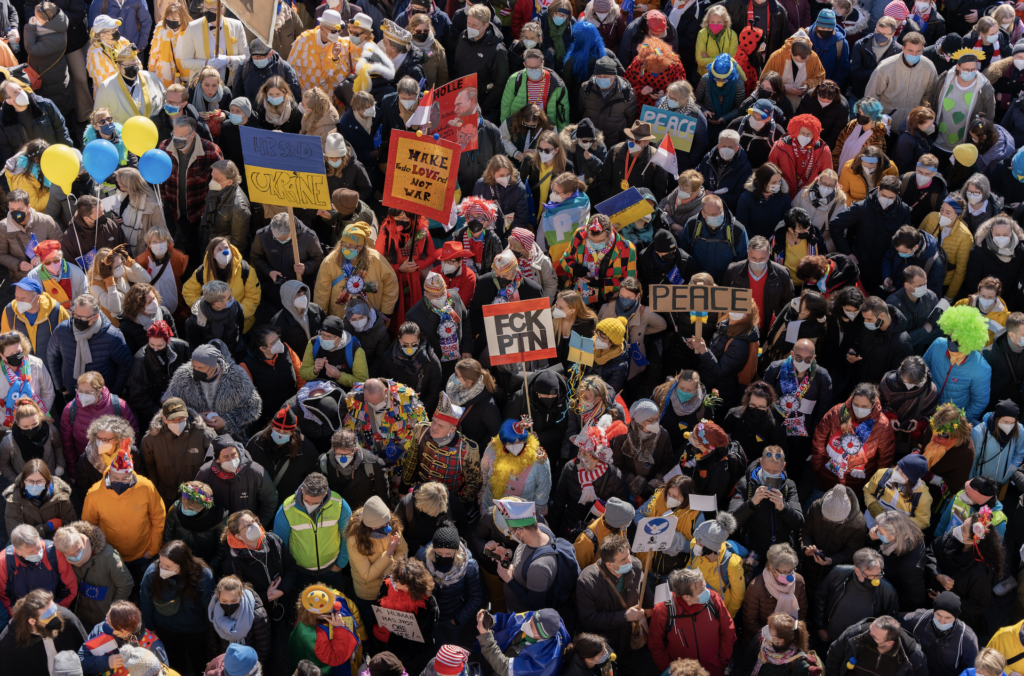 Pro-Ukraine protesters in Cologne, Germany, February 28, 2022/Shutterstock
This piece is part of Our Policy Series on the Canada-EU Relationship.
By Dietlind Stolle and Maria Popova
April 21, 2026
The European Union’s difficulty in forging a forceful and coherent foreign policy is often blamed on institutional limits or on leadership gaps. But the deeper constraint is domestic — and it runs through European societies themselves.
Across Europe, a new divide is hardening over how to respond to Russia’s aggression. The divide cuts across the familiar lines of left and right, and even across longstanding battles over European integration.
At its core lies a simple but decisive question: should Europe confront Russian aggression to prevent a wider attack, or should Europeans be looking for ways to forge a compromise with their Russian neighbour, even at Ukraine’s expense? European citizens are divided.
Russia’s war against Ukraine is no longer a foreign policy question for Europeans. It has become a domestic political battleground.
This security–collaboration divide structures public opinion, reshapes party competition, and increasingly decides elections. Political parties and candidates have begun to take clear, sometimes starkly opposing positions—and voters are on board.
In our research across 21 EU countries and the UK using the EUI-YouGov survey, we find that more Europeans seek security solutions to Russia’s threat than collaboration with Russia, but there is significant variation across the EU. People in Finland and Sweden are the most security-oriented Europeans in our data, while Greeks and Bulgarians are most interested in appeasing Russia.
The graph below shows that there is not one single factor that distinguishes the security-oriented Europeans from the collaboration-oriented. This dimension cuts across many standard cleavages including East/West, left-right, pro EU and anti-EU.
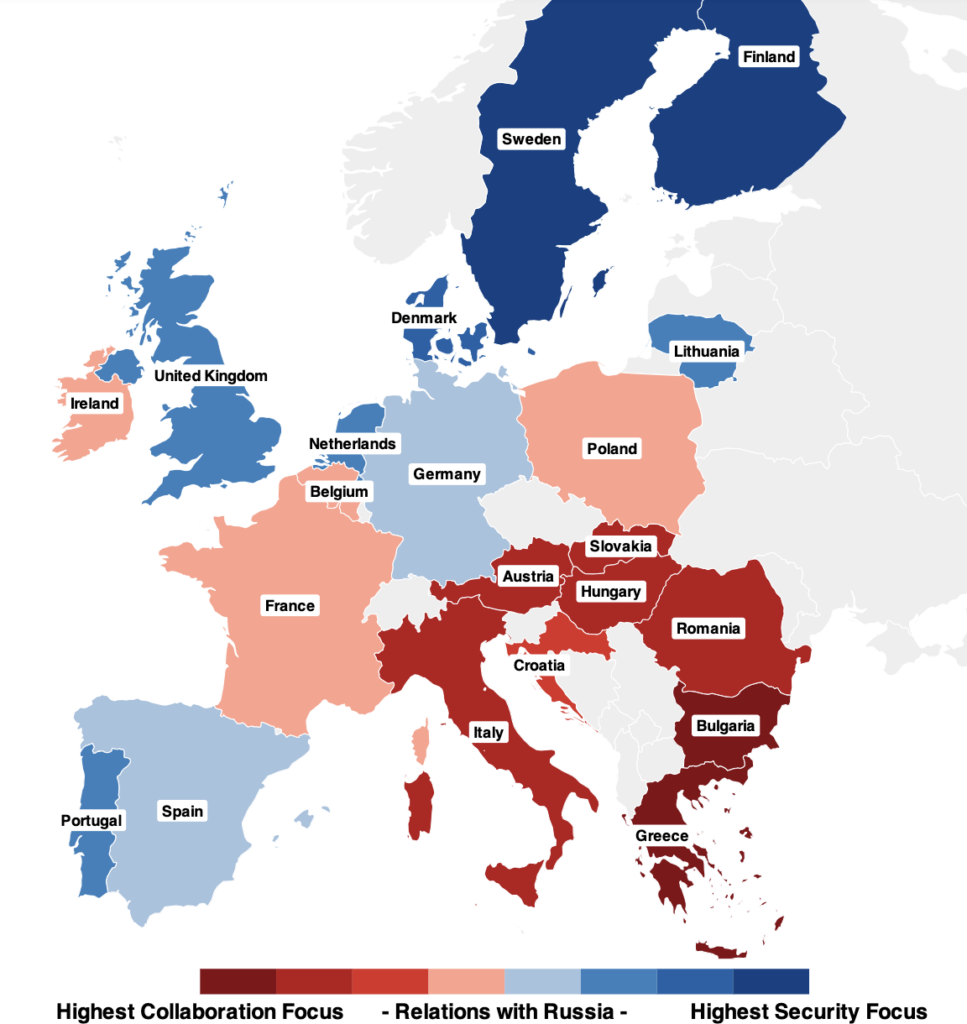
Parties, left and right, position themselves along this new dividing line. While many parties, such as Labour in the UK, France’s Renaissance, and Germany’s governing coalition, promise to strengthen Europe’s defence capacity, complete its energy pivot away from Russian supply, and establish a Special Tribunal for the Crime of Aggression Against Ukraine, others take conciliatory positions towards Russia that they call pragmatism.
Fidesz in Hungary, the AFD in Germany, and SMER in Slovakia, all have advocated restoring the energy relationship with Russia despite the war and making diplomatic concessions to Russia instead of supporting Ukraine to victory.
Recent elections bring this into sharp focus. In Hungary, the end of Viktor Orbán’s long tenure signals a shift toward the security-oriented camp and a re-alignment with mainstream EU-level policy.
Over the past four years, Orbán has staunchly opposed the European Union’s collective decisions on Russia and Ukraine. He has sought to block or water down sanctions, refused European partners’ offer to help diversify away from Russian energy dependence, obstructed military and financial aid for Ukraine, and vetoed Ukraine’s EU accession path.
Removing this one outlier does not resolve Europe’s deeper problem—it exposes it. In Bulgaria, voters have just given a resounding mandate to former president Rumen Radev and his Progressive Bulgaria party, which ran simultaneously on affirming Bulgaria’s EU and NATO membership while advancing an accommodating stance towards Russia, justified by cost-effectiveness, diplomacy, and pragmatism.
Radev’s victory underscores that the security-accommodation divide is not the same as the familiar pro-EU-Eurosceptic cleavage. More professedly Euro-Atlantic politicians like him may start proposing collaboration with Russia to solve domestic economic dilemmas.
For policymakers, the message is blunt. The constraint on European action is not only between states — it runs through them. Governments may align on sanctions or military support today, only to face domestic backlash tomorrow.
Our research identifies a significant group of voters, beyond the security-focused or the Russia-appeasers, who support Ukraine in the face of Russian aggression in principle but hesitate to back decisive policies if they translate into higher domestic economic costs or risks.
For example, this winter, Belgium’s ostensibly Ukraine-supporting government balked and ultimately sank the EU-level plan to use Russia’s frozen assets to issue a major loan to Ukraine. The fact that at least a quarter of Belgians support Ukraine only insofar as such support does not make Belgium vulnerable to potential economic and legal consequences probably accounts for the outcome.
The Belgian foreign minister, Maxime Prevost, argued seizing the assets would put Belgium at risk of bankruptcy if Russia sued them in international court and won. These voters are not marginal—they can be swayed in different directions and determine policy outcomes.
This matters for Canada. Ottawa has taken a clear position on the security side of the divide, backing Ukraine militarily, financially, and politically, and coordinating closely with European allies.
Political entrepreneurs have already adapted. Across Europe, some parties are mobilizing cost concerns, war fatigue, and energy insecurity, especially in the wake of the ongoing problems in the Middle East. These parties frame accommodation of Russia as peace-making and collaboration with Russia as pragmatism.
Others emphasize that providing Ukraine with the backing to win the war means taking realistic responsibility for all of Europe’s security in the face of Russia’s open threats and ongoing aggression. From this perspective, Ukraine’s success in defending against Russia is understood as protecting all of Europe.
This matters for Canada. Ottawa has taken a clear position on the security side of the divide, backing Ukraine militarily, financially, and politically, and coordinating closely with European allies. The EU-Canadian alignment on the need to counter Russian aggression is one part of the reason there has been widening discussion of deeper institutional ties between the EU and Canada (the other part being the increasingly problematic and adversarial stance of the Trump administration towards both Canada and the EU).
But Canada should be clear-eyed about the diversity of positions at the national level in Europe that exists underneath the diplomatic cohesion at the supranational EU level.
Two implications follow:
First, European alignment on Russia is uneven and contested. Electoral turnover can shift national positions in EU member states quickly, especially where governments depend on cost-sensitive constituencies. Canada should plan for variability across partners and over time, rather than assume a single European stance.
Second, this divide creates openings for external influence. Moscow has long sought to exploit economic vulnerabilities and political fractures in Europe. Russian state-backed media and aligned networks amplify precisely the narratives that resonate with cost-sensitive voters — emphasizing war fatigue, the risks of escalation, and the economic burden of supporting Ukraine — while framing collaboration as pragmatism rather than concession
The risk is not simply overt alignment with Russia and active obstructionism, à la Orbán, but the erosion of European focus and resolve under the guise of diplomacy and pragmatism.
For Canada, this suggests a dual-track approach: deepen cooperation with those European partners committed to a European security-first strategy, while maintaining broader engagement across the Union. It also reinforces the importance of NATO and of bilateral ties with key European states, which may prove more reliable than EU-wide consensus in moments of stress.
Europe’s geopolitical challenge is not only external. The end of the Orbán era does not resolve Europe’s Russia problem; it reveals how deeply it is embedded in domestic politics. The divide is not temporary — it is structural. And it will shape Europe’s capacity to act for years to come. Canada’s strategy should be calibrated accordingly.
Dietlind Stolle is James McGill professor in political science at McGill University and the former director of the Centre for the Study of Democratic Citizenship.
Policy Columnist Maria Popova is Hiram Mills associate professor of political science at McGill University and the co-director of the Jean Monnet Centre Montreal.