
‘Family Secrets’: A Daughter Uncovers her Polish Parents’ Hidden War
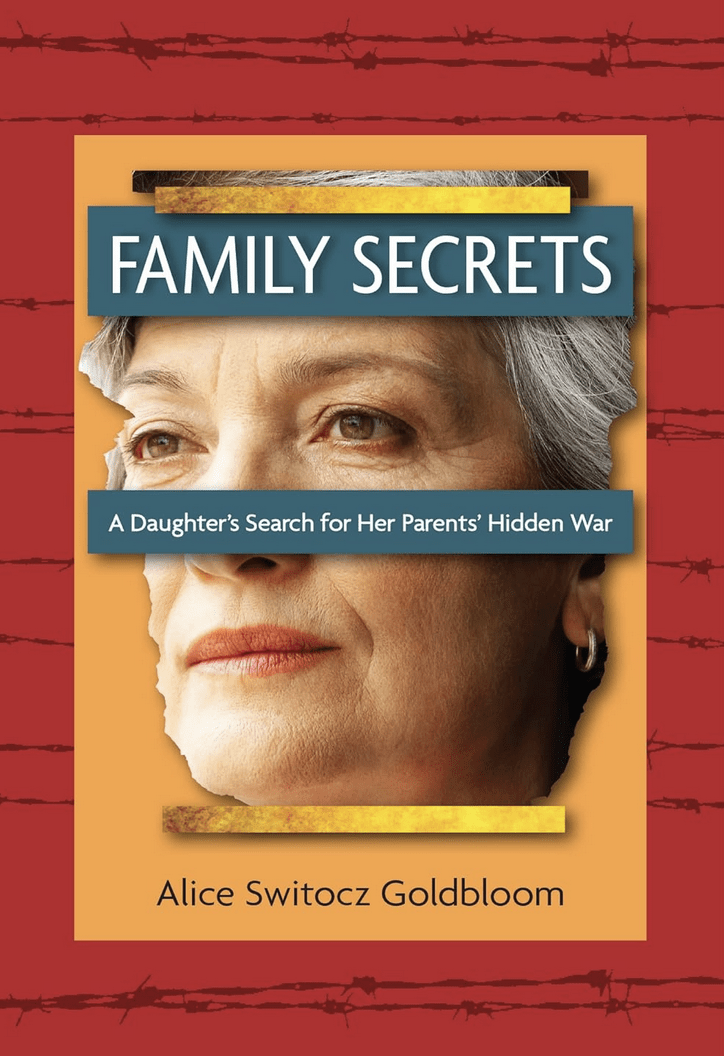
Family Secrets: A Daughter’s Search for her Parents’ Hidden War
Nimbus/Pottersfield Press, February, 2026/224 pages
Reviewed by Maureen Boyd
March 23, 2026
Is there an adult child who does not wish they had paid closer attention to their parents’ stories of their lives, who wished they had asked more questions?
And what of the parents who didn’t want to tell their stories?
In a beautifully crafted part-memoir, part-detective story, we follow Alice Switocz Goldbloom on her discovery of her family’s secrets, a little-known part of Polish history, and of herself.
Alice is the daughter of Polish immigrants, the daughter of a mother who did not talk about her past. It took the last years of her father’s life for Alice to learn of his time as a member of the Polish Home Army resistance.
Only after the death of both her parents did Alice learn of her mother’s years spent as a forced labourer in Nazi Germany and her paternal grandparents’ deaths in Adolf Hitler’s concentration camps.
Both her parents were Polish Catholics, both ended up in the displaced persons’ camps in Germany, and both refused to return to Poland after the Soviet betrayal and subsequent occupation.
In 1951, they came to Canada.
Alice’s mother, Maria, emigrated first, arriving in Montreal to work as a housekeeper for a prominent Westmount lawyer and his wife; her father, Edward, whom Maria planned to marry, followed a few months later through Pier 21 in Halifax.
Only after the death of both her parents did Alice learn of her mother’s years spent as a forced labourer in Nazi Germany and her paternal grandparents’ deaths in Adolf Hitler’s concentration camps.
With $5 in his pocket and relying on Polish connections and word of mouth, Edward walked from Sarnia’s train station to knock, unannounced, on the door of a stranger — a Polish friend of a Polish friend — where was welcomed with a meal and a bed. Within 48 hours, he had a job.
Three months later, Maria left Montreal for Sarnia and was welcomed by the same family. Within three days, wearing an elegant satin wedding gown trimmed with covered buttons —a gift from her Montreal employers — she married Edward and they celebrated their wedding around a picnic table in the backyard with other newly-acquainted, newly-arrived Polish immigrants.
“Polish people helped Polish people,” was how Edward described the closeness of the Polish Canadian community.
Growing up with her two sisters, Alice was embarrassed by her funny clothes, home-made school snacks, and her mother’s accent — to being the ungrateful daughter, the immigrant kid who wanted more.
Accompanying her father on his first trip back to Poland in 25 years didn’t make her 16-year-old self appreciate her roots; it convinced her more than ever that she needed to leave “Smalltown”, her name for Sarnia.
Off Alice went to Carleton University. She married and divorced young, worked on Parliament Hill for a cabinet minister in the Trudeau government, eventually made her way to Montreal, and married again — this time to a man from a prominent Jewish family.
Children did not immediately follow. After years of trying and treatment, Alice and her husband decided to adopt. By chance, the social worker assigned to their case was a Jewish woman who discovered late in life that a Polish Catholic family had saved her and her mother during the war — she masqueraded as their child and her mother their maid.
That connection led to Alice adopting two Polish-born children. Only later did she realize that her daughter was born in the same hospital as her father — seventy-three years apart.
Throughout, Alice recalls an emotional distance between her and her mother—a weight of expectations Alice felt but did not fully understand.
With two toddlers and a demanding career, news of her mother’s cancer diagnosis came too late and the disease progressed too fast. Alice lamented, “I was never brave enough to pierce the silence around her memories. And now it was too late”.
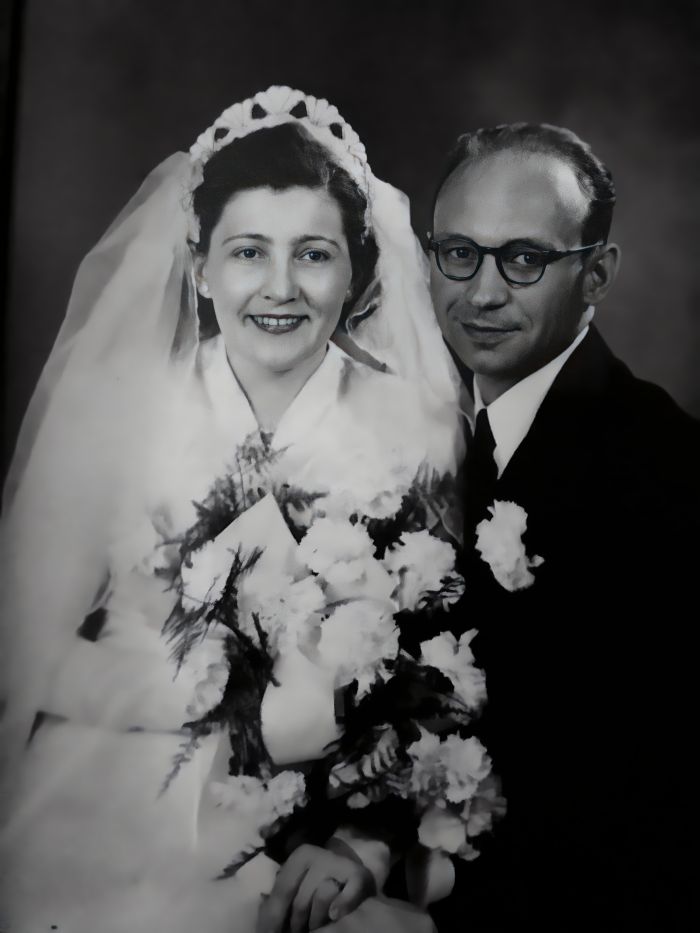
Maria and Edward Switocz on their wedding day in 1952
It took a decade more for her father to share his memories. When Alice asked if he remembered the day the Germans bombed Warsaw, something shifted: “Memories became our new territory.”
Over the years, Alice teased out the details of her father’s life and researched the story of wartime Poland. Hitler’s occupation meant the end of Edward’s chemistry studies: just one small consequence of the purging of Poland’s intelligentsia — 50,000 killed of which 7,000 were Jews.
By war’s end, Poland had lost more than half its lawyers, 45% of physicians and dentists and nearly as many university professors, clergy and teachers.
Edward joined the 380,000-strong Polish Home Army, the largest resistance force in Europe, fighting in — and surrendering after — the Warsaw Uprising. He was sent with other resistance fighters to the notorious POW camp at Lamsdorf, from which the Nazis led him on a forced 94-day, 800-km “death march” before he was liberated by the United States Army.
In 1947, Holland opened its borders to refugees, and Edward secured a job at Philips Electric, where he met Maria.
It was only after her father’s death at 98 that Alice discovered her mother’s story — that she was sent from her small Polish village to Germany, one of almost two million Polish citizens forced to work for Hitler’s war machine. For two years, she laboured in a crew clearing wooded land for Bavaria’s largest iron and steel works.
With her legs badly swollen and covered with sores that would not heal, she was sent to a farm working equally taxing hours. The long years of standing, heavy lifting and poor nutrition permanently affected Maria’s health, scarring her physically and mentally.
In researching the story her parents never told, Alice came to a unique understanding of her roots and of the magnitude of what they had endured.
The late Irving Abella and Harold Troper’s excellent None Is Too Many details Canada’s restrictive immigration policy towards Jewish refugees during the Holocaust. Displaced persons were also initially restricted, but between 1947 and 1951 Canada finally opened its doors, admitting 157,000 DPs as part of an immigration work program.
Maria was among one of the last to benefit — her travel expenses covered in return for a one-year contract in a low-paying job where there was a shortage of workers, including domestic service.
Alice turned to archives and historical records to research her family history and that of Poland, exploring why the wartime persecution and murder of 2.7 million Polish Catholics isn’t better known. Alice believes the omission wasn’t accidental.
She blames the Allied powers deciding Poland’s fate without Polish participation, despite Poland supplying the fourth-largest forces for the Allied war effort and never collaborating with the Germans.
The Soviet-backed communist government then began hunting down the people who had fought for Poland’s freedom, falsely branding them Nazi collaborators.
The communist government distorted the history of the Home Army and silenced discussions about Stalin’s war crimes, including the 1940 execution of 22,000 Polish Army officers and intelligentsia by the Soviet Secret Police (NKVD), their remains dumped in mass graves at the edge of the Katyń forest.
In researching the story her parents never told, Alice came to a unique understanding of her roots and of the magnitude of what they had endured.
Alice marvels at what her mother kept sealed away, including that the Westmount house where Maria had worked as a housekeeper — the family who gifted her the wedding dress — stands just two blocks from where Alice lives today. During numerous visits, her mother never said a word.
“And perhaps that was her greatest act of mothering: to keep sealed away the story of a world she never wanted me to know, letting me grow up in the light of all her hopes,” writes Alice. “Giving me an ordinary life.”
Maureen Boyd, C.M., is chair emerita of the Parliamentary Centre, a nonprofit organization that has worked for the past half-century in more than 70 countries supporting legislatures to better serve their citizens.