
From Reliance to Resilience: Mark Carney’s Foreign Policy
 Prime Minister Mark Carney in the Oval Office on May 6, 2025/WH image
September 10th, 2025
This month will see two major tests for Prime Minister Mark Carney, making it a potential turning point less than half a year into his tenure. One is the return of the House of Commons, and the other is the United Nations 80th General Assembly.
Carney’s performance will underscore Canada’s transformed relationship with the United States. And, as the Prime Minister defends his policy response to that transformation to Canadians in the House and outlines it for the world at the UNGA, the unprecedented overlap between domestic and foreign policy created by America’s trade war will be inescapable.
But already, in the face of a volatile, autocratic, and economically coercive American president, Carney is revitalizing Canada’s international relations, doubling down on economic security and making our defence posture more muscular.
Carney recently described Donald Trump’s impact on global affairs: “What’s going on is not a transition, it’s a rupture, and its effect will be profound.”
In what he repeatedly describes as a “hinge moment” in history, Carney is reshaping both domestic and international policy to meet the demands of a more dangerous and divided world.
At the heart of Mark Carney’s foreign policy is what might be called pragmatic internationalism—a doctrine rooted in alliances and multilateral cooperation but grounded in the hard reality of American retrenchment and global disorder. Carney is redefining Canada’s relationship with the United States from one of reliance to one of resilience.
For Carney, economic security and national security are inextricably linked: ‘There can be no true security without economic prosperity.’
At this writing, Carney is still managing a series of sectoral trade negotiations with the Trump administration—on steel, aluminum, autos, lumber and defence procurement. We also need to be mindful that when negotiating with Donald Trump, as with China, a ‘deal’ is inevitably just a pause in negotiations before he comes back for more.
At the same time, Carney is building counterweights by strengthening ties with European partners and deepening relationships with emerging powers. As he said in his first major defence and security speech at the Munk School in June ahead of both the Kananaskis G7 and the Hague NATO Summit, “Canada can work towards a new international set of partnerships that are more secure, prosperous, just and free.” His stated aim is to create “A new era of integration between like-minded partners that maximizes mutual support over mutual dependency.”
Carney’s foreign policy is tightly woven into his domestic agenda. Initiatives such as the Buy Canadian Policy and the new Major Projects Office are designed to protect Canadian workers while fast-tracking infrastructure, to reinforce competitiveness and support trade diversification.
His ambition is clear: to build “the strongest economy in the G7.” For Carney, economic security and national security are inextricably linked: “There can be no true security without economic prosperity.”
The most visible transformation so far is in defence.
“In a darker, more competitive world,” Carney told his Munk audience, “Canadian leadership will be defined not just by the strength of our values, but also the value of our strength.” Citing cyberattacks, climate shocks, and the threat posed by revisionist powers like Russia and China, Carney announced Canada would meet NATO’s 2% spending target this fiscal year in the Munk speech, later committing at The Hague to NATO’s request for an increase to 5% by 2035.
He laid out a four-pillar strategy to rebuild the Canadian Armed Forces: investing in personnel and equipment, enhancing capabilities, strengthening Canada’s defence industry, and diversifying partnerships. He pointedly declared that Canada should no longer send three-quarters of its defence capital spending to the United States. Future submarine procurement may come from Germany and Norway, or South Korea. Defence research will be tied more closely to European partners. However, interoperability with the U.S. through NORAD remains a pragmatic requirement—likely meaning the continued acquisition of F-35 fighter jets.
Carney’s new defence industrial strategy is designed to align Canada with NATO’s rearmament agenda and open the door to joint research, procurement and innovation. It will also deepen the Canadian presence in the Arctic and integrate the Coast Guard into defence planning. A new agency—Borealis—will advance frontier technologies in artificial intelligence and quantum science as part of a wider sovereignty strategy.
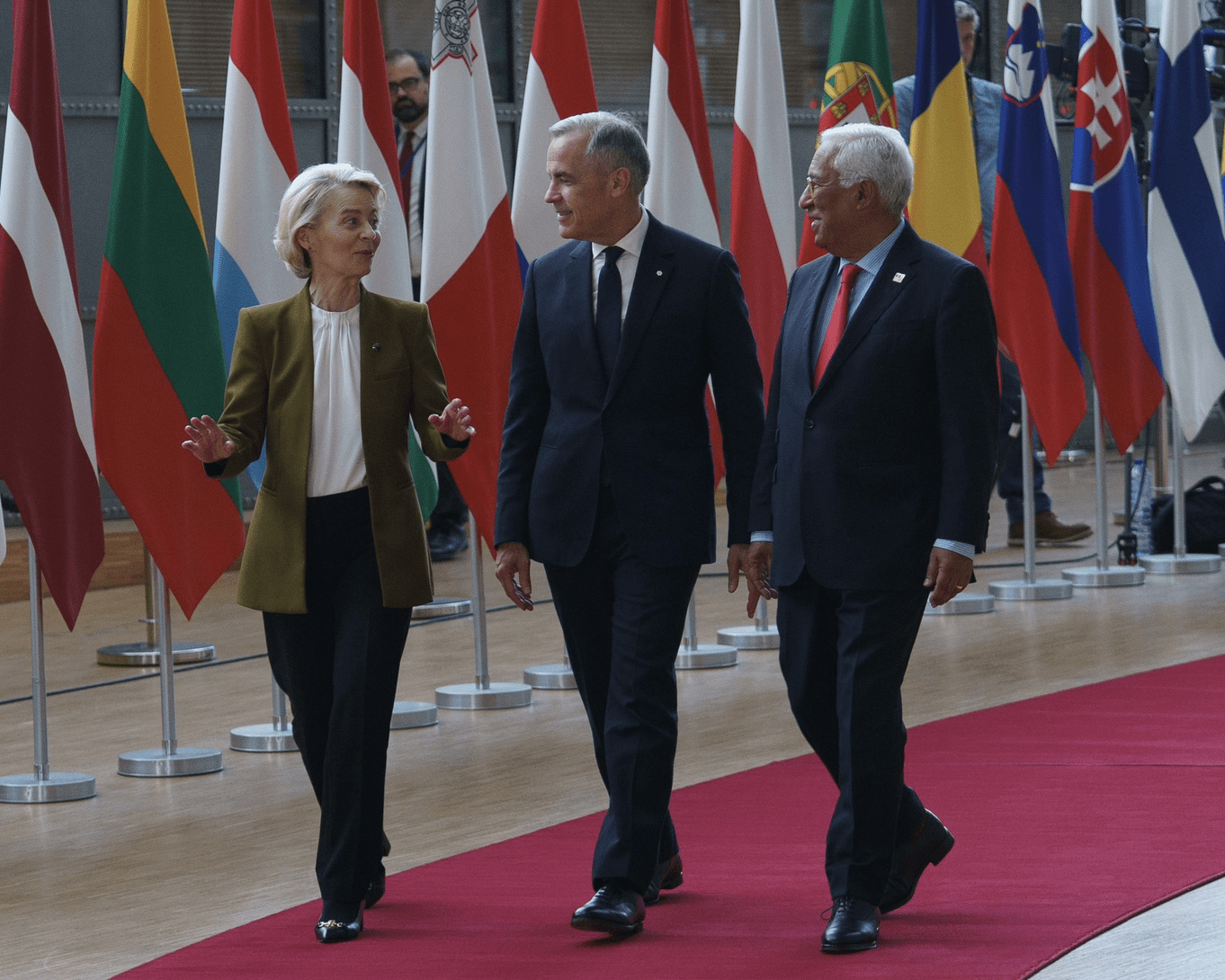
Prime Minister Mark Carney with European Commission President Ursula von der Leyen and EU Council President António Costa on June 23, 2025/Mark Carney X
Carney would be wise to frame these investments as continuity rather than a major shift, building on the trajectory set by Stephen Harper’s Canada First and Justin Trudeau’s Strong, Secure, Engaged and Our North. Cross-partisan consensus through changes in government is essential to maintaining readiness, long-term strategic capability and global credibility.
The underlying shift in Carney’s worldview is the recognition that alliances and trading relationships can no longer rely on the benevolence of a U.S.-led order. Instead, he is promoting strategic realism: Because countries must now buy access to the world’s largest economy, this is not about decoupling from the United States; it is about reducing dependence.
Carney’s approach reflects and resonates with the legacy of Louis St. Laurent’s 1947 Gray Lecture, which laid out the framework of postwar Canadian foreign policy. Built around international law, democratic cooperation, and defence of human dignity, that postwar vision was grounded in rules-based multilateralism—not as idealism, but as a means for middle powers like Canada to earn influence at the global table. St. Laurent and Pearson called it functionalism—the idea that smaller states could “punch above their weight” if they had the competence and capacity to contribute.
In the early Cold War era, if the Americans were the architects of global institutions, we were the engineers. From Bretton Woods to the UN, from NATO, to the Commonwealth, Canada played a constructive role in building international frameworks. Carney is trying to rekindle this spirit in what might be called functional multilateralism. The world has changed—but the middle power logic remains.
Carney’s first diplomatic calls as Prime Minister were to Paris and London. At the G7 in Kananaskis, he invited leaders from Brazil, India, South Africa, Indonesia, Australia, Mexico, Ukraine, and South Korea—expanding Canada’s circle of strategic partners beyond the traditional club.
Follow-through, not fanfare, will determine whether this pivot is sustained.
At the core of his worldview is a moral dimension, deeply informed by his 2020 BBC Reith Lectures and his 2021 book Value(s). Carney argues that “markets are not ends in themselves—they are means to deliver prosperity” and that “value must be underpinned by values.” For him, international law is not an abstraction. It is a strategic tool for protecting Canada’s interests in a world of great- power competition.
“When we stand up for territorial integrity, whether it’s in Ukraine or Gaza, we are also standing up for the territorial integrity of the Canadian Arctic,” he said in June. In a world where “middle powers must compete for interests and attention,” Carney believes Canada must bring strength as well as values to the table.
The Prime Minister’s foreign policy is gaining traction. His new defence policy has public support, and premiers across the country have endorsed his economic and infrastructure strategy. But support is conditional. Follow-through, not fanfare, will determine whether this pivot is sustained.
As Carney has put it: “If we want a more reliable world, we need a stronger Canada.” Reinvesting in sovereignty, diplomacy, innovation and alliances should be a shared national project. Carney has outlined the direction, the challenge now is delivery to ensure Canada has the credibility to lead and the capacity to act.
At this critical moment in global affairs, Canada can again step forward as a leader, not a follower, in reforming and reshaping a rules-based and just world order.
Contributing Writer Colin Robertson, a former career diplomat, is a fellow and host of the Global Exchange podcast with the Canadian Global Affairs Institute in Ottawa.