
Here at the Royal Canadian Geographical Society, Lake Ontario is Still Lake Ontario
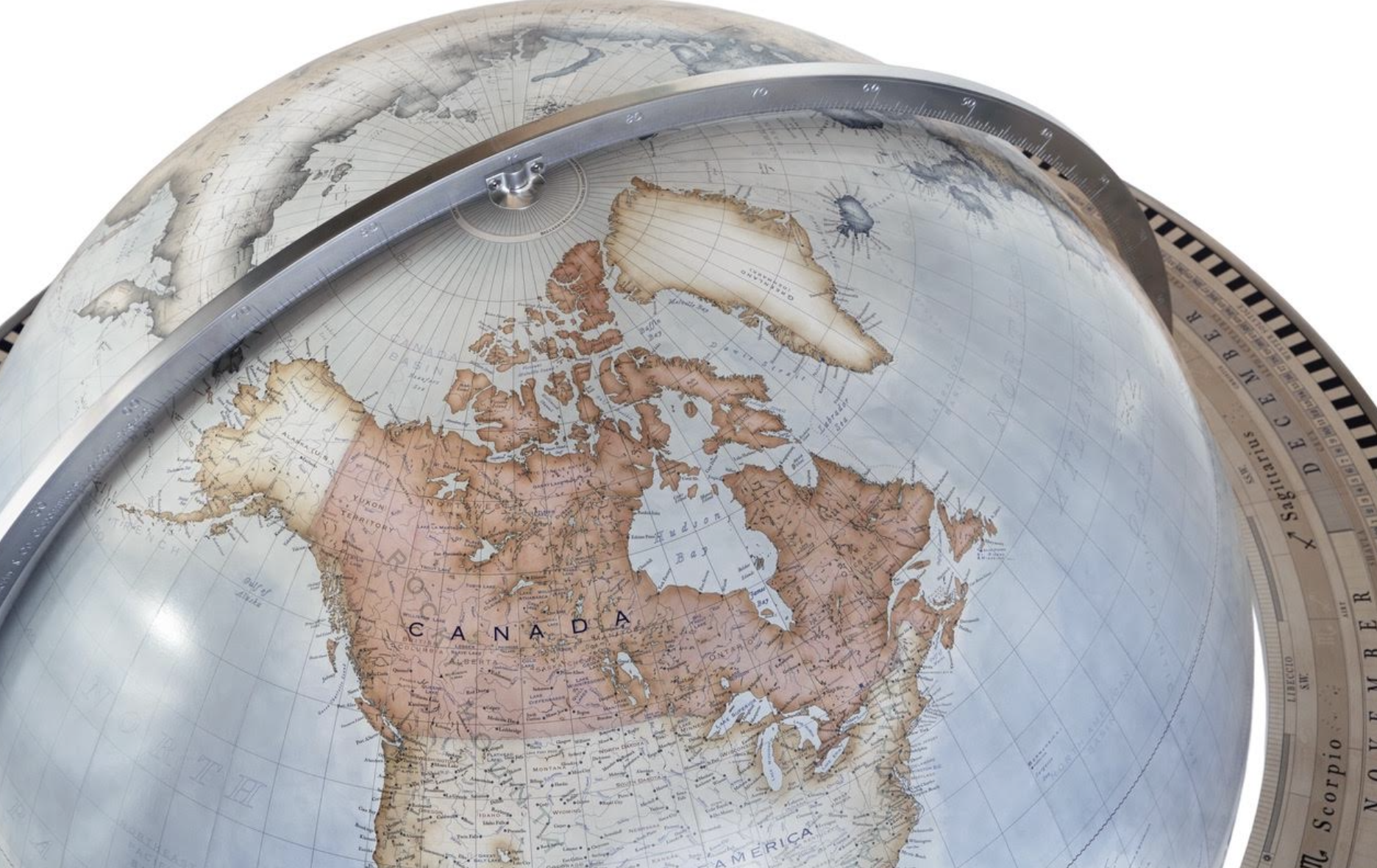 The Royal Canadian Geographical Society’s Canada Globe/RCGS
August 29, 2026
This week, the Royal Canadian Geographical Society (RCGS) moved a large globe — 127 cm (50 inches) across — into its newly renovated Sir Christopher Ondaatje Reading Room.
The Canada Globe, as we like to call it, includes the society’s coat of arms and motto “Ducit Amor Patriae — Love of Country Leads Me.” The custom globe was hand painted in 2025. It is a physical statement about the importance of Canadian and global geography.
The handcrafted masterpiece, created by Bellerby & Co. Globemakers of London, is the largest Bellerby globe available for commission and the only one in Canada. It was unveiled one year ago and has defiantly protected names and places recently expunged by the Trumpian lexicon of geography.
During his first weeks in office in January 2025, President Donald Trump signed an executive order directing federal agencies to rename the Gulf of Mexico the “Gulf of America.”
A month later, U.S. government departments and agencies updated their international geographic standards to reflect the change, and on February 9, 2025, the United States celebrated “Gulf of America Day.”
But in February 2025, in snowy Ottawa, as our team took note of these geographical pronouncements, we decided that names matter, that sovereignty matters, and that our newly commissioned Canada Globe would both reflect our love of country and be a symbol of resistance in a world of high-octane rhetoric, including declarations about making Canada the “51st state.”
So, if you visit our headquarters at 50 Sussex Drive in Ottawa and give the Canada Globe a spin you will see that the Gulf of Mexico is still…the Gulf of Mexico. And Denali is still…Denali. Denali means “the high one” in the Koyukon language and describes the highest peak in Alaska. President Trump signed an executive order to rename that magnificent mountain in 2025, reverting to its previous name, Mount McKinley.
At the Royal Canadian Geographical Society, we didn’t follow that order, either.
The original design for the Canada Globe had North America all in the same colour, consistent with other continents, but RCGS CEO John Geiger insisted that Canada be painted in “imperial pink,” a colour that reflects our constitutional monarchy, historic ties to the United Kingdom and membership in the Commonwealth of Nations.
A quote from Margaret Atwood graces the Canada Globe, and represents our dedication to a world of discovery: “These expeditions have no end. Through the tangle of each other, we hunt ourselves.”
Canadian culture, identity, and a respect for the cultures of peoples around the world are reflected in the Canada Globe; values that we believe represent the best of what Canada should aspire to be.
This week, we are happy to report that despite the official pronouncements from the Oval Office in Washington, at our office, in faraway Ottawa, on the Canada Globe, Lake Ontario will remain…Lake Ontario.
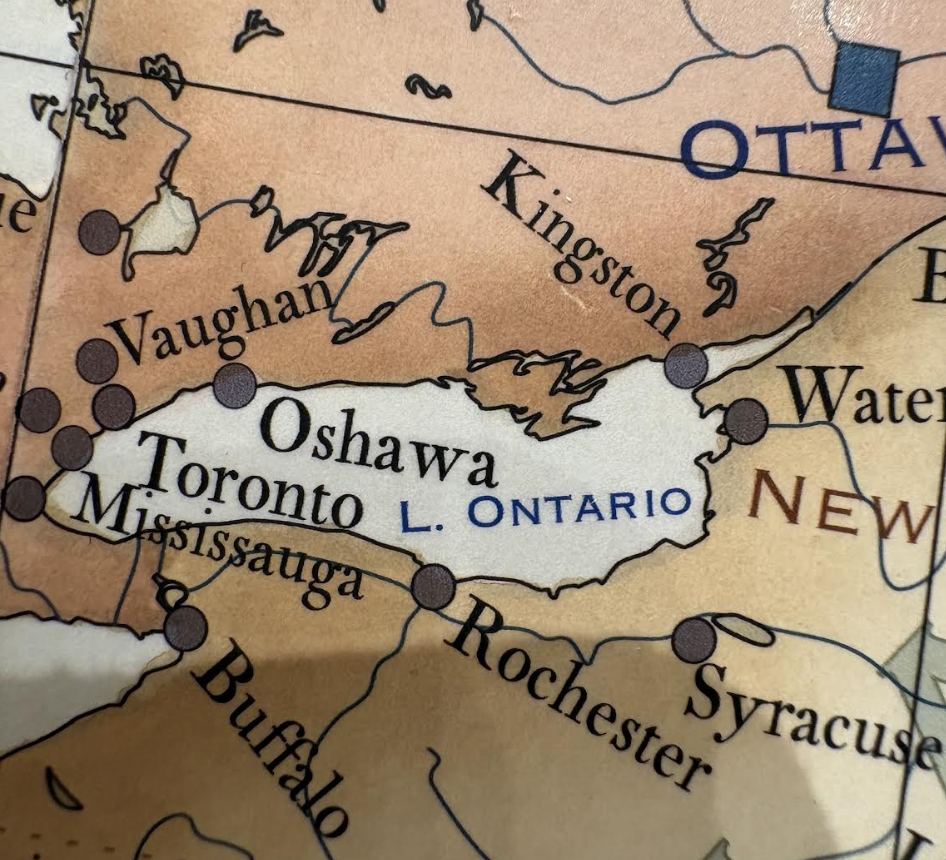 The RCGS Canada Globe, detail/RCGS
There are many reasons for this. The first, of course, is that you can’t simply pick up a Sharpie, write your signature in bold brushstrokes on a document and erase a word that predates the U.S. Declaration of Independence of 1776 and Canadian Confederation in 1867. The word “Ontario” is an Indigenous word; it predates the creation of both countries.
Prime Minister Mark Carney wrote in response to President Trump that the word Ontario is derived from the Wendat word “Ontari’io, which, appropriately, means “the lake is beautiful, the lake is big.”
Other Indigenous translations for the word include “beautiful lake,” “lake of shining waters,” and — simply but powerfully — “Great Lake.”
More than 150 First Nations have cultural identities that bind them to the Great Lakes watershed. Were they consulted about the name change? Why would you erase a word with such deep and symbolic meaning to Peoples who have used the word for centuries?
The Great Lakes don’t need anyone to tell them to be great again. No ego-boosting is required; we all know they are great. And the watershed is critically important to our way of life; so important that borders shouldn’t matter, geopolitics should be set aside, because water is critical for our collective survival.
The Great Lakes-St. Lawrence River watershed represents 20% of the supply of surface freshwater in the world and provides drinking water to 45 million people who live on both sides of the border.
All of us are incredibly fortunate to have benefited from this geographic wonder. Why politicize something that has sustained life for millennia?
Ten years ago, in January 2016, Canadian poet and musical icon Gord Downie was walking along the frozen shores of Lake Ontario when he wrote the lyrics of what would be his final album.
Born in Kingston, Ontario, right on the lake, Downie wrote a love song titled, “The Lake,” about a body of water that he called home. He described the lake as a place “that sparkles and dances, with all the warmth and calm of a hand to my chest.”
As Gord Downie so eloquently sang, “You’re Lake Ontario, the love of my life.”
Water is life.
Water is in constant movement, it is never static, and like maps, it changes and evolves. It responds to the environment it moves through.
We are living in a very different environment, and in a world where longstanding alliances are shifting and splintering. But if you were to poll the people who live on the shores of Lake Ontario — Canadians and Americans — I suspect that, among the many things they’d agree on, renaming the lake is not among their priorities.
And that is what gives me hope. That people, real people who live, work, swim and drink from this incredible watershed will recognize that the Great Lakes and St. Lawrence River are the love of our lives — partly because they are shared by both countries — and that we need to work together to protect this natural wonder for our common humanity.
Lake Ontario is that kind of place, that kind of word, with that kind of history.
On the Canada Globe, it will remain: Lake Ontario.
Rosemary Thompson is Senior Vice President, External, for the Royal Canadian Geographical Society.