
Hockey Before Helmets: ‘The Hammer’ Nails His Memoir
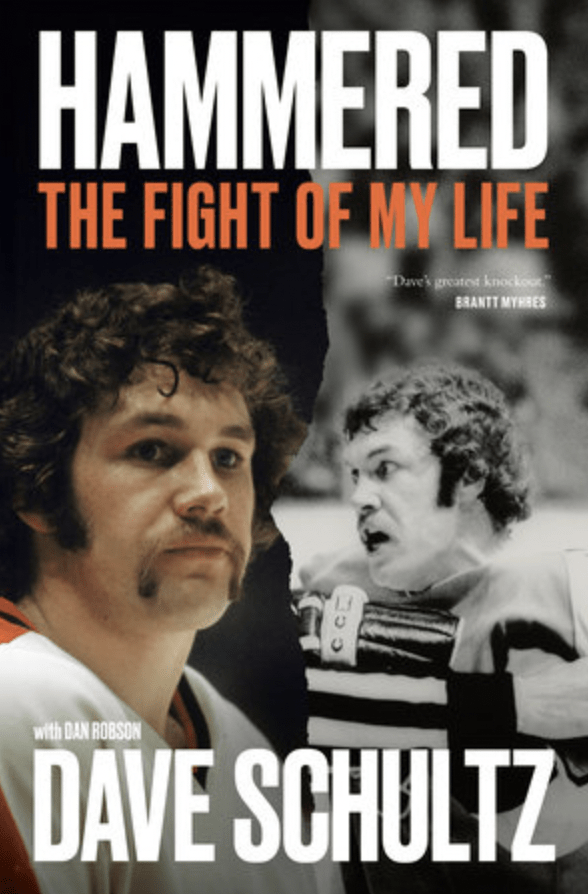
Hammered: The Fight of My Life
By Dave Schultz and Dan Robson
Penguin Random House, October 2025/296 pages
Reviewed by Paul Deegan
October 27, 2025
Growing up in Montreal, I was a Habs fan, but I also (more quietly) liked the Philadelphia Flyers.
That came from my friend Will Putnam, an American kid who joined us for a year at Loyola High School. His dad was executive vice-president of the Alouettes. Earlier, Mr. Putnam had a minority ownership position with the Flyers. Years later, when my sister Judy got married, I got to know her father-in-law, Jean Gauthier, a journeyman who spread his 166 NHL games over ten seasons and three different teams. He earned a Stanley Cup ring with the Habs and played 65 games for Philadelphia in their inaugural season.
In his foreword to Hammered: The Fight of My Life, Bernie Parent, who was one of Jean’s teammates on that expansion team, credits Dave ‘The Hammer’ Schultz with making the “Broad Street Bullies”, as the Flyers were known, the great, confident, united team they became.
Schultz seems very attuned to his and his team’s place in NHL history: “The Hammer. The most feared man on skates. The policeman, the enforcer, before the term was used to describe players who laid out the unwritten rules of the game. I spent more time in the penalty box in a single season [472 penalty minutes]than anyone in history…We were the Broad Street Bullies, notorious for the fear we provoked in our opponents and the success that followed. We won two Stanley Cups and became one of the NHL’s most remembered teams. We changed the game.”
Schultz later renounced the violence he was known for in the days before helmets, when bench-clearing brawls were part of the spectacle and players like him were encouraged to use force (notably in the 1982 book Confessions of a Hockey Enforcer and the concurrent New York Times op-ed, A Letter to My Son About Violence.)
Of the hockey he played in the 1970s, he says scoring and fighting were symbiotic, not mutually exclusive. “When we scored goals, opponents came after our goal scorers. It fell on guys like me to step in to defend our most skilled players. And when I did, our opponents felt they had to avenge their crumpled cheap-shot artist by sending someone else after me to settle the score.” To Schultz, it was a matter of honour: “You want to try to take advantage of somebody? Well, then somebody is going to take advantage of you.” He almost sounds like Robert De Niro playing Al Capone in The Untouchables: “Somebody messes with me, I’m gonna mess with him.”
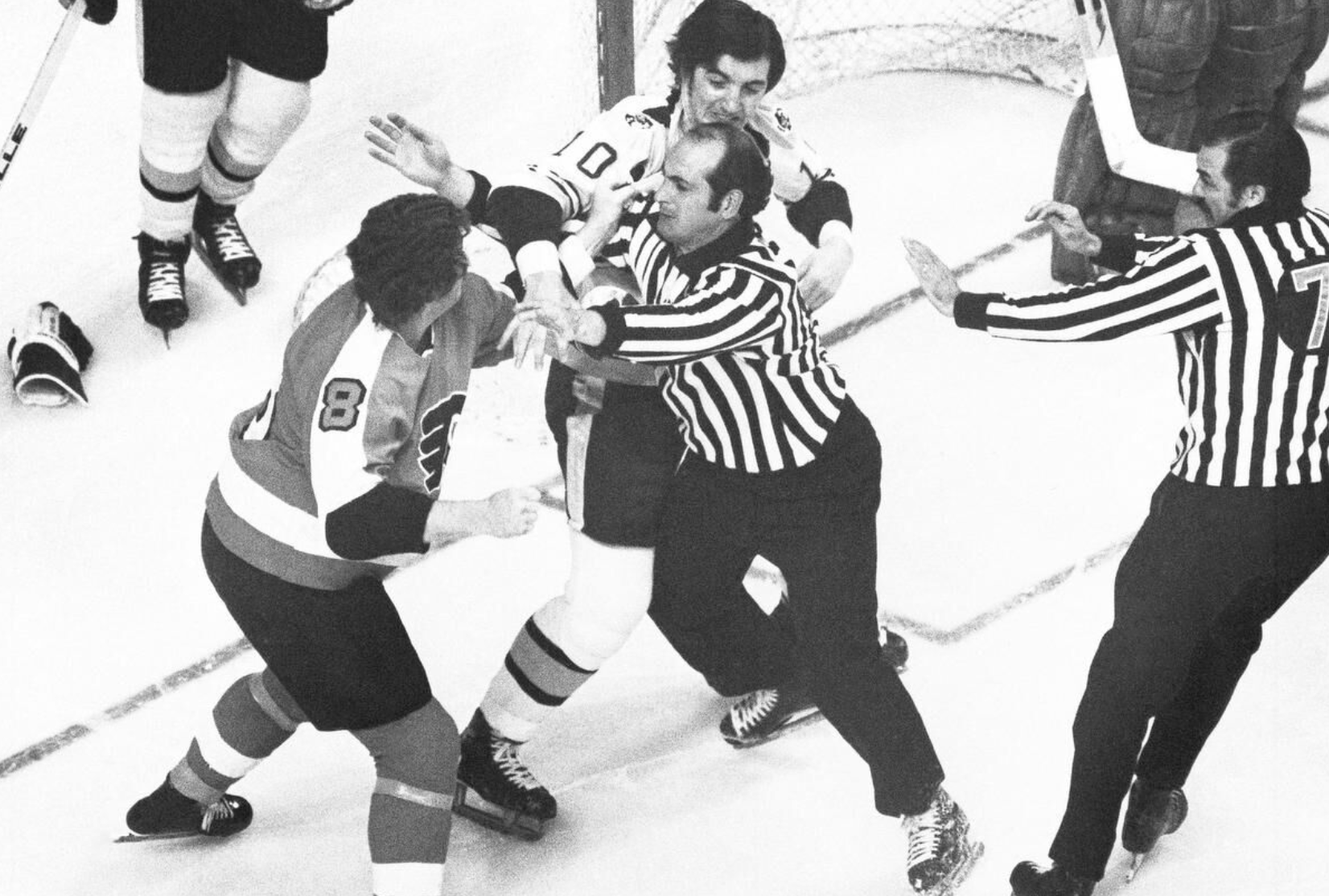 Dave Schultz in a first-period fight during an NHL playoff game in Boston/AP
While much of his time in hockey is reminiscent of the movie Slap Shot, he shares some lessons on leadership and winning. On Bobby Clarke, who became the youngest captain in NHL history at 23, Schultz writes: “Clarke led by example. It was impossible to outwork him. And no one hated losing as much as he did. He might be beaten on one play, but he’d come back even more ferociously on the next. And although he didn’t talk much in the dressing room or off the ice, when he did say something, everyone listened.”
Yet, for all his success on the ice, it seems that Schultz needed to write this book – not to reminisce, but to come to terms with himself. “It’s odd how someone whom so many people seem to know can also feel alone,” he writes. “But that’s often the reality for an aged sports icon. I’m a hockey card in a dusty shoebox, a collectible pullout from a newspaper. I’m a name twice carved into the Stanley Cup. I’m a trivia question. A cartoon character. I am a memory.”
While his story is tragic, it is one of self-discovery – not self-pity. The juxtaposition of strength and vulnerability runs throughout the book.
The man who hit rock bottom at age 74 takes us back on a long and winding trip, where hockey is only part of the story.
The Hammer grew up in Saskatchewan and came from very modest means. He describes it as a good childhood, and he notes the lessons he learned on the farm as the kind that stick with you your entire life. One of those lessons, unfortunately for Schultz, was his father’s search for relief in the bottom of a bottle. And Schultz speaks candidly about a sexual assault by an older man when he was 11. “I planned to take it to the grave,” he writes. “And I didn’t tell anyone about it for almost six decades, when I realized that that horrible violation would never leave me.”
This is not a breezy, feel-good book full of locker-room anecdotes and dished dirt of celebrity athletes, nor is it a book that glorifies the “enforcer” in hockey. Rather, it a very real, raw, and deeply personal account of a life of hurt, pain, and struggle.
It’s the story of a man who almost drank himself to death and the triumph of a man who is finding his own peace, with the encouragement of his own family and his hockey family: teammates, NHL Alumni Association, and the NHLPA, and is finally ready to stop fighting with his own traumatic past and to start living. The chapters about his recovery are as fascinating as those devoted to his NHL playing days.
After a career of being notorious for dropping his gloves, The Hammer has dropped a great book.
Paul Deegan is CEO of Deegan Public Strategies, was an executive at BMO and CN, and served in the Clinton White House.