
How Brazilian Democracy Fought Back, and the Challenges Ahead for Lula
November 4, 2026
How often does an octogenarian incumbent become the comeback kid?
Luis Inácio Lula da Silva confronted massive odds in Brazil’s recent election. In early October, the immutable leader of the Workers’ Party (Partido dos Trabalhadores, or PT) he co-founded in 1980 lost the first round of the presidential election to his 45-year-old opponent, Flavío Bolsonaro of the Liberal Party (PL).
The anointed heir of bolsonarismo, the far-right political movement led by his father, Jair, that seeks to reverse the social democratic agenda of lulismo, was ready to move into the Palácio do Planalto.
Since the re-establishment of Brazil’s democracy in 1989, no runner-up in the first round had gone on to win the second. Moreover, candidates on the right have won the past seven elections in Latin America, many in thrall to Trumpism.
Yet Lula triumphed, securing his fourth non-consecutive term in his seventh attempt since 1989, achieving one of the greatest political revivals in our times.
The outcome is a victory for democracy, social equality and environmental protection in Brazil. As the largest country and largest economy in Latin America, the eighth-largest economy in the world, and a diplomatic heavyweight in the global South, the ramifications of this election in Brazil carry wider significance.
Yet the challenges facing Lula, from economic pressures and social polarization to right-wing advances in the National Congress, are mounting. Can he defend his legacy during this final tenure?
Competing Political Visions
The campaign pitted two starkly competing visions of Brazil.
Lula had delivered solid economic growth and low unemployment in his third presidency (2023-2026). His administration exempted low earners from income tax and raised the minimum wage. It restored the budget for Bolsa Familia, which provides conditional cash transfers to poorer citizens, a central policy during his first two presidential terms (2003-2011).
The program has improved school attendance and health outcomes while reducing poverty and inequality over the last two decades, benefitting an estimated 20 million families and 50 million individuals.
During the campaign, Lula pledged higher cash transfers, debt relief for small businesses, and free public transport on weekends. Congress passed his proposal to guarantee workers two days off each week, benefitting 30 million.
In contrast, Flavío Bolsonaro vowed to cut spending, government ministries and bureaucratic perks. He promised to intensify environmental deregulation and weaken protections for indigenous peoples. Deforestation in the Amazon had surged notoriously during the presidency of his father (2019-2023), who enjoyed ardent support from extractive industries and big agribusiness.
Lastly, violence has declined in recent years. Yet perceptions of insecurity, and the spread of organized crime and drug gangs, concerned many voters. Flavío persuaded Trump to designate two local cartels as foreign terrorist organizations, provoking Lula to claim foreign interference.
Finally, Flavío promised to grant his father political amnesty. Last year, the Supreme Federal Court (SFC) imposed a 27-year prison sentence on Jair, an admirer of the country’s military dictatorship (1964-1985), for plotting a coup on January 8, 2023, after losing the 2022 election. Trump linked the imposition of tariffs on Brazil last year to his imprisonment. Right-wing supporters demanded clemency for those convicted in the failed putsch, which involved a plot to assassinate Lula and other senior officials.
To many Brazilians, the return of bolsonarismo posed a direct threat to the rule of law. That Flavío bears an uncanny resemblance to his father didn’t help.
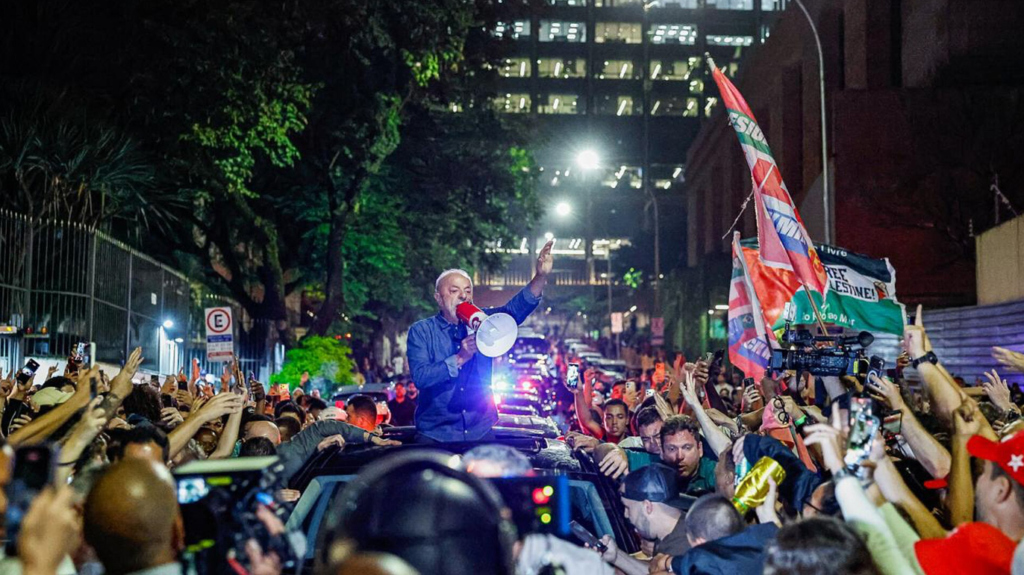 Lula addressing a post-victory crowd in Sao Paolo, October 26, 2026/Lula Oficial
Mobilizing the Electorate
The results of the first round, on October 4th, where 125 million voters cast their ballots, rang alarm bells in many quarters. Concerted electoral mobilization determined the outcome of the second round, on October 25th, which saw 128 million people vote — the highest turnout in 20 years. The electoral swing towards Lula, comprising voters who either did not vote in the first round or changed their minds in the second, was more than 10 million votes.
Digital technology enabled this dramatic turnaround. A political ally of Lula transformed a WhatsApp handle, called Lula’s Army, into a centralized communication channel. The number of followers swelled from roughly 50,000 to nearly 11 million. A smart digital strategy allowed Lula, a consummate 20th-century political organizer, to post selfies for audiences in the 21st. He repeatedly called Flavío a miliciano (“militiaman”), reminding voters of his reported links with organized crime. Yet spontaneous protests also erupted, turning into mass demonstrations, rallies and marches, led by workers and students.
In the final televised debate, Flavío called Lula “nine fingers”, referring to a digit he had lost in a factory accident. The crude jibe allowed Lula to emphasize their profound class divide: “I was a minor and working at night, because either I worked or I did not eat. I will not accept a posh guy calling me ‘nine fingers’.” The exchange went viral. Millions of his supporters, wearing the PT’s signature red and waving the Brazilian flag, joined massive rallies across the country.
Flavío claimed the final result was rigged. The Supreme Federal Court (SFC) extended voting by two hours after the PT cited mass delays in public transit. Yet the PL made similar requests, claiming that heavy flooding prevented its supporters from casting their ballots. Ultimately, less than 35,000 ballots were cast in the extended voting.
Facing cases of money laundering, Flavío was ordered by the SFC to surrender his passport. He fled to Miami, declaring himself the ‘true president’. But his congressional allies, who had made huge gains, recognized the election was fair. Denying the electoral verdict, he fled to Miami under the protection of the Trump administration, seeking refuge in the United States as his father did following his defeat in 2022.
The Challenges Ahead
Lula now faces many tests.
First, roughly four million votes separated the two contenders in the final result. Yet the 51.8-48.2 percent split reflects a society polarized ideologically, socially and regionally. Workers and the poor in northern states, older Catholic voters with collectivist values, urban professionals, cosmopolitan middle classes and financial elites backed Lula four years ago. They remain the foundation of lulismo.
In contrast, the social coalition around the Bolsonaro family encompasses small entrepreneurs, agribusiness and big mining firms; members of the police, military and private security firms; and Evangelical Christians advocating personal responsibility and patriarchal values. Many of these supporters are concentrated in the ‘Brazilian Bible Belt’ and southern states of the federation.
In 1980, evangelicals comprised 8 per cent of the population. By 2022, they represented 27 per cent, roughly 50 million people. The growing cowboy-chic culture and popularity of sertanejo, a Brazilian version of country music, illustrates a deeper cultural shift. US flags were common at Flavio’s events.
Second, the real tumbled 8 percent against the US dollar after the final verdict, its worst fall since 1999. The Bovespa equity index lost 15 per cent, its worst performance since 1990. Lula’s campaign pledges are estimated to cost almost $USD9 billion next year. Yet mandatory spending consumes roughly 90 percent of the government budget. Moreover, despite low unemployment, many citizens have trouble making ends meet so take up gig work. For many Uberização, the “Uberisation” of the economy, underscores the need to create productive jobs. Others believe it reflects a new entrepreneurial culture.
Similarly, Lula deserves credit for dramatically scaling back deforestation in the Amazon, the largest tropical rainforest in the world. But recent deforestation has transformed it into a net carbon source. Moreover, the failure to find alternative livelihoods pulled many in the region into the Bolsonaro camp. Finding a sustainable way forward, as western democracies reduce efforts to tackle climate change, is paramount.
Today, roughly 80 per cent of households confront rising consumer debt in Brazil, exacerbated by high interest rates. The budget deficit and public debt are expected to reach 8 and 82 per cent of GDP this year, respectively. Managing divergent expectations amid these constraints will challenge the new administration.
Third, since 1994, every president of Brazil has faced a National Congress dominated by other parties, requiring a coalition to approve budgets and pass laws. Lula has ample experience navigating such waters. But right-wing parties won big in these congressional races–especially the consolidation of hard right forces in the Senate–that ran concurrently with the first presidential round. Bolsonaro’s Liberal Party is the largest force. The old guard of the PT was vanquished. The party, given Lula’s age and previous health woes, must find a viable successor. These realities will test Lula’s leadership skills in his final term.
Finally, there are currently few center-left governments in the world. Lula’s triumph disrupted the recent tide of right-wing victories in Latin America that had created the enabling conditions for the ‘Donroe doctrine’. Lula’s victory, and the astonishing victory of the Democrats in the US midterms, make it harder for Trump to interfere in the region. Progressive forces elsewhere will hope these dramatic events signal their wider resurrection.
Brazil has long pursued greater strategic autonomy through a multi-aligned foreign policy. Historically, it champions multipolarity and the G20, the reform of multilateral institutions to reflect the voices and interests of developing countries, and greater Latin American integration and South-South cooperation.
These priorities will likely return with greater emphasis under Lula. However, Brazil also recently joined Canada in advocating the Partnership for Multilateralism, co-sponsored by democracies in the industrialized west and global South. How it promotes this new initiative alongside fora like the BRICS, and balances ties between China and the United States, will be important to watch.
Sanjay Ruparelia is Jarislowsky Democracy Chair, Toronto Metropolitan University, and a Senior Fellow, Asia Pacific Foundation of Canada and Centre for Strategic Statecraft.