
Ian McEwan’s ‘What We Can Know’: An Ode to Our Before Times
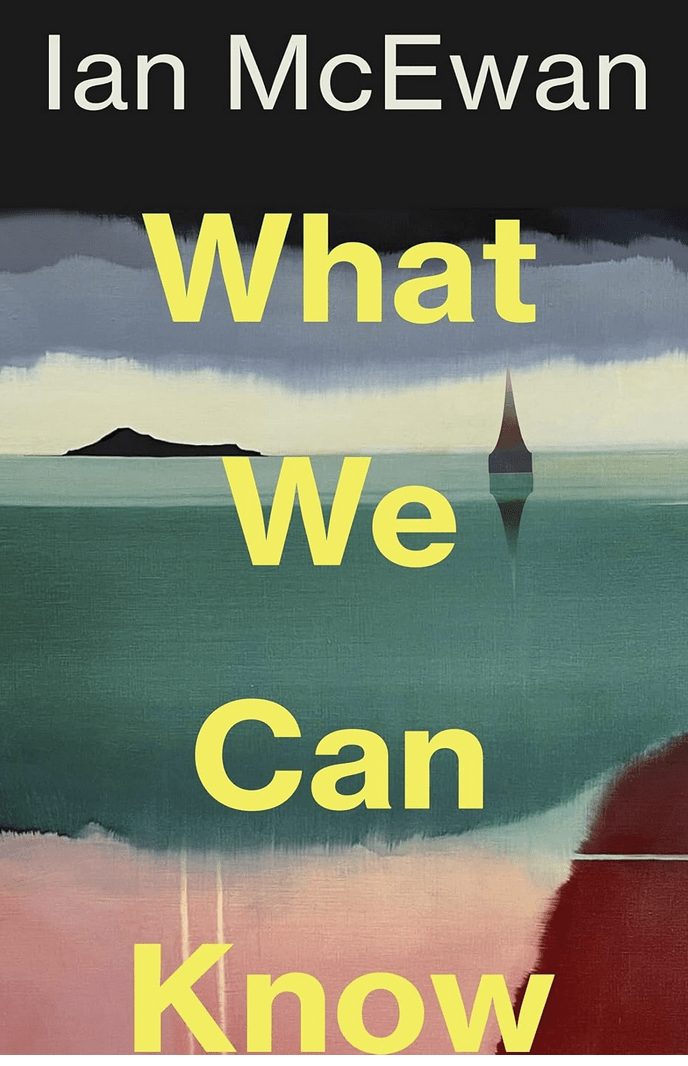
By Ian McEwan
Penguin Random House, Sept. 2025/320 pages
Reviewed by John Delacourt
November 16, 2025
About 70 pages in to Ian McEwan’s latest novel, What We Can Know, his main character, Tom Metcalfe, a literary studies scholar, describes what it’s like to teach students in 2119, when all that remains of Britain after a misfired Russian nuclear warhead falls short of America, unleashing hemispheric flooding, is an archipelago of hilltops — a period known as “The Derangement:”
“Most of our history and literature students care nothing of the past and are indifferent to the accretions of poetry and fiction that are our beautiful inheritance. They sign up to the humanities because they lack mathematical or technical talent. We are the poor cousins and we don’t get the smartest bunch. Our offices are dilapidated. Many of them leak. Our salaries are fixed at one half the rate for our scientific colleagues. We console ourselves that we are more in touch than they are with the bottomless ignorance of the generational zeitgeist.”
At this point in the novel, this reader was reminded of the dictum that the best science fiction is infused with the details of the author’s contemporary world, that Orwell’s 1984 relied on the author channeling his experience of 1948; that Atwood’s The Handmaid’s Tale is, as she has said, simply an extrapolation of real-life precedents and trends.
Metcalfe goes on to describe what he enjoys about his work:
“I prefer teaching the post-2015 period, when social media were beginning to be drawn into the currency of private lives, when waves of fantastical or malevolent or silly rumours began to shape the nature not only of politics but of human understanding. Fascinating! It was as if credulous medieval masses had burst through into modernity, rushing into the wrong theatre and onto the wrong stage set. In the grisly stampede, grisly government secrets were spilled, childhoods despoiled, honourable reputations trampled down and loud-mouthed fools elevated. Meanwhile good poetry was written …”
I’d submit that only Atwood and Ishiguro, among McEwan’s contemporaries, can so deftly illuminate the present from the future. The grisly stampede resonates strongly, but it’s the “fascinating” and the “meanwhile” in this paragraph that signal a greater complexity at work, and are indicative of what makes What We Can Know McEwan’s most affecting and accomplished novel in years.
Because what Metcalfe finds fascinating about the post-2015 period McEwan clearly does too. At the heart of the story is the scholar’s dogged research into the circumstances surrounding the reading of a poem called “A Corona for Vivien” during a dinner party in 2014 by its author, an all-too familiar version of the 20th century poet — a little Larkin, a little Hughes — named Francis Blundy. McEwan’s high-resolution focus is trained on the ‘meanwhile’ for much of the ensuing narrative, as Metcalfe embarks on a quest to find Blundy’s poetic MacGuffin.
And as well chosen as that metaphor of “credulous medieval masses” rushing onto the wrong stage set might be, it betrays McEwan the cultural seer: the writerly persona he cultivated in the aughts, perhaps not entirely by design (those pre-Derangement years, when we’d make novelists into public intellectuals), and who’s been all-too present in some of McEwan’s disappointing novels post-Atonement: 2024’s Lessons or his Saturday, from 2005, which centered on Britain’s largest-ever political demonstration, against the Coalition of the Willing’s misadventures in Iraq. It can be difficult to make the characters’ observations their own and not the author’s in a work unafraid to take on larger themes.
I’d submit that only Atwood and Ishiguro, among McEwan’s contemporaries, can so deftly illuminate the present from the future.
But in What We Can Know, it works. As much as Tom Metcalfe is a detective sifting through all the emails, notes and cultural effluvia of the early 21st century to puzzle out why the reading of this particular poem becomes so resonant years later, it is McEwan writing as Vivien to reveal its emotional underpainting that compels the reader to reflect on the theme McEwan handled so richly in Atonement: what the author conceals and reveals, what’s translated from the personal and particular to make a story enduring and universal.
The novel is structured in two sections: the first foregrounds Metcalfe’s study as he journeys to what remains of Francis Blundy’s cottage in North Oxford, a kind of culmination of the forensic study he’s carried out on the circumstances leading to the reading of “A Corona for Vivien.” The second is Vivien’s account of her final months with her first husband, Percy, and the crime that led to his death, followed by the impact it has on her second marriage to Blundy.
There is more than enough plot packed into the two halves of the narrative: revenge plots, literary arson and yes, a murder. This is McEwan the expert craftsman who can inhabit genres from the espionage thriller (The Innocent, Sweet Tooth) to Highsmith-ish macabre tales (The Comfort of Strangers, The Cement Garden) with ease.
But here his gifts are in the service of a different formalistic challenge, and key to his authorial intention is the term “The Derangement” itself. The Indian novelist and essayist Amitov Ghosh first coined it in his book The Great Derangement: Climate Change and the Unthinkable almost a decade ago. Ghosh writes of the limitations of the realist novel to address the immense, imminent sense of climate catastrophe we’re living with now:
“It is as though our earth had become a literary critic and were laughing at Flaubert, Chatterjee … the age of global warming defies both literary fiction and contemporary common sense: the weather events of this time have a very high degree of improbability.”
How to make the improbable plausible? McEwan’s What We Can Know succeeds because it is really about what we can feel; about which parts of the human heart will survive us despite our derangements — both the great and the less so.
Policy Contributing Writer John Delacourt is Senior Vice President of Counsel Public Affairs in Ottawa and author of the novels Ocular Proof, Black Irises, Butterfly, Provenance, and The Black State.