
In Ankara, Trump May Not be NATO’s Biggest Problem
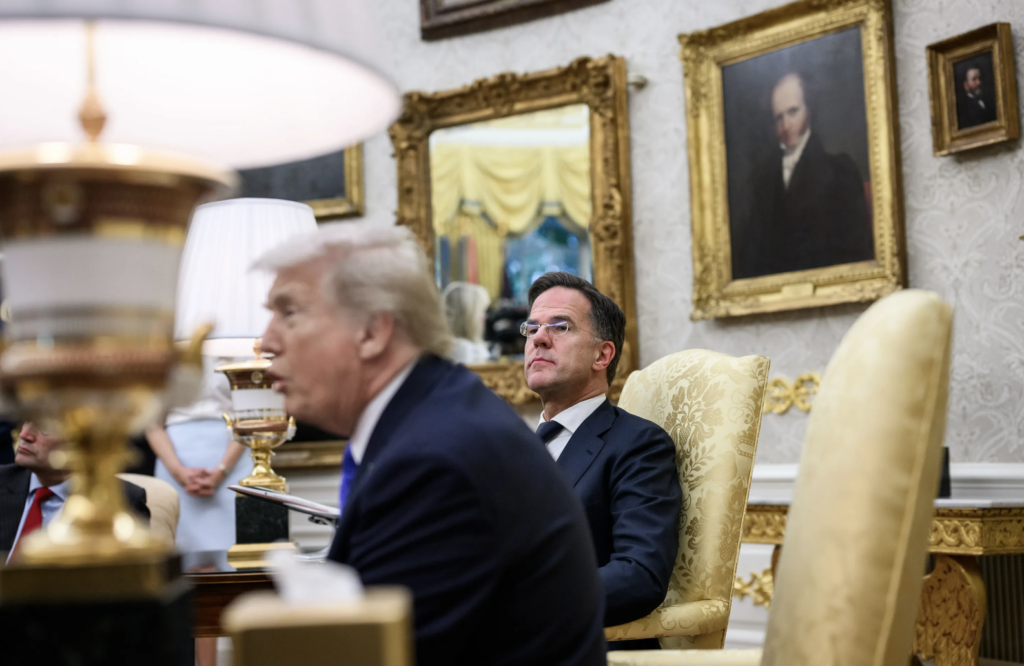 NATO Secretary General Mark Rutte and President Donald Trump in the Oval Office/WH
By Perrin Beatty and Fen Hampson
July 3, 2026
On July 7th and 8th, NATO leaders will gather at the presidential palace in Ankara for their annual summit. As at every heads-of-government meeting at which the United States is present these days, all eyes will be on Donald Trump.
Will he berate his fellow leaders for refusing to support the United States in its Iranian misadventure? Will he announce further drawdowns of American forces in Europe, following the withdrawal of thousands of troops from Germany and the cancellation of the brigade deployment to Poland (a decision he later reversed)?
Will he, once again, name and shame those allies dragging their feet on defence spending?
The official agenda prioritizes implementing last year’s historic spending pledges, ramping up defence industrial production, sustaining support for Ukraine, and preserving transatlantic unity.
However, transatlantic unity is in short supply. The Iran war has soured relations with Washington to the point of breakdown. Trump was furious that allies declined to join his bombing campaign or help with his naval blockade, instead going out of their way to express their disapproval by disallowing U.S. overflights or the use of bases for offensive operations.
He has derisively called NATO a “paper tiger” and openly mused for years about quitting the alliance altogether.
Washington continues to blow hot and cold on helping Ukraine in a war, now in its fifth year, where Kyiv has inarguably gained the upper hand. Ukraine’s relentless drone attacks on Russian refineries and energy infrastructure have forced fuel rationing across much of Russia and produced long queues at the pumps, even for Muscovites who, until recently, were comfortably insulated from a war a thousand kilometres away.
Vladimir Putin himself — no stranger to obfuscation even in peacetime — has now conceded the shortages.
And yet, however tempting it may be, it is wrong to conclude that NATO’s problem is just an erratic and volatile American president who is upending longstanding norms of stable, reliable U.S. leadership in one of the world’s oldest and most durable alliances.
An even greater threat lies at Europe’s doorstep. Many European leaders are now convinced that Putin, having been bloodied in an unpopular war that increasingly threatens his grip on power, will take a run at the Baltics in his determination to rebuild the old Soviet empire. Senior Nordic and Baltic officials agree that the possibility of Russian aggression against a NATO member within a few years is real.
And Washington may be handing Putin a precedent. Trump has spent months threatening military action against Cuba to finish off the remnants of the Castro regime. Should he act, Putin could reasonably conclude that a smash-and-grab operation against Estonia, Latvia or Lithuania is fair game.
Given all the challenges the democracies face today, NATO leaders should be encouraged that Canada can at least offer part of the solution.
These states are lightly defended. NATO’s forces, including the Canadian-led brigade in Latvia, provide a tripwire, not a full defence. Putin is broadly hinting that unless Europe abandons Ukraine, there will be greater Russian mischief along NATO’s northern flank.
NATO unity also faces testing at the ballot box. In France’s upcoming presidential race and in Germany, where the far right is ascendant, Putin-friendly parties promise voters relief from soaring energy prices by resuming trade with Russia. It will be difficult to sanction the Kremlin while recreating the old dependence on Russian gas.
As the summit takes stock of defence spending commitments, the news is not good. The 2025 Hague pledge to reach 5% of GDP by 2035 looks increasingly hollow. Outgoing British prime minister Keir Starmer’s budgetary contortions — a £298 billion investment plan that still leaves Britain at barely 2.7 percent of GDP and prompted the resignation of his defence secretary, John Healey — are the canary in the coal mine.
The unhappy reality is that major capital equipment programs and expanded forces can only be financed through a mix of tax increases, cuts to social programs and higher public debt. That’s a toxic combination for any politician.
The political challenge becomes stronger because economic growth across Europe and Canada is anemic. Absent an improbable Keynesian multiplier driven by defence spending, leaders will find themselves in the same fiscal vice as Starmer and his successor as the postwar welfare state collides with the demands of the national security.
Canada has an important role to play in this high-stakes game. Reuters reported Thursday that Prime Minister Mark Carney is aiming to unveil the 10 founding nations of the Defence, Security and Resilience Bank (DSRB) during the NATO Summit, “as part of his call this year for an alliance of ‘middle powers’ to combat what he sees as the fracturing of the traditional U.S.-led world order.”
In that U.S.-led world order, Canada was NATO’s junior North American partner. Today, however, the senior partner remains mired in a military miscalculation that has proven both the lack of intellectual capital in the current White House and the disproportionate geopolitical leverage of energy.
International Energy Agency Director Fatih Birol recently pronounced Canada an energy superpower in the making. It was a point Carney underscored Thursday during his announcement with Alberta Premier Danielle Smith of the proposed Alberta-West Coast pipeline.
When Canada’s prime minister shows up in Birol’s hometown of Ankara next week, he will represent a country that’s finally assuming its share of the common defence burden and helping reduce the world’s dependence on dangerously unreliable sources of energy.
Given all the challenges the democracies face today, NATO leaders should be encouraged that Canada can at least offer part of the solution.
Hon. Perrin Beatty, PC, OC, is the former President and CEO of the Canadian Chamber of Commerce and served as a federal minister in seven portfolios, including Treasury Board, national revenue, solicitor general, defence, health, communications, and external affairs.
Fen Osler Hampson, FRSC, is the Chancellor’s Professor and Professor of International Affairs at Carleton University, and President of the World Refugee & Migration Council. He is the former Director of Carleton’s School of International Affairs and author and co-editor of some 48 books on international affairs.