
‘Let Pierre be Pierre’ is a Great Strategy…for the Liberal Party

By Bruce Anderson
August 25, 2025
In our latest national Spark*Insights survey (3000 adults, August 14-18) the Liberal lead in voting intention was just north of 10 points, similar to the gap in the latest Nanos poll.
While different methodologies can sometimes lead to different “horserace” numbers, most polls seem aligned on how Canadian voters compare the Liberal and Conservative leaders: while Poilievre looked like a political darling last year, today the picture isn’t pretty for him.
At an overall level, 66% of Canadians have a positive view of Carney; 47% say the same thing about Poilievre. Among men, where Poilievre had a big lead last year, the Conservative leader’s approval net is now just +1. Carney’s is +36. If there was a ‘Pierre for PM’ bromance – it has definitely cooled.
Poilievre had also built a beachhead with young people. But today, among voters under 30, Poilievre is -2; Carney is +38.
About two out of three people (64%) think the Conservatives should replace Poilievre. It’s not unusual that people who voted for another party might say that. But what might well concern Conservatives is that this is also the sentiment of 27% of those who voted Conservative earlier this year, as well as 54% of Albertans, and 42% of self-described right-of-centre voters. The base is soft.
Almost a third (31%) of Conservative voters approve of how Carney is running the government. And half of Albertans (49%) — the fortress of the Conservative Party — say if they were to choose between Carney and Poilievre in another election today, they would prefer Carney. In the polarized era that we have been living through, seeing these numbers is unusual, to say the least.
Asking people what they see in the personalities and traits of these individuals, side by side, helps explain what’s happening. On a range of traits , the gap is pretty consistently in Carney’s favour.
Carney has a 29-point advantage for being “calm and rational”, 27 for being a “kinder person” 25 for “deep and useful experience” and 24 for “more thoughtful and strategic”. He’s also seen as better able to pull people together and as someone who tries to understand other people’s perspectives.
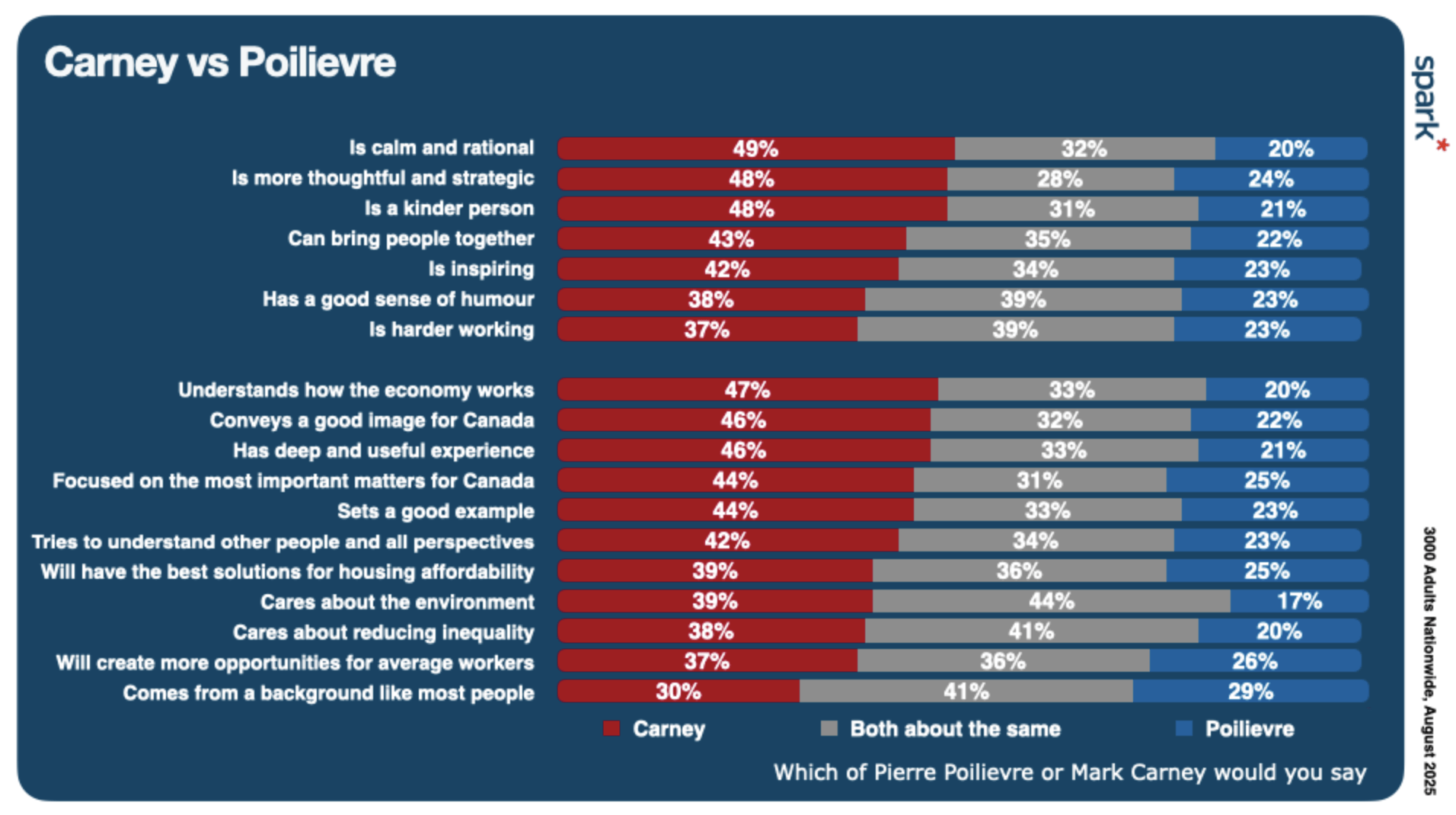
Beyond traits that speak to personality, Carney also compares favourably on a range of issues, including ideas for affordable housing, understanding the economy, creating more opportunities for average workers, reducing inequality and caring about the environment.
In fact, on every one of 18 different measures tested, Carney had an advantage. The only one where it was close was “comes from a background like most people”, something Conservatives probably thought would be a marked advantage for them. Their efforts to paint Carney as elite have not panned out.
Let’s look at Alberta voters again…a province where the Conservatives have beaten the Liberals by more than 30 points in each of the last five federal elections. Across the 18 items tested, Carney has an advantage on 8, Poilievre on 10. Look at this chart another way, and note that two thirds of Albertans think Carney is better, or the equal of Poilievre on every single item, in the most important fortress of the CPC.
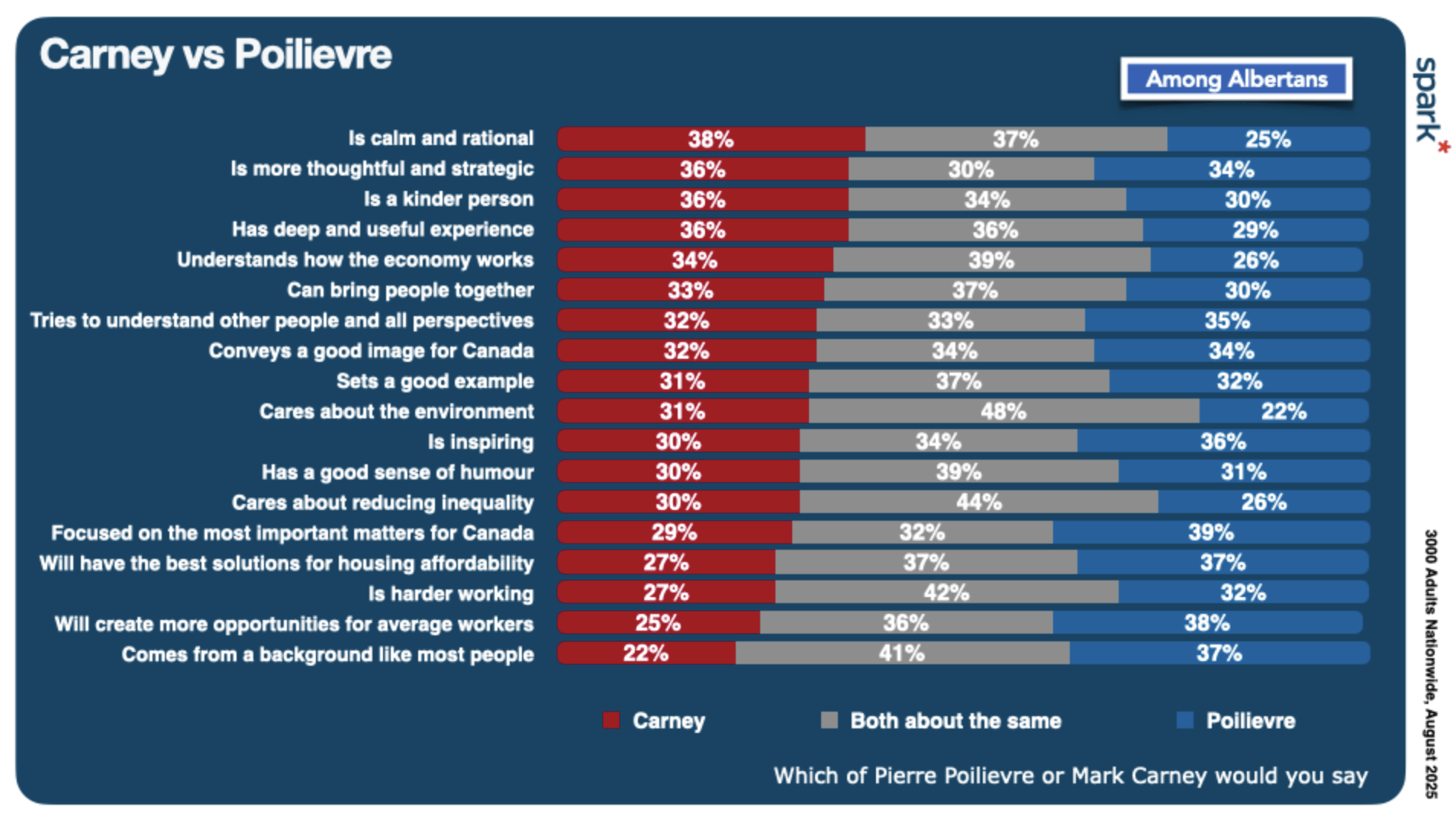
Taking the same approach to examining how Conservative voters feel — roughly half to two thirds say Poilievre is better than Carney, but the norms for something like this would generally be higher.
Looking at the same data among young men and women reveals that Poilievre is competitive with Carney among young men (a step down from his advantage last year) and not so competitive among young women.
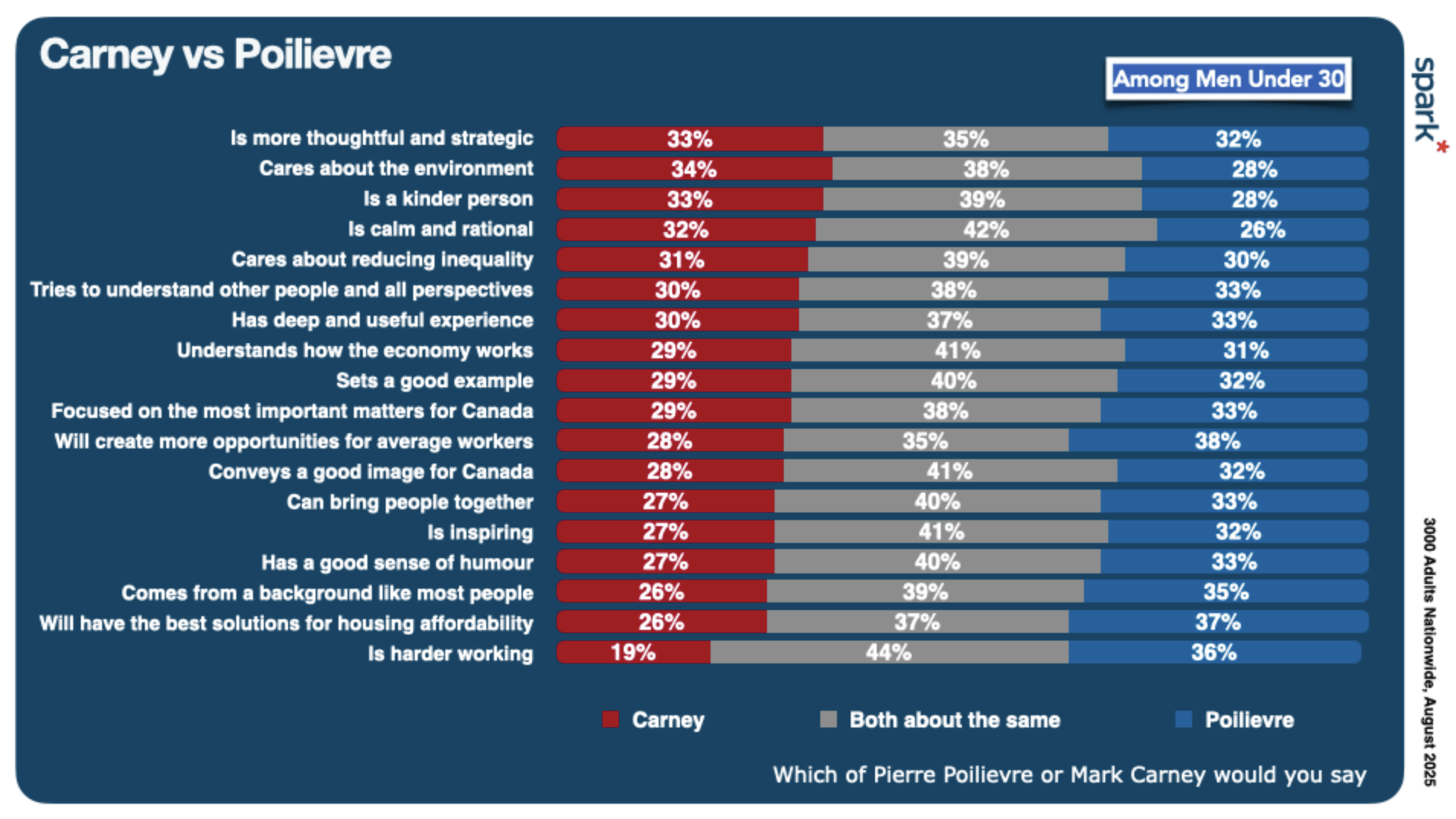
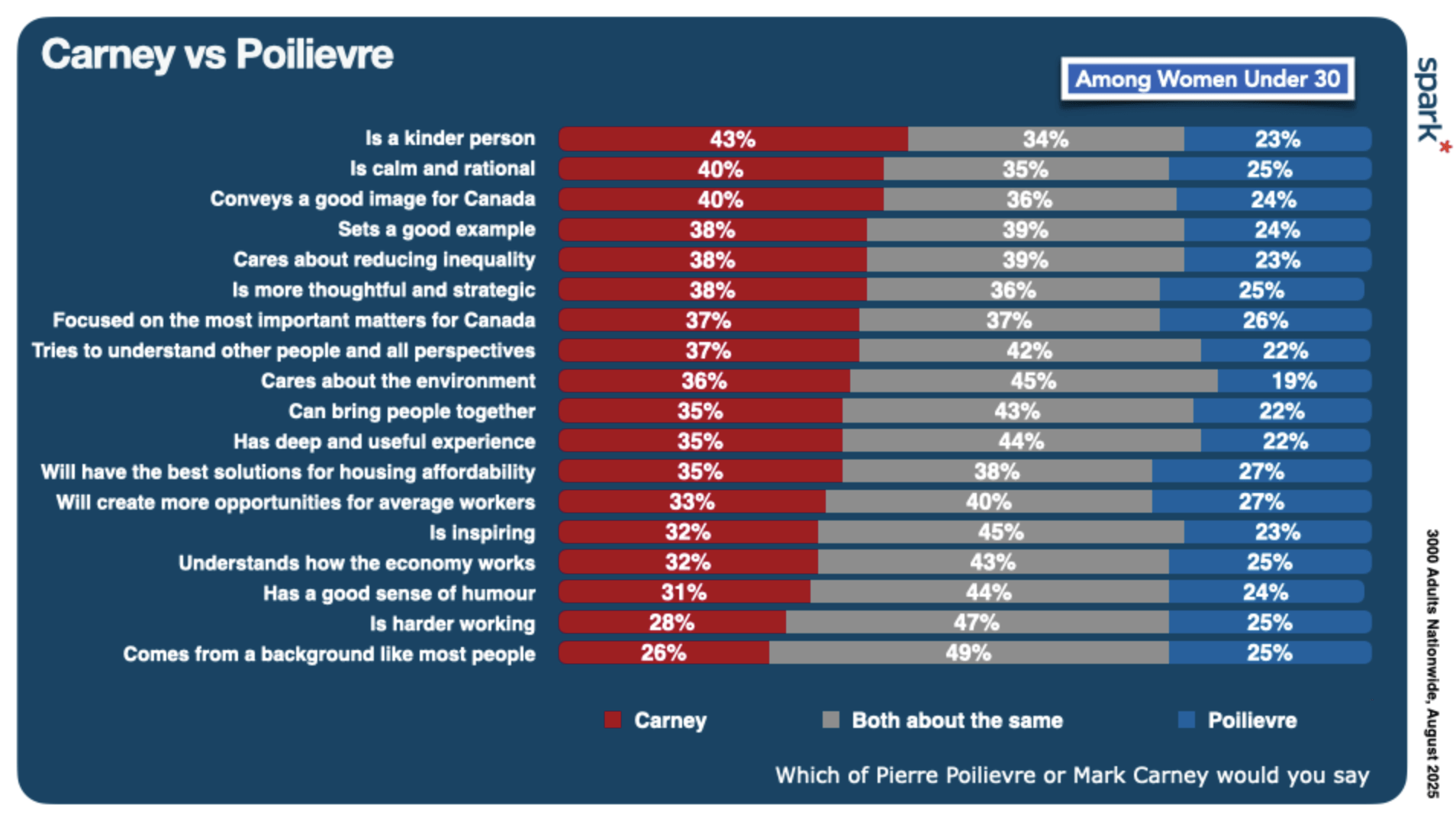
Poilievre’s problem isn’t just that Carney is well-liked — it’s that Poilievre isn’t. Simply waiting for Carney to shed popularity is more like a hope than a strategy for the Conservatives.
Poilievre’s chances of winning depend on him becoming more appealing to more people.
And therein lies the rub. Some of Poilievre’s most fervent supporters think it’s best to “let Pierre be Pierre”. No doubt many Liberals feel the same way.
Policy Contributor Bruce Anderson has been a pollster, strategy and communications advisor for more than 40 years. He is a frequent commentator on Canadian politics and public policy including on The Bridge podcasts. He is a founding Partner and Chief Strategy Officer of Spark Advocacy. He was an active, public supporter of Mark Carney during the Liberal leadership campaign and federal election.