
Letter from Britain: 10 Years Later, a Country Still Haunted by Brexit, Among Other Ghosts

By Jeremy Kinsman
June 5, 2026
MARLBOROUGH, Wiltshire — After nearly a year away from England, I’ve returned to find the people — as ever — carrying on calmly, but the country’s politics mired in discontent, regret, disruption, and uncertainty.
In the wake of a monthslong drama starring the ghost of Jeffrey Epstein, the political ghost of New Labour peer Peter Mandelson, the popularity ghost of Keir Starmer’s 2024 landslide, and, most recently, the ghost of Tony Blair and its ensuing backlash, a pall has settled as the 10th anniversary of the Brexit referendum looms on June 23rd.
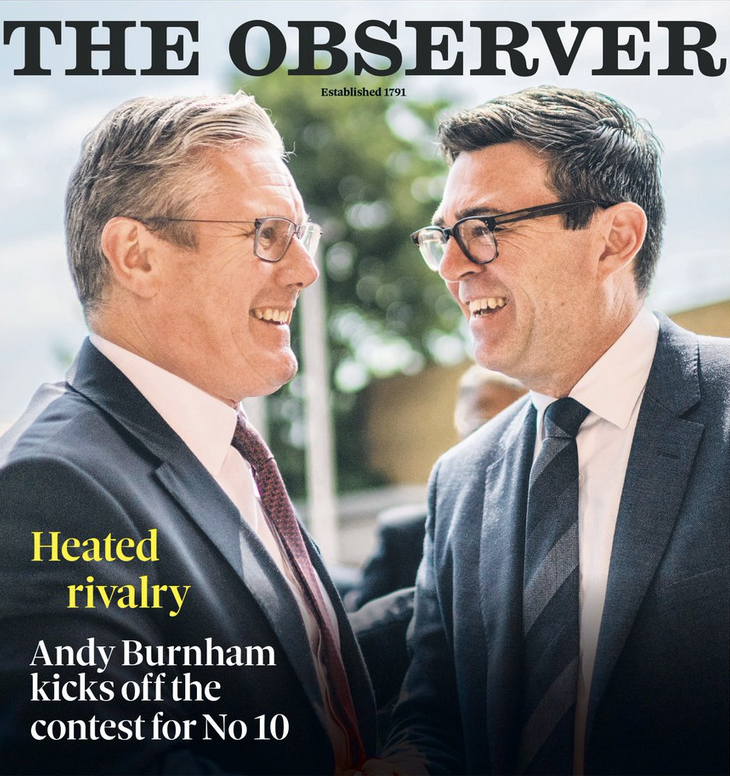
So far, the antidote seems to be Andy Burnham, Mayor of Greater Manchester. Panicky Labourites — haunted by the cautionary example of Joe Biden in 2024 and bolstered by the “Carney effect” on Canada’s Liberals in 2025 — are aiming to re-cast their leader sooner rather than later by bringing Starmer down to make room for Burnham.
Burnham, 56, the straight-talking and demonstrably effective mayor since 2017 of the country’s “Capital of the North” and football mecca, first entered electoral politics in 2001 as a Manchester-area MP. He rose to be a senior New Labour Minister, competing for the party leadership Ed Miliband won following Labour’s loss to the Tories in 2010.
Party rules specify that candidates for party leadership must be sitting MPs, and Labour’s central committee blocked Burnham’s application to stand in an earlier by-election in February, making Starmer appear both threatened and petty.
Last month, Manchester-area Labour MP Josh Simons resigned his Makerfield seat so that Burnham could contest it on June 18th in what is being touted as the most significant by-election in British history.
The outcome in a working-class constituency that has been represented by Labour MPs since 1983 but whose eight wards went Reform in recent local elections is by no means a given. But the latest Survation poll shows Burnham with a 10-point lead, and the appeal of electing a local northerner as the probable next prime minister will likely prevail among voters.
Many in Labour hope Burnham can reset Britain’s national mojo. He has presented himself in Makerfield as the man to repair the “sadness” he reports finding on doorsteps, and the country needs to recover from the past decade and the public cleavage over Brexit.
While averse to a re-run of the traumatic referendum, Burnham says he expects the UK to rejoin the EU in his lifetime. A May 26th YouGov poll showed 70% support among Britons for closer ties with the EU without rejoining, while the latter option now tracks at 56%.
Labour’s leadership crisis is a far cry from two years ago, when Starmer — who began professional life as a human rights barrister — led the party to a lopsided majority of two-thirds in Parliament at 411 seats, though with only 33.7% of the votes over the Conservatives, who suffered their worst-ever defeat, losing 251 seats with 23.7% of votes.
No one tries any longer to pretend that Brexit has paid off. Institutional estimates of Brexit’s economic costs cite a probable loss of 4-6% of expected GDP.
The rout ended a topsy-turvy Brexit-era Conservative reign that consumed five prime ministers (Cameron, Johnson, May, Truss, and Sunak) in eight years. It also prompted relief that the political centre had held off a populist, nativist right-wing challenge from Reform UK that garnered 14.3% of the vote but only five seats in Parliament.
But the political, social, and economic reverberations from the divisive and ethically dubious (on the ‘Leave’ side) Brexit referendum campaign echo to this day. The result pulled the UK out of the EU by a coin-toss vote of 52% to 48%. Any diagnosis of Britain today encounters its enduring psychological legacy.
No one tries any longer to pretend that Brexit has paid off. Institutional estimates of Brexit’s economic costs cite a probable loss of 4-6% of expected GDP. But die-hard Brexiteers within the Conservative and Reform parties still abhor any inklings of EU rapprochement.
Opinion polls indicate that two-thirds of the British public considers Brexit a mistake. Absent the phantom stimulus from a spate of trade and economic agreements Brexit proponents promised, especially with the US, it seemed obvious that Starmer should gear his attention abroad to reacquiring a privileged trade status with the EU.
He held off, fearing to offend the Northern “Red Wall” working-class Labour voters who had defected to Reform over Brexit, and whom Labour wished to lure back.
Reform UK remains a Trumpian one-man show led by Nigel Farage, who toiled for years as the flamboyant founder of the UK Independence Party (UKIP) in the European Parliament before leading the 2016 Brexit campaign that he and Boris Johnson littered with falsehoods over immigration data and the alleged European subjugation of British sovereignty.
Polls indicate that in an election held today, Reform UK would win, and Farage would be prime minister. Though another general election isn’t required before 2029 and Labour could conceivably regain political momentum, Britain’s first-past-the-post electoral process could permit the Trump-aligned Reform, with a base of 30%, to sweep the more crowded field.
Starmer’s authority had been waning over a year of stumbling performance. But his situation became critical when his appointment of Mandelson as ambassador to the United States grew rancid over the Blair-era minister’s friendship with the late élite sex trafficker Jeffrey Epstein.
Then, on May 7th, Labour suffered massive losses in county and municipal council elections. Reform UK gained 1,452 council seats with 26% of the vote. In addition to losing to nationalist parties in Scotland and Wales, Labour lost 1,498 council seats, posting only 17%, roughly the same percentage as each of Conservatives, Greens, and Liberal Democrats.
In one fell swoop, a century-long joint hold on the electorate by Labour and Conservatives gave way to a five-party competition for power.
Where did Starmer go wrong? His lack of experience as a working politician and manager of the complicated Westminster process handicapped him. Prior to the last chaotic decade, major party leaders in the UK typically spent years as ministers, sat for decades in caucus, thrived on canvassing the public, and, when required, offered soaring oratory.
Starmer never seemed, in his modest and decent way, to acquire the feel for the role a British PM must play, any more than Boris Johnson or Liz Truss did in their immodest, failed tenures.
Labour returned to power in 2024 by replacing its previous, controversial leftist leader Jeremy Corbyn with Starmer, a no-drama accomplished manager, who’d had an admirable pre-politics career as director of public prosecutions, civil service chief of over 3,000 barristers and solicitors.
That he also seemed a somewhat technocratic type seemed initially — after Britain’s roller-coaster decade — to be a welcome political plus.
Starmer stepped into a time of political disarray and anxiety almost everywhere in the democratic world, where political shelf-life has been limited by technological trench warfare and incumbents are on the defensive.
Though Starmer’s approval rating sunk to the lowest recorded for a UK Prime Minister — 20% — it is on a par with Emmanuel Macron’s — 22% — and tops German Chancellor Friedrich Merz’s at 16%. All three countries have had their basic left-right duality shaken by challenges from the extreme right and radical left.
Starmer and Chancellor Rachel Reeves have underlined that a major part of the government’s policy management challenge was their inheritance from Conservative predecessors of a pandemic-swollen deficit that, at 5% of GDP, is roughly double the level normally considered fiscally responsible in Britain.
When Starmer finally said ‘no’ to US demands that the UK join in the US-Israel attack on Iran, he received his first upward bump in approval at home in a year.
Wanting to emphasize fiscal responsibility, the Labour government slashed within a month of taking office a winter home heating subsidy for seniors, limiting it to the poorest and oldest, but squeezing-out millions of pensioners of modest means having to confront the UK’s (to a Canadian) confoundingly high heating and electricity costs.
The government had to reverse what appeared to be a politically incomprehensible decision, at an early cost to its credibility and judgment.
Though weary of melodrama, British voters still craved a leader with a vision for making things better, especially on the issues of affordability — like everywhere else — and on delivery of services which, in areas of complaint familiar to Canadians such as healthcare waiting lists, seemed to be in steep decline.
Farage thrived as a beneficiary of disgust with establishment politicians, and of public pushback on especially illegal immigration. But his recent emphasis on white nationalist issues (with rabid encouragement from MAGA personalities), and his close identification with Trump, may have gone too far for the English sense of fair play.
Starmer himself worked hard to please Trump in response to coercive US tariffs, to the point of embarrassing many Brits with his kowtowing to a president of whom only 11% of the British have a favourable opinion. Indeed, when Starmer finally said “no” to Trump’s demands that the UK join in the US-Israel attack on Iran, he received his first upward bump in approval at home in a year.
Foreign policy constantly kept Starmer from attending to urgencies in his domestic in-tray. Once Trump bailed out from supporting Ukraine, Starmer energetically led the effort to coordinate support from Europe, Canada, and likeminded allies. Belittled by Trump, he increasingly aligned with European leaders on foreign policy in general, including on Israel-Palestine issues.
Tony Blair expressed regret last week that the UK did not support the US war on Iran, judging the US to be “the indispensable cornerstone” of UK security. Foreign Secretary Yvette Cooper publicly rejected the position, saying that Britain had learned the lessons of Blair siding with the US war on Iraq, and that alignment with the US was not always in the UK’s interest.
In this, the UK, the EU, Canada, and others are constructively like-minded. The stakes on June 18th for Burnham, for Starmer, for the Labour Party, and for Britain are indeed high.
Policy Columnist Jeremy Kinsman served as Canada’s ambassador to Russia, high commissioner to the UK, ambassador to Italy and ambassador to the European Union. He is a Distinguished Fellow of the Canadian International Council.