
Letter from Washington: Parsing the Takeaways from the Trump-Xi Bilateral
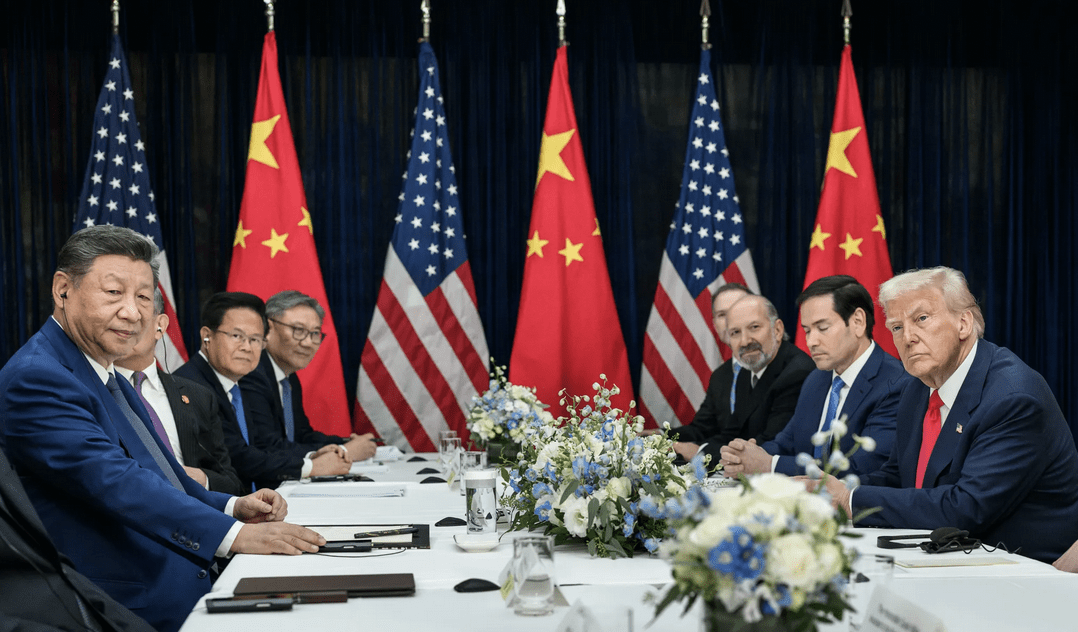 The October 30 bilateral between President Xi Jinping and President Donald Trump at Gimhae International Airport, Busan, South Korea/WH image
By Jennifer Lee and Robert Goldberg
November 11, 2025
The dust has sufficiently settled on the Donald Trump-Xi Jinping bilateral of October 30th to be able to confidently compare, contrast, and assess the U.S. and Chinese narratives out of the meeting.
Although the summit between President Trump and China’s President Xi in South Korea appears to have produced a “trade truce,” the interpretations of the outcomes given by the two sides are significantly different. The US view – with Trump calling his meeting a “12 out of 10” – is that each side provided measurable commitments; economic and trade ties alone define bilateral ties.
For China, the commitments are vaguer, part of an effort to manage overall risk, and are viewed in a geopolitical context, i.e., important but potentially complicated by broader relationship issues. In addition, the two sides differ on how to go about enforcing the commitment and what mechanisms will be used if disputes arise.
Troubling as well is that bilateral talks are confined to two sets of key interlocutors: Trump and Xi, Treasury Secretary Bessent and Chinese Vice Premier He Lifeng. While there is undoubtedly preparation at lower levels, those officials – especially on the US side – lack authority and are not empowered to make the trade-offs that set the stage for senior-level meetings.
Contrasting the readout on the US side and the readout on the Chinese side and evaluating recent announcements implementing some aspects of the agreement offers insight into whether the “trade truce” is a pause in the confrontation between the two sides or will have some longer lasting impact.
Issues with specifics but also discrepancies in interpretation or implementation challenges:
- Tariffs: The US readout provides more specifics on the timeline of tariff suspensions and Chinese commitments. According to Washington, the total tariff rate will be lowered from 57% to 47% as of Nov. 10 (reflecting the decrease in the fentanyl rate from 20% to 10%) and “suspension of heightened reciprocal tariffs on Chinese imports” will be maintained or a year from Nov. 10. The US will also extend the expiration of certain Sec. 301 tariff exclusions (which were due to expire Nov. 29) through Nov. 10 of next year. According to the US, China will suspend all of the retaliatory tariffs it has announced since Mar. 4, including “tariffs on a vast swath of U.S. agricultural products: chicken, wheat, corn, cotton, sorghum, soybeans, pork, beef, aquatic products, fruits, vegetables, and dairy products” as well as extend its expiration of its market-based tariff exclusions until Dec. 31 of next year. The Chinese readout simply notes that the US will continue the heightened reciprocal tariff suspension for another year and that China will adjust its countermeasures as appropriate.
- Rare earths: Both sides confirm the US will put off the BIS “50%” affiliates rule for a year and China will suspend its export control regime on rare earths and related measures that it announced Oct. 9. But the US also says “China will issue general licenses valid for exports of rare earths, gallium, germanium, antimony, and graphite for the benefit of U.S. end users and their suppliers around the world. The general license means the de facto removal of controls China imposed in April 2025 and October 2022.” (This was not mentioned by the Chinese readout). China has now signaled that it will suspend for one year licenses needed for the export of five rare earths (the four noted by the US as well as tungsten), but it seems likely to continue examining them for end-user destinations, particularly those involving national security issues such as samarium, which is used in supersonic fighter jets and missiles.
- Soybeans: The US lists China’s annual purchasing commitments (at least 12 MMT of US soybeans this November-December and at least 25 MMT of soybeans annually 2026-2028), while China notes a consensus was reached on expanding agricultural trade but does not list specifics. Watch for whether China fulfills its 12 MMT commitment for the remainder of the year (as well as purchases other US ag products; it has already begun limited purchases of wheat). This will be difficult given it has already met its needs for 2026 and storage options for this year are largely exhausted.
- Fentanyl: The US side emphasizes China’s commitment to stop the flow of precursors to the US, while China notes a consensus on drug cooperation. Notably, Beijing has always asserted that the issue is as much demand-side as it is supply-side driven and that many of the precursors have legitimate pharmaceutical benefits.
- Entity list: The US readout said, “China will suspend or remove all of the retaliatory non-tariff countermeasures taken against the United States since March 4, 2025, including China’s listing of certain American companies on its end user and unreliable entity lists,” but the Chinese readout does not mention anything specifically about entity lists.
Issues without any specifics:
- Semiconductors: One the most significant areas of uncertainty deals with China’s access to US chip technology. Previously, US policy was to tighten the ratchet on chips and high tech generally in the name of national security. Now it appears that this technology has increasingly become leverage for Trump in trade negotiations, with licensing requirements and other restrictions turned on and off depending on concessions from the other side. But it seems – at least for now – that China will not receive Nvidia’s high-end Blackwell chips (which Trump said he would discuss with Xi but ultimately did not bring up in the meeting), nor will it get the watered-down B30 chips per a recent White House announcement. The status of Nvidia chairman Jensen Huang’s talks with the Chinese remains unclear; Trump had earlier suggested the US would be “in the room” as a “mediator” at that meeting. Subsequent to the rare earths agreement, both sides also moved to restore the export of Nexperia chips (used in the global automobile industry), with the US apparently relaxing its listing of Wingtech Technology, Nexperia’s parent company, and China agreeing to the chip exports provided they were for civilian use; Beijing announced Nov. 9 it is lifting the relevant controls.
- TikTok: No final agreement was reached on the sale.
- Energy: The US side mentions US energy purchases by China, but the Chinese readout does not.
Issues with known details:
- Phase One trade probe: The US side appears to be going forward with a USTR investigation into how/whether China fulfilled its obligations under the Phase One agreement negotiated in 2019. China has criticized the decision, saying it has “scrupulously” lived up to its commitments.
- Maritime: The US will suspend the punitive measures implemented as a result of the Sec. 301 investigation into China’s maritime and shipbuilding dominance until Nov. 10 of next year, and China will remove its retaliatory measures including related sanctions.
Watch out for:
- Strategic issues: Importantly, Trump and Xi failed to touch on pertinent high-level strategic tensions, including Taiwan, the South China Sea and China-Philippines relations, threats from the DPRK, and Chinese support for Russia’s actions in Ukraine (e.g., purchases of Russian gas, provision of military arms/technology). Team Trump’s approach has elevated short-term transactions in the relationship and appears less interested in tackling serious strategic policy challenges. China likely has little interest in discussing Taiwan absent a US declaration that its One China policy “opposes” Taiwan independence rather than the usual position that it is up to both sides of the Taiwan Strait to determine their destiny.
- Continued diplomatic issues: In addition to the absence of a high-level shared agenda, the lack of high-quality interlocutors and the general mistrust between officials in Beijing and Washington erode the potential for improved bilateral ties. Comments like those of Treasury Secretary Bessent – saying that US trade actions against China are justifiable because the Chinese are unreliable – exacerbate the problem. Also of note is the absence of the hundreds of daily interactions (business and commercial, sporting, students) that once characterized the bilateral relationship and were important building blocks creating some semblance of goodwill and trust.
With a transactional president, the transactions are essentially all that matters. If China issues exports of rare earths not currently on the one-year exemption list in a timely manner, purchases the amount of soybeans called for in the US statement, and takes aggressive measures to limit the export of fentanyl precursors, the trade truce should hold.
But the “agreement” likely will not play out in this fashion, and the US administration may not be able to resist taking other actions that, from the Chinese side, require a reaction – or vice-versa. As Chairman Mao once said, “all is chaos under heaven, the situation is excellent.” Expect troubled waters in the months ahead and a reprise of a “trade truce” during Trump’s visit to China next year.
Jennifer Lee is a Senior Associate at The Scowcroft Group, where she provides analysis to corporate clients and financial institutions covering East Asia, Latin America, resources and the energy transition, as well as export controls.
A Principal of The Scowcroft Group, Robert Goldberg provides strategic advice, business solutions and informed analysis on the Asia-Pacific region, with a focus on China and Northeast Asia as well as regional security and economic institutions.