
Mark Carney’s Strategy for the Age of Electricity

May 15, 2026
In January, Prime Minister Mark Carney gave a speech in Davos that went viral with its stark honesty about a rupture in the world order. From the campaign trail to his first year in office, Carney has consistently described the challenges Canadians face as a hinge moment for the country, a turning point requiring dramatic change.
And that was before the American-Israeli war with Iran and ensuing closure of the Strait of Hormuz sparked a global energy shock described by Fatih Birol, head of the International Energy Agency, as “worse than 1973, 1979 and 2002 together.”
In Europe and, especially, Asia, surging prices for gasoline, diesel and natural gas have spurred governments to question how best to ensure their nations’ energy security. While they pursue near-term options to secure scarce supplies of oil and gas and insulate consumers from exorbitant prices, they are also arriving at a similar conclusion about how best to durably protect their citizens and economies from inevitable future shocks: scaling domestic clean electricity supply and meeting a growing share of their energy needs with electrification.
This isn’t a revolutionary concept, in fact markets have been moving in this direction for the past decade. Motivated by climate action, which got the spotlight, and energy security alike, investment has been pouring in. Last year, for every $1 invested globally in fossil fuel production, $2 was invested in clean energy and electrification.
For energy importers, especially, the business case is simple: increase domestic electricity production, use more electricity to meet a greater share of energy needs, reduce reliance on fossil fuel imports and exposure to price shocks.
While Canada has plenty of domestic oil and gas resources, we are still exposed to the economic harms that accompany price shocks. Today, we feel this most acutely at the pumps, with surging gasoline and diesel prices. These high prices will pass through the economy and be felt elsewhere, especially at grocery stores. While natural gas prices are more insulated from price trends beyond our borders, growing LNG exports will increase our exposure in the future.
Which brings us to Prime Minister Carney’s eagerly anticipated Powering Canada Strong: A National Strategy for an Electrified Canadian Economy. A change in context and leadership means this isn’t climate strategy shaping energy outcomes, but rather energy strategy shaping multiple priority outcomes: energy security, economic competitiveness, affordability, sovereignty and, yes, critical progress towards a safer climate.
The strategy sets the right ambition—doubling electricity supply by 2050 and accelerating electrification across the economy. While the latter wasn’t quantified, the Spring Economic Update offers a hint at the scale of the opportunity, noting that “Currently accounting for about 20 per cent of total final energy use, electricity’s share is projected to double in the decades ahead as industries electrify and new technologies scale.”
While it doesn’t get the same profile (or generate headlines) the strategy recognizes that “because the cheapest electricity is the power never used, energy efficiency and grid modernisation are some of the most effective ways to address affordability.” If we combine the inherent efficiency benefits of electrification with additional energy efficiency efforts, we can readily double energy productivity and stretch the value of our electrons further.
Double electricity supply. Double electrification. And double energy productivity.
It’s a compelling opportunity that will deliver a range of real and tangible benefits to Canadians from coast-to-coast-to-coast, while future-proofing our economic growth.
That covers the “what” and the “why,” but of course any hope of success depends on the “how?” To that end, the Prime Minister laid out four pillars that will guide the strategy:
- Build the infrastructure needed to double Canada’s electricity generation
- Connect Canada’s fragmented grids East-West-North through new and expanded transmission lines
- Train, attract, and retain the talent needed to build the grid of the future
- Make more of the technologies and components powering our grid here at home
Build. Connect. Train. Make.
It’s a simple formulation that has the benefit of being the right formulation. These are the things we’ll need to do well to succeed.
The emphasis on growing production within the electrification supply chain stands out as novel and could prove to be the sleeper opportunity that delivers outsized and unexpected value to Canada and our trading partners. Not only does the supply chain risk becoming a bottleneck for the buildout, but it also presents a significant economic and export opportunity given global trends towards electrification.
Described as the “electro-tech stack,” it spans inputs (minerals, energy), materials and components (refining, cathodes, equipment), systems (generation, grids, electrified end-uses), control (software, AI, optimization), capital and deployment. China dominates mass manufacturing, so there’s little sense in Canada trying to become a low-cost mass manufacturer. But there are niches where Canada possesses comparative advantage and growth potential, notably clean inputs, bottleneck grid equipment, and system intelligence.
Canada’s electricity supply chain potential
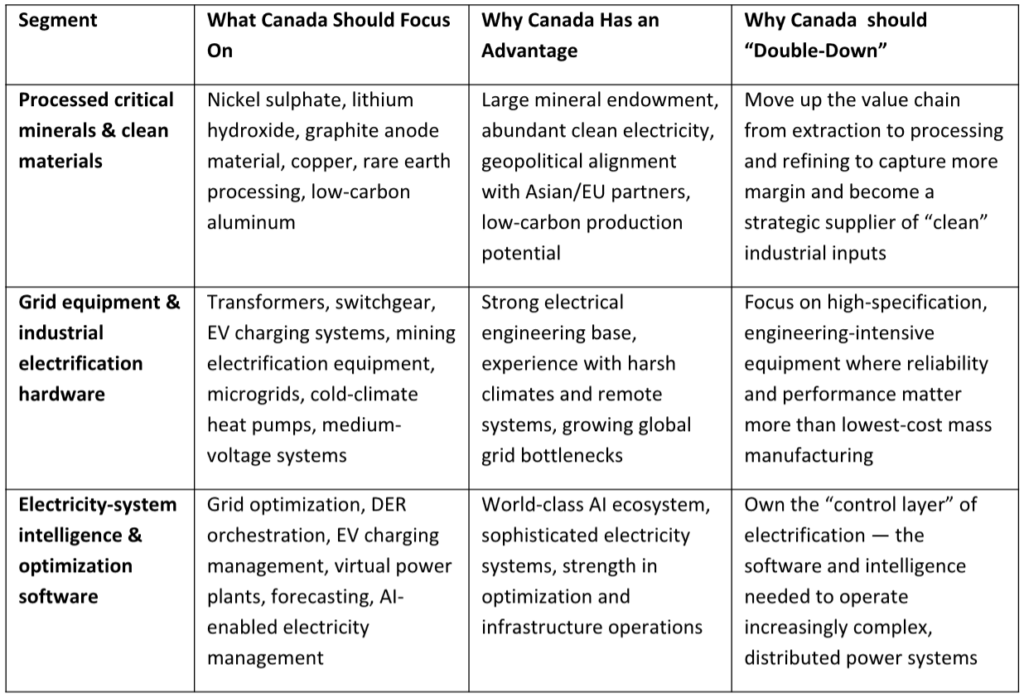
Beyond meeting our own needs, building our capacity in these sectors positions Canada to help meet the needs of our trading partners, who are embarking on similarly ambitious electricity buildout and electrification efforts.
According to a recent analysis by the Transition Accelerator, Canadian companies are already finding success in doing so. Exports in clean energy supply chains grew 21% faster than all other exports over the last five years, and Canada’s market share of these exports is growing. This success can be turbo-charged with industrial policy targeting those segments of the supply chain where we have strong comparative advantage.
Delivering on the full range of benefits elucidated in Powering Strong requires swift action to translate the four pillars into steel in the ground, new wires, more workers and made-in-Canada widgets. The strategy identifies two dozen areas for action, which the government is now seeking input on. This consultation should be focused and fast, as there’s no time to waste.
Most importantly, provincial governments need to be brought on board and kept on board given they have direct oversight for electricity systems. On interprovincial transmission lines, in particular, they have demonstrated an encouraging willingness to work together to overcome the barriers that have stymied interest, as evidenced by the Ontario-initiated National Energy Corridor Agreement. Not surprisingly, the federal-provincial relationships will hinge around the age-old question of who pays for what, and who benefits.
This fall’s federal budget will stand as an important litmus test of the Carney government’s resolve to translate this strategy into steel in the ground. It’s estimated that doubling electricity supply will require a trillion dollars of investment.
A recent analysis of the UK’s electricity and electrification ambition found that the economic ROI on such investment is 4:1. In Canada, given the energy intensity of our economy and our supply chain potential, the ROI could be even greater. There’s no time to waste in mobilizing and deploying investment.
In launching the strategy, Prime Minister Carney drew on a quote from Marshall McLuhan that captures the moment well: “Our Age of Anxiety is, in great part, the result of trying to do today’s jobs with yesterday’s tools—with yesterday’s concepts.”
As the International Energy Agency has noted, we have now entered the Age of Electricity. The coming months and years will demonstrate whether we’re using today’s best tools to meet tomorrow’s challenges.
Contributing Writer Dan Woynillowicz is the Principal of Polaris Strategy + Insight, a public policy consulting firm focused on climate change and the energy transition.