
Mark Carney’s Values-Based Realism Will be Tested as Much by China as by Trump
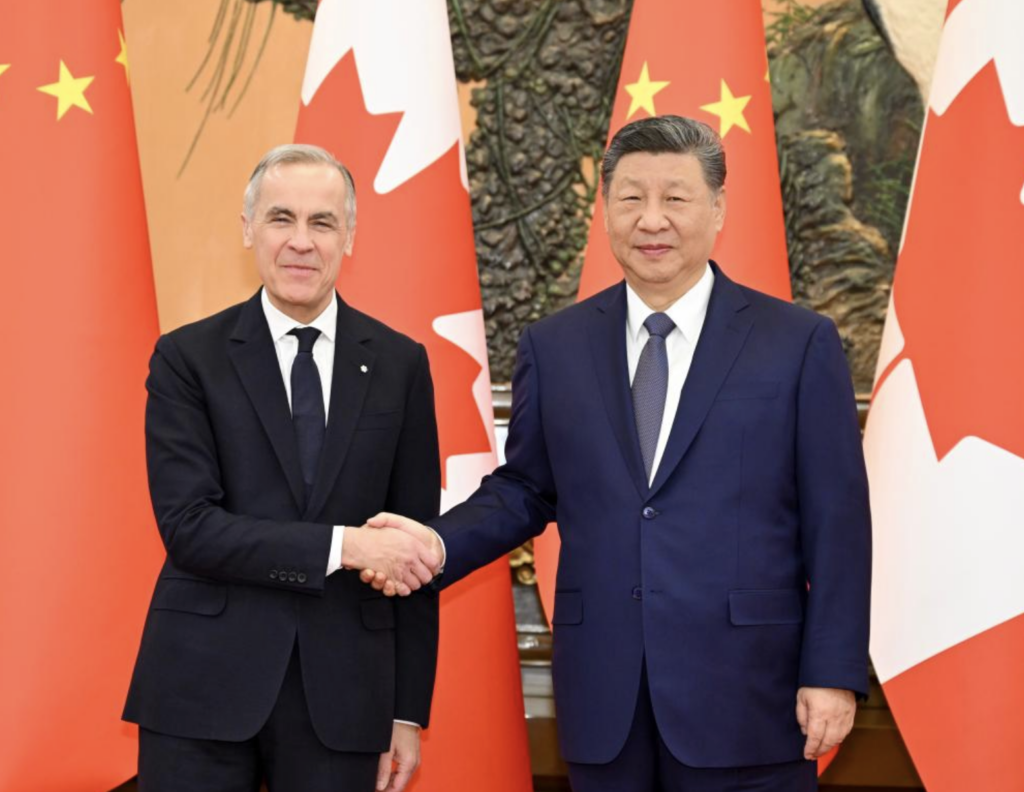 Prime Minister Mark Carney and President Xi Jinping in Beijing on January 16, 2026/Xinhua
June 22, 2026
Prime Minister Mark Carney’s decision to launch a new strategic partnership with China has the potential to be the most consequential shift in Canada’s China policy since Pierre Trudeau first recognized the People’s Republic in 1970, two years ahead of the United States.
After years of diplomatic freezes, trade disputes, arbitrary detentions, allegations of foreign interference, and growing geopolitical rivalry between Beijing and Washington, the idea of a Canada-China “strategic partnership” can seem like a recalibration of Justin Trudeau’s Indo-Pacific strategy or a throwback to an earlier era.
It is neither.
The world of 2026 is very different from the world that existed when Canada first embraced engagement with China in the 1970s or when Jean Chrétien led his Team Canada missions in the 1990s.
While the dispute over the arrest of Meng Wanzhou and the detention of the “Two Michaels” is not forgotten, there is an increasing recognition that the binary swings in approach to China of the past two decades have neither served Canadian interests nor meaningfully advanced our values.
China is now the world’s second-largest economy, a technological powerhouse, a military competitor of the United States, and an indispensable actor in addressing global challenges, from climate change to global health.
The question facing Canada is not whether to engage China. It is how. Carney’s answer is to apply his ‘values-based realism’, advancing interests that also reflect our values just as he has done with the United States under Donald Trump.
The question of the new strategic partnership – how and what it means – was the subject of a half-day series of speeches and panels hosted last week by the Chinese Embassy in Ottawa with legislators, business leaders, scholars and civil society. Separately, it was also part of a discussion the Taipei Economic and Cultural Office hosted last week for visiting senior Taiwanese officials.
Canada and China have profound disagreements on human rights, arbitrary detention, foreign interference, cybersecurity, and international security. But Canada cannot advance its economic, environmental, and geopolitical interests by pretending China does not exist. Carney’s approach, therefore, is neither confrontation nor accommodation. It is selective and constructive engagement.
The communiqué signed in January by Carney and President Xi Jinping rests on the following pillars: energy and clean technology; trade and economic cooperation; public safety and security; multilateralism and global governance; and culture and people-to-people exchanges.
Canada recognizes the People’s Republic of China as the sole government of China, but it has never formally endorsed Beijing’s claim of sovereignty over Taiwan.
Ministerial visits have ramped up. So have business interactions and people-to-people contacts including between think tanks and universities, thanks to visa-free travel for Canadians to China.
Industry Minister Mélanie Joly met last week in Shanghai with Chinese EV auto companies. Carney will meet again with Xi when China hosts November’s APEC summit in Shenzhen. The challenge now is to realize the goal of increasing Canadian exports to China by 50% by 2030.
Much work needs to be done, including providing greater clarity and transparency from both sides around investment and regulatory provisions. If achieved, the end result will be one of the defining characteristics of Canadian diplomacy in an age of ‘variable geometry’ — a world in which countries cooperate with different partners on different issues rather than dividing neatly into opposing camps.
Canada already does this.
We work closely with the United States on continental defence, especially in the Arctic, while engaging in strenuous trade negotiations. We partner with European allies on Ukraine, especially with the Nordics in the High North, while taking a different approach to migration. We cooperate with Mexico in mining and manufacturing while competing for investment. We engage Gulf states on energy while disagreeing on human rights. China should be approached in the same manner.
The opportunities are substantial.
China remains one of Canada’s largest export markets. Canadian farmers, seafood producers, forestry companies, mining firms, universities, pension funds, and financial institutions all have significant interests there.
The removal of punitive tariffs on Canadian agricultural exports and renewed access for exporters represent tangible gains for Canadian businesses and workers. Handled with care, China may join Japan and Korea in making cars for Canadians, especially if American manufacturers decouple from Canada.
Energy may prove especially important. China remains one of the world’s largest consumers of energy and one of the largest investors in clean technology. Canada possesses resources China needs, including liquefied natural gas, uranium, potash, critical minerals, hydroelectric expertise, carbon-capture technologies, and environmental services.
At a time when Ottawa is seeking to diversify trade beyond the United States, the potential for mutually beneficial cooperation is difficult to ignore.
Climate change offers another avenue for engagement. Whatever their political differences, Canada and China share an interest in reducing emissions, improving energy efficiency, developing battery technologies, strengthening climate resilience, and advancing clean-energy innovation. There are few global environmental challenges that can be solved without meaningful Chinese participation.
Yet the road ahead is anything but straightforward, beginning with wariness among farmers and seafood producers, based on their experience of trade disruption through tariffs or questionable claims on the quality of Canadian food exports.
Then there is the geopolitics.
Nowhere is the complexity of the relationship more evident than in Taiwan. For China, deviation from the One China policy is a “red line” as Chinese Ambassador Wang Di reiterated at last week’s session.
Canada recognizes the People’s Republic of China as the government of China, but it has never formally endorsed Beijing’s claim of sovereignty over Taiwan. Since 1970, Ottawa has maintained a careful balance: constructive relations with China alongside extensive commercial, educational, and cultural ties with Taiwan.
That balance is becoming harder to sustain.
Taiwan is now one of Asia’s most prosperous economies, a vibrant democracy, and a critical link in global supply chains, particularly in semiconductors and advanced technologies. Canadians understandably sympathize with Taiwan’s democratic success and support stronger ties.
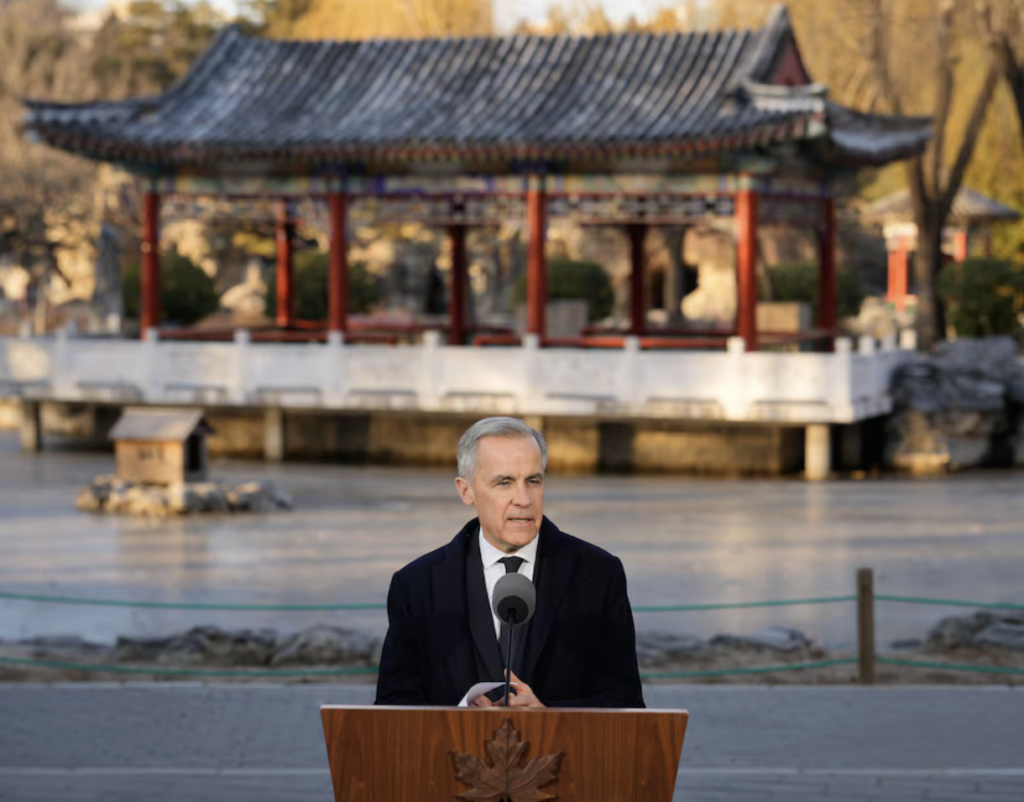 Prime Minister Mark Carney holds a news conference in Beijing, January 16, 2026/PMO
Canada also has a profound interest in preserving stability across the Taiwan Strait to ensure freedom of navigation, especially in vital sea lanes as Canada seeks to diversify trade and export more to the Indo-Pacific. Canadian warships and aircraft regularly conduct freedom-of-navigation exercises and overflights. Any conflict or blockade would disrupt supply chains, destabilize financial markets, raise energy costs, and threaten the broader international order.
Canada therefore faces a delicate challenge. It should support Taiwan’s resilience, expand trade and investment ties, oppose coercion and intimidation, and encourage its meaningful participation in international organizations such as INTERPOL, World Health Organization (WHO) and the Comprehensive and Progressive Agreement for Trans-Pacific Partnership (CPTPP).
But Canada should also avoid symbolic gestures that increase tensions without improving Taiwan’s security. Supporting Taiwan and maintaining productive relations with Beijing are not mutually exclusive objectives. The goal should be to preserve peace, freedom of navigation, and the status quo while encouraging a peaceful resolution of differences.
Human rights present an equally persistent challenge. Canadian concerns over forced labour, the treatment of Uyghurs in Xinjiang, restrictions in Tibet, the erosion of freedoms in Hong Kong, and broader questions surrounding civil liberties and ethnic minorities continue to shape adverse public perceptions of China. Allegations of foreign interference and transnational repression have further eroded public trust.
These concerns are real and cannot simply be set aside in pursuit of commercial advantage. Democracies must protect institutions, universities, diaspora communities, research partnerships and political systems without slipping into xenophobia. Canada’s initiative and subsequent Declaration Against Arbitrary Detention in State-to-State Relations is now signed by 82 nations.
One of the lessons of the past decade is that Canadians expect their government to defend democratic values and human rights and enforce our laws to contain activities that are covert, coercive, or corrupting, even while pursuing economic interests. A mature relationship with China therefore requires the confidence to engage where interests align and to disagree openly where values diverge.
The United States presents another challenge in our relationship with China.
President Donald Trump’s administration views deeper engagement between allies and China with suspicion. Washington increasingly frames competition with Beijing as the central organizing principle of international politics, linking trade, technology, Taiwan, human rights, and security into a single strategic framework.
The US appears determined to remain the predominant strategic power in the Indo-Pacific. That serves Canadian interests, but not if pursued through a full-throated containment policy demanding that allies follow suit.
Realism recognizes that China matters economically, environmentally, and strategically. Values remind us that interests alone cannot define Canadian foreign policy.
Any Canadian government seeking closer economic ties with Beijing will inevitably face scrutiny from American policymakers concerned about technology transfers, critical minerals, strategic infrastructure, and supply-chain security.
But Canada is not the 51st state.
Our prosperity depends overwhelmingly on the United States, but our interests are not identical to Washington’s. Pierre Trudeau led the West in recognizing Beijing. Brian Mulroney maintained dialogue after Tiananmen Square. Jean Chrétien expanded commercial relations while preserving alliance commitments. The lesson is not that Canada should choose Beijing over Washington. It is that Canada should pursue Canadian interests.
This is where Carney’s ‘values-based realism’ becomes more than a slogan.
Realism recognizes that China matters economically, environmentally, and strategically. Values remind us that interests alone cannot define Canadian foreign policy. Together they provide a framework for engagement without illusion and cooperation without naiveté.
If there is a lesson from the long and often troubled history of Western relations with China, it is that neither wishful thinking nor hostility provides a reliable guide to policy. The challenge is not to transform China into something more congenial. It is to understand China as it is.
We can learn from Australia on how to engage China without becoming dependent, and how to defend national interests without turning every disagreement into a crusade.
The ultimate test of Canada’s new strategic partnership will not be the communiqués signed in Beijing. It will be whether Canada can secure concrete benefits for Canadians while safeguarding national security, democratic institutions, human rights, and the rule of law.
In a fragmented world marked by great-power rivalry, middle powers have fewer opportunities to shape events. But they also have greater incentives to build bridges where others build walls.
Canada’s task is not to become pro-China or anti-China. It is to proceed intelligently, advancing our interests and applying values-based realism.
China pursues its national interests just as every other major power does. Canada should do the same.
That means engaging where interests align, pushing back where principles require, defending freedom of navigation in the Taiwan Strait, supporting human dignity wherever it is threatened, and preserving enough diplomatic flexibility to navigate a world whose geometry grows more variable by the day.
If Mark Carney can achieve that balance, the new strategic partnership may prove less a gamble than an example of modern Canadian statecraft. In the turbulent diplomacy of the 21st century, working with everyone while surrendering to no one may be the most realistic strategy of all.
Policy Contributing Writer Colin Robertson, a former career diplomat, is a fellow and host of the Global Exchange podcast with the Canadian Global Affairs Institute in Ottawa.