
More than the Canadian Warren Buffett: Prem Watsa and The Fairfax Way
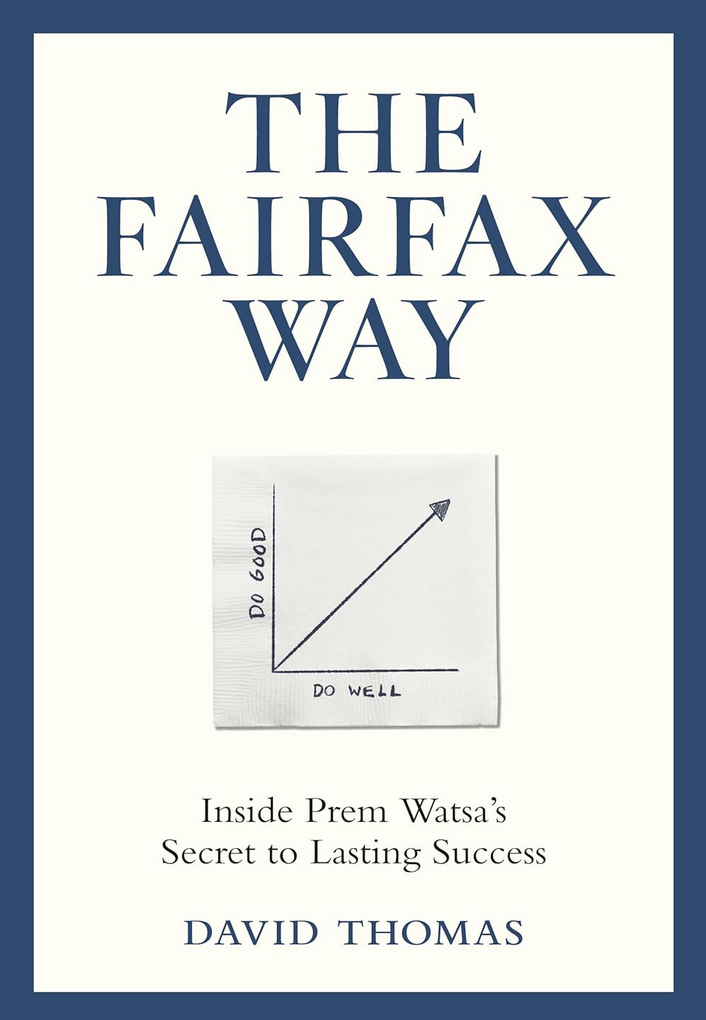
The Fairfax Way: Inside Prem Watsa’s Secret to Lasting Success
By David Thomas
Penguin Random House, November 2025/376 pages
Reviewed by Paul Deegan
November 10, 2025
I’ve never met Prem Watsa, chairman and chief executive officer of Fairfax Financial Holdings Limited, but I was very impressed when I heard him speak at the Horatio Alger Association of Canada’s Excellence Gala in Toronto a year ago.
Alger was, of course, known for his formulaic “Rags to Riches” stories. The Fairfax Way: Inside Prem Watsa’s Secret to Lasting Success by David Thomas is a modern-day version of those books but, rather than fiction, this fairy tale is fact. I’ve known and dealt with Thomas as a business news editor for two decades. I always found him to smart, sophisticated, fair, and balanced, so I was particularly interested to dive into his book. He didn’t disappoint.
While some business books jump around, Thomas clearly delineates the book into two halves: the corporate story and an examination of Fairfax’s approach to value investing, as well as its strategy and culture.
Watsa has been called the “Canadian Warren Buffett”, and the comparison is a good one. Thomas cites Watsa’s admiration for John Templeton, who ran one of the most successful mutual funds ever, lived frugally, and was a generous philanthropist. Indeed, at the Horatio Alger dinner I attended, Watsa spoke fondly about Templeton.
Born and raised in Hyderabad, India, Prem did not come from money.
“In 1972, there were 582,837,973 people in India, 5,049 of whom would arrive as landed immigrants in Canada, a nation of 22,218,463, writes Thomas, “One of them was Prem Watsa.” Thomas adds that when Watsa attended the Ivey business school at Western to pursue his MBA, “Prem couldn’t even afford to go to a movie or eat at McDonald’s.”
Armed with his MBA, Watsa is apprehended by the police as he is running to a job interview at Confederation Life. There had just been a bank robbery nearby, and the police pinned Watsa to the hood of a cruisier. He did get the job, which paid $11,000 per year and launched his incredible career. Nine years later Tony Arrell, the legendary value-minded investor, lured Watsa to Gardiner Watson.
By the time Watsa arrived, Arrell had already jumped ship. In 1984, Watsa and Tony Hamblin, his former boss at Confederation Life, formed Hamblin Watsa Investment Counsel – with Hamblin handling fixed income and Watsa looking after equities. In 1986, Fairfax was born. Its motto: “Fair and Friendly Acquisitions”.
There had just been a bank robbery nearby, and the police pinned Watsa to the hood of a cruisier. But he did get the job, which paid $11,000 per year and launched his incredible career.
Before the 1987 stock market crash, Watsa sold down half of the company’s stock portfolio and booked large profits (Fairfax proved prescient again with its big short against the U.S. housing market in the lead-up to the global financial crisis). With a string of acquisitions, the 1993-1998 period were go-go years for Fairfax. Indeed, over the first 13 years, Fairfax stock price had compounded 48 per cent annually.
While Watsa racked up accolades for his bold, bearish calls leading up the global financial crisis, he was perhaps too cautious in the 2010-2016 period. The chapter devoted this is titled “Driving With the Brake On”. At one point during that period, 100% of their equity portfolio was hedged. Thomas notes, “In 2016, the company’s five-year return for its equity investments was minus 7 per cent, while the S&P 500 advanced almost 15 per cent.”
Thomas quotes extensively from Watsa’s annual letter to shareholders. According to Thomas, “For the best tool to understand what Fairfax is thinking, doing, or worrying about, read the chairman’s letters to shareholders. The letter started out as a one-pager in 1985, hit double digits in 1996 and now runs around thirty pages of strategic insights, background context, market wisdom, bearish musings, dad jokes, and some strong hints on future direction.”
It’s clear that Thomas sees great CEO letters not as some rote summary of activities, but as an MBA seminar, which this book also serves as. Chapter 18 is a series nine case studies, where Thomas succinctly presents learnings from major acquisitions by Fairfax.
Throughout the book, there are references to Watsa’s devout Christian faith. The penultimate chapter has fewer than a handful of pages, but it gives the reader an intimate look into how his faith is interwoven into his business philosophy. “Very simply, we truly think of business as a good thing,” explains Watsa. “By providing outstanding service to our customers, looking after employees, providing a return for shareholders, and then redirecting a portion of the profits into the communities we serve, we think business can be a calling.”
It’s clear that Prem Watsa would have tried to veto any attempt by the publisher to name this book The Prem Watsa Way (Warren Buffett’s book is The Warren Buffett Way). Fairfax is bigger than its remarkable, publicity-shy founder. This book would be a perfect stocking-stuffer for investors and business students, but its appeal is broader than that.
Thomas delivers an intimate portrayal of a man more Canadians should learn about, celebrate, and emulate. Prem Watsa is so much more than the Canadian Warren Buffett, he is a success story beyond anything Horatio Alger could have ever imagined. And, he is a reminder that immigration has made Canada stronger, more prosperous, and a force for good in the world.
Let’s hope Thomas has a few more books in him. He has the potential to join Howard Green, Rod McQueen, and Gordon Pitts as one of the great modern-day chroniclers of Canadian business.
Paul Deegan is CEO of Deegan Public Strategies. He was an executive at BMO and CN, and he served in the Clinton White House.