
Notes from the Citadel: Alberta, Canada, and the Lessons of History
 Historic perspective: Bob Rae at the Citadel in Quebec City
By Bob Rae
May 25, 2026
We are living through a moment when our democracy, unity, and international engagement are once again being tested.
In the last week alone, I’ve spoken at the Together/Ensemble conference in Calgary on the UN Sustainable Development Goals, followed by the Democratic Engagement Exchange dialogue on the state of Canada’s democratic health.
The bad news is that our politics seems precarious. The good news is that the appetite for dialogue and public discourse has never seemed higher.
This past weekend, my wife Arlene and I were in Quebec City, honoured to join the Governor General’s Canadian Leadership Conference.
It was an intensive three days of animated discussion on all the topics Canadians in general and Policy writers and readers in particular have been debating — from sustainable prosperity, to resilience amid volatility, to Canada’s place in the world, to leadership and security (my panel).
While this was unfolding in the province that has taught itself and us so much about the darkness and light of nationalism, the subject that preoccupied us beyond the official agenda was Alberta.
Premier Danielle Smith’s announcement last Thursday that she would include a question that could unleash an independence referendum on Alberta’s pre-scheduled October 19th referendum has now become the most urgent threat to Canada’s future.
It follows a complex process in which competing citizen campaigns for petition signatures for and against independence unfolded over many months.
The decision by the province’s Chief Electoral Officer to validate a referendum on Alberta independence was overturned on May 13th by Justice Shaina Leonard, who upheld the arguments of Indigenous groups that the Crown’s duty to consult could not be avoided by the Alberta government ahead of any independence referendum.
This is the second such decision by an Alberta court, and the second time the Premier has responded by insisting that to allow “Trudeau-appointed judges” to subvert the “will of the people” was anti-democratic.
These arguments are not new, either in Alberta or elsewhere, and this is not the first time that provincial governments with authoritarian tendencies have been curbed by the courts.
Among the most notorious laws of the Alberta Social Credit government, first elected in 1935, was its requirement that newspapers issue a “correction” and reveal their sources if the government concluded that stories were untrue. In Quebec, Maurice Duplessis’ government shut down, with its “padlock law” publications deemed to be “subversive” or “bolshevist”.
The Orwellian nature of this abuse of majority power was eventually struck down by the Supreme Court of Canada.
The Court’s decisions in these (and other) cases were important precursors to the unanimous Supreme Court opinion on the Quebec Secession Reference in 1998.
That opinion stands firmly for the principle that in a constitutional, federal democracy, minority rights matter, and even a majority vote in a provincial referendum cannot override these protections. The rule of law means that the law is above us all.
This applies to Canada particularly, because we are a federal country, and because Section 35 of the Constitution Act was designed to make it clear that “existing aboriginal and treaty rights” were specifically protected.
This reality led to a body of Supreme Court decisions (including the 1973 Calder case recognizing Aboriginal title, which predates patriation) that have recognized that neither federal nor provincial governments can ignore the existence of indigenous people whose presence predates the arrival of European explorers and settlers.
The myth of terra nullius — that somehow Canada was the land of no one before first contact — was exploded.
Compared with the richness and complexity of a country created with what Saskatchewan Deputy Attorney General John Whyte described in his oral submission to the Supreme Court in the Quebec Secession Reference as “the threads of a thousand acts of accommodation”, it should be clear that a populism that fails to recognize the dignity of difference is more a variant of authoritarianism than a form of democracy.
This is the fight we are now in, at home and around the world.
Governor General Mary Simon, coming to the end of her term of office, reminded participants in Quebec City of the challenges facing both Canada and the world, including climate change and the pressures on Arctic nations and communities. I have had the pleasure of working with her since the constitutional discussions of the early 1980’s. Her wisdom and thoughtfulness prevailed above the passionate debate.
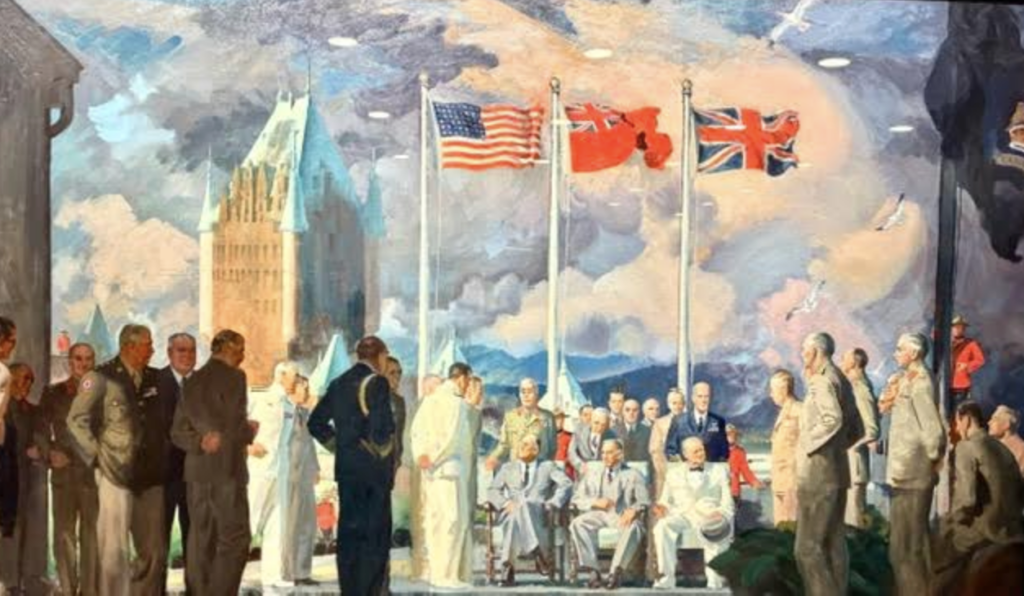 ‘The 1943 Quebec Conference’ by Reginald Hubert Rogers, on display at the Citadel
Visiting the Citadel, I was also reminded that in August of 1943, a young diplomat named Saul Rae — in whose footsteps I followed half a century later as ambassador to the United Nations — looked on as Winston Churchill, Franklin Delano Roosevelt and Mackenzie King reaffirmed their commitment to the Atlantic Charter and agreed on preparations for the D-Day Normandy landings. My father would leave Canada shortly thereafter for Algiers, where he served with General Vanier at Canada’s mission to the Free French.
In what I’ve been writing, reading and saying recently, I keep running into Roosevelt as the immortal exemplar of American leadership whose contrast against the current incumbent remains a powerful source of moral clarity.
In January 1944, a few months after that first of two wartime Quebec conferences, President Roosevelt in his State of the Union address laid out for his fellow Americans and the world the inextricable connections among the timeless themes of sustainable prosperity, national resilience, free trade, leadership and security — “economic security, social security, moral security—in a family of nations.”
“The best interests of each nation, large and small, demand that all freedom-loving Nations shall join together in a just and durable system of peace,” President Roosevelt said. “In the present world situation… unquestioned military control over disturbers of the peace is as necessary among nations as it is among citizens in a community. And an equally basic essential to peace is a decent standard of living for all individual men and women and children in all Nations. Freedom from fear is eternally linked with freedom from want.
“There are people who burrow through our nation like unseeing moles and attempt to spread the suspicion that if other Nations are encouraged to raise their standards of living, our own American standard of living must of necessity be depressed.
The fact is the very contrary. It has been shown time and again that if the standard of living of any country goes up, so does its purchasing power — and that such a rise encourages a better standard of living in neighbouring countries with whom it trades. That is just plain common sense.”
The same pathologies of isolationism, protectionism and authoritarian bullying surround us today, as they have in the most difficult days of our past.
Canadians are not only facing a wave of tactical populism from a rogue American president, we are facing it at home as well. Appeasing it at home makes as little sense as does appeasing the predatory hegemons once again bedeviling humanity.
We are at an especially challenging moment. We have to recognize that the rights and freedoms we take for granted in Canada are actually shared by different governments — federal, provincial, Indigenous — as well as by each of us as individuals.
As King, Roosevelt and Churchill knew, the real task of leadership is not just counting heads. It is turning heads. Faced with the lying machines in our hands, our task today is to counter with truth. Polls change. Heads turn. Truth matters.
As there was in a previous era of malignant autocratic madness harrowing nations across continents, there is a rational, morally and intellectually honest discourse unfolding — in Calgary, in Quebec City, in rooms and on platforms across Canada and beyond.
I could not be more grateful to be a part of it.
Policy Columnist Bob Rae teaches and writes on law and public policy. He is the Visitor of Massey College, a Distinguished Fellow at the Munk School at the University of Toronto, a Senior Fellow at the Forum of Federations, and a Matthews Fellow in public policy at Queen’s University. He served as Ontario’s 21st Premier, interim leader of the Liberal Party of Canada, and Canada’s Ambassador to the United Nations.