
On Being Canadian: Bringing Out the Best in Our Worst Moments
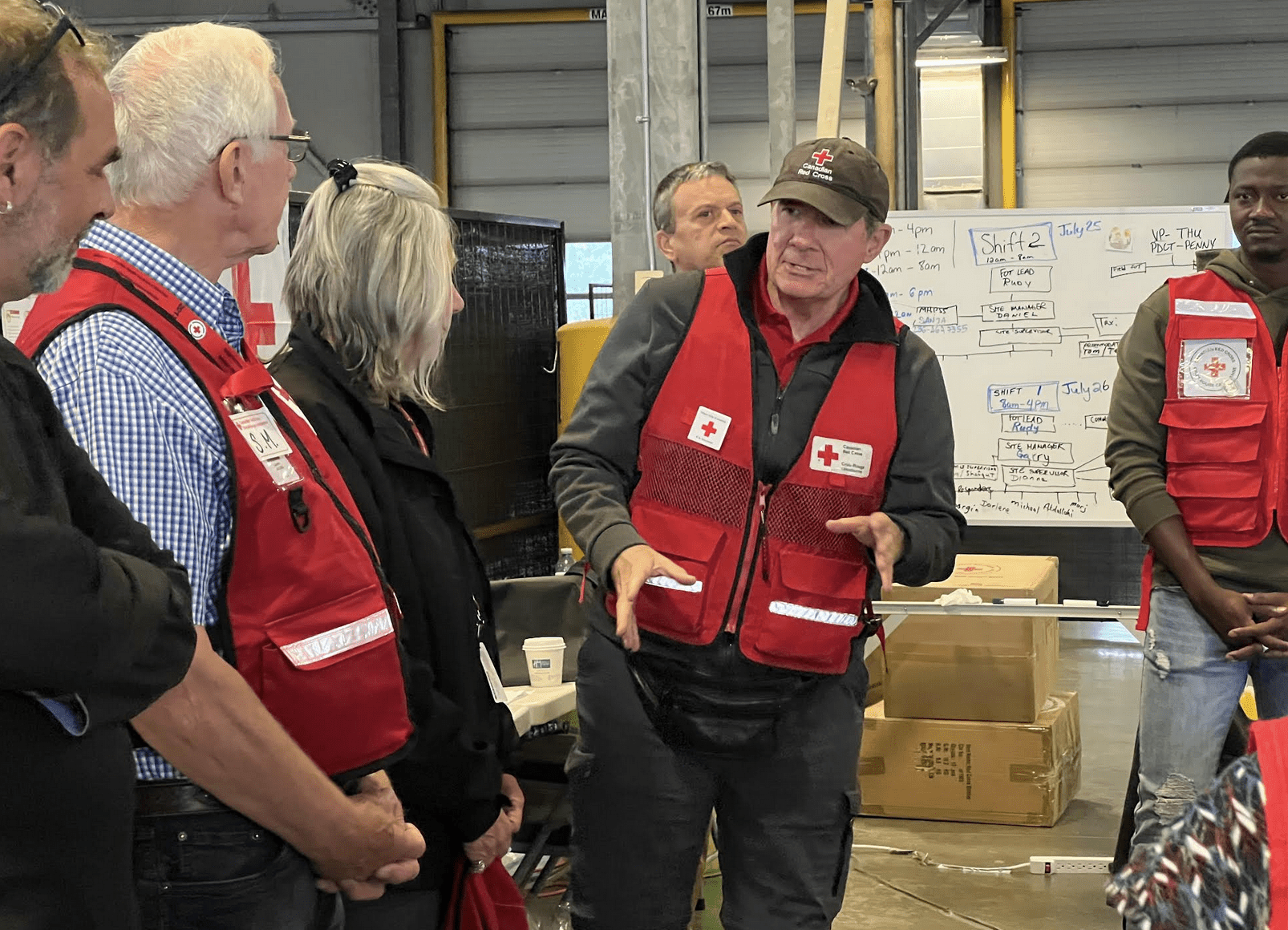 Guy Lepage briefing staff and volunteers in Edmonton in August 2024 as the Red Cross prepared to welcome evacuees from the Jasper wildfires/Angela Hill-Canadian Red Cross
By Guy Lepage
August 28, 2025
My earliest sense of what it means to be Canadian goes back to when I was nine years old. In 1967, the whole country was celebrating Canada’s Centennial with a host of activities from coast to coast to coast, including Expo 67, the Montreal World’s Fair that brought the world to Canada and introduced a confident, modern Canada to the world.
I was fortunate to live in the nation’s capital, so on that July 1, then called Dominion Day, I made the annual trek to Parliament Hill with my parents for the festivities marking Canada’s birthday.
When you’re a kid, celebrating Canada’s birthday every year is pretty straightforward; a party with music, flags, balloons and maybe some cake. But the celebration for Canada’s 100th birthday seemed special, even at that age.
Fast-forward to the early days of my first career, as a journalist working for the Ottawa Citizen and then CJOH TV (now CTV Ottawa). That’s when I reconnected with celebrating Canada, sent back to Parliament Hill as an adult by assignment editors to cover the events of Dominion Day, and later, post-1982, Canada Day.
And while the festivities were similar to when I was a child, the meaning surrounding Canada’s birthday grew for me. It was about pride and appreciating what we have in this country.
Over years of July 1sts, I interviewed many people on the Hill about why it’s important to celebrate being Canadian.
Their answers never changed:
- It was the best country in the world.
- They were proud of what Canadians had accomplished.
- They had pride in calling Canada home.
- They believed Canadians cared for each other.
- And they felt safe here.
As a reporter, objective standards compelled me to leave my own feelings out of the stories. I couldn’t say that I agreed with those answers. But I was happy that most people felt the same way I did.
After moving to Toronto, I eventually left journalism for a 20-year public service career advising the Ontario government and the premier of the day on emerging issues.
And it was here, amid the cut-and-thrust of daily political life, far from the balloons and cake of Canada Day, that I found a much deeper, emotional sense of what it meant to be Canadian.
Events and the choices I made following that transition enabled me to see Canada through the eyes of a humanitarian.
That new perspective opened up for me 20 years ago this week. On August 29, 2005, Hurricane Katrina hit landfall on the coast of Louisiana, pounding the Deep South, devastating New Orleans, causing an estimated $125 billion (2005 U.S. dollars) in damage and killing more than 1,800 people.
The American Red Cross, in urgent need of additional volunteers to cope with the massive disaster and its aftermath, reached out to the Canadian Red Cross (CRC) for assistance.
Then Ontario Premier Dalton McGuinty offered 100 members of the Ontario Public Service as part of the Canadian response. As a former reporter who had covered every manner of local crisis, I was a good fit for a three-week deployment in the Southern US as a Public Affairs Officer.
Based in Biloxi, Mississippi, I visited nine emergency shelters set up along the Gulf Coast, each one operated by volunteers caring for hundreds of people who had lost everything.
I escorted media crews who wanted to see the destruction firsthand and what the Red Cross was doing to assist people. I also travelled to New Orleans to support fellow humanitarians who were dealing with the aftermath of the levee breaks in that city.
What I wasn’t prepared for were the harrowing escape stories survivors shared with me.
One man described how the water rose so quickly in his home, he had to use an axe to cut a hole through his roof to escape.
Another who took refuge in a neighbour’s home had to climb onto the roof and sit in a boat attached to the house to ride out the storm.
What I was most affected by was the resilience shown by people who had lost everything, and were sleeping on camp cots in shelters, surrounded by whatever they bought with Red Cross funds. They were grateful for the assistance they received but were determined to rebuild their lives in an area they knew could be destroyed again by the next hurricane.
That first Katrina Red Cross deployment, when I learned what a difference one person can make to a life in crisis, led to a major change in my own life.
Since then, I’ve deployed nearly 30 times for the Red Cross to major disasters in seven provinces, to two other hurricanes in the US, and the Haitian earthquakes of 2010. I also assisted in Ukraine Relief Operation from Budapest, Hungary in 2022.
What does Canada mean to me, as a Red Cross humanitarian worker wearing the iconic red vest? At home and abroad, I believe what defines us is that in times of crisis, Canadians often think first about their neighbours before they think of themselves. Countless times, and in countless ways, I’ve seen and experienced this national generosity of spirit.
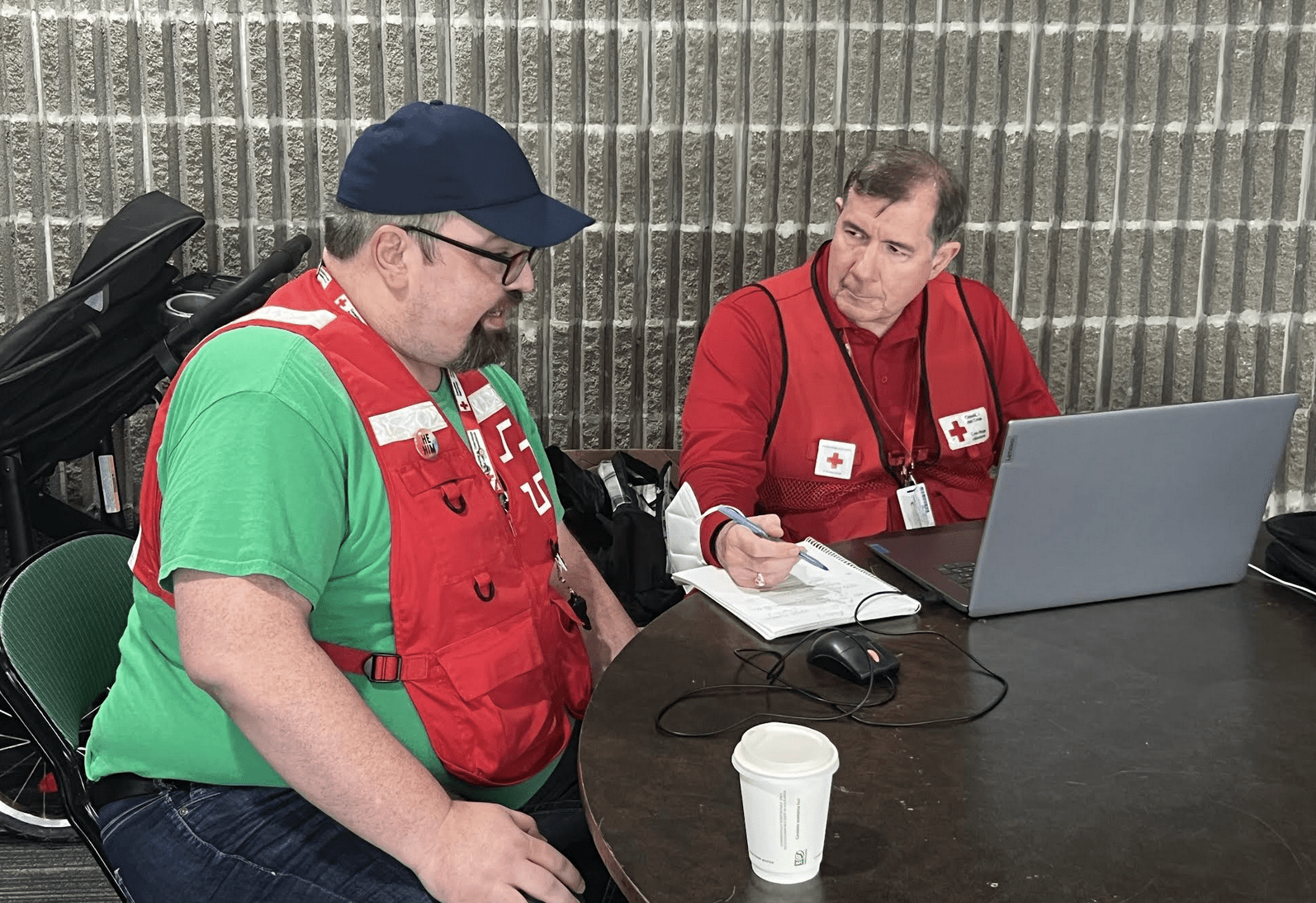 With Red Cross colleague Corey Jakobsze in Winnipeg, assessing the needs of evacuees from this summer’s Manitoba wildfires/Canadian Red Cross
This summer, I spent six weeks in Manitoba with more than 800 Red Crossers providing services to more than 30,000 evacuees forced from their homes by wildfires.
I met a woman named Janice in Flin Flon, in late June. She had fled her home along with the 5,000 neighbours evacuated from the community when a massive wildfire threatened to consume their town.
“I have a home to come home to; it’s kind of double-sided because I work in private home care and I know some of my clients have lost their homes, they don’t have a home to come back to,” she said of the devastation. “But we’re a strong town, we’ll pitch together, we’ll help. We’ll support them, we’ll get them up and going again.”
In July last year, I deployed to Edmonton, where the Red Cross was assisting evacuees from Jasper after that wildfire destroyed a third of the town.
One evacuee, who was now unemployed because the gas station where he worked was gone, summed up what many evacuees also told me.
“The best thing is that everybody is safe and alive, that is the best thing,” he said, “Everyone escaped successfully.”
The relationship between volunteers and the people we assist in times of crisis is transformational, not transactional. At its core is the knowledge that next week, or next year, you, or your mother, or father, or child, could be in a crisis like this one.
The Red Cross responds to a disaster every three hours across Canada. And what I have witnessed firsthand, over and over, is that Canadians always step up to assist others who are going through a crisis.
They do this by volunteering with the Red Cross or other organizations, or by opening up their wallets.
So far, Canadians have donated millions of dollars to the Canadian Red Cross for wildfire relief operations in Manitoba, Saskatchewan, and Newfoundland and Labrador.
And I can tell you firsthand, people who receive assistance are extraordinarily grateful.
If character is best judged on bad days rather than good ones, the window I’ve had has revealed the same qualities, over and over again — compassion, resilience, selflessness and shared values that cherish life above things.
I’ve served Canadians in their worst moments, and it has been a privilege.
The 2025 wildfires response operation is the largest in Canadian Red Cross’ recent history. Since May, the Red Cross has been providing humanitarian assistance to people impacted by wildfires across the country with operations in Saskatchewan, Manitoba, Ontario, and Atlantic Canada – and surpassing operations during the COVID-19 pandemic.
Please click here to donate: Helping To Strengthen Resiliency – Canadian Red Cross.
For his volunteer work, Guy Lepage has received the Order of the Red Cross, the Canadian Red Cross’ highest and most prestigious award for individuals who have dedicated decades of service to the organization at home and abroad. Earlier this year, he was awarded the King Charles III Coronation Medal. The medal recognizes individuals who have made significant contributions to their communities and demonstrated exceptional service and dedication.