
On Being Canadian in a Time of Bilateral Conflict
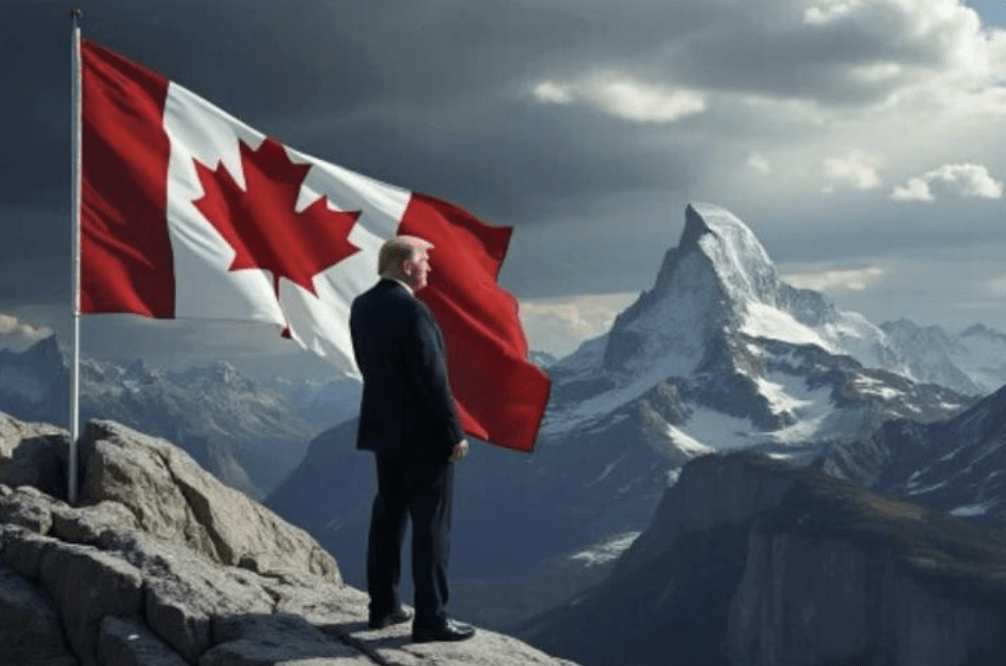 Donald Trump’s moving personal tribute to Canada, with Matterhorn/’Truth Social’
By Lisa Van Dusen
July 1, 2025
“We may be a small country, but we’re a great one, too. We’re the country of Beavertails and Margaret Atwood, Esi Edugyan and poutine. Of Lester Pearson, Oscar Peterson and The Weeknd. Of Christopher Plummer, Donald Sutherland and butter tarts. Of Sandra Oh and Michael J. Fox. Of Lorne Michaels’ moue, and Catherine O’Hara’s hiss. Of the Levys, Dan and Eugene. Of the Ryans, one and two. Of Guy A. Lepage and Elliot Page. Of Gurdeep Pandher. Of the Yukon. Of Joni Mitchell’s right hand. Joni Mitchell’s left hand, come to that. Of sorry when we mean it, and occasionally when we don’t. Just to be polite.
A friend who bullies us is no longer a friend. And, since bullies only respond to strength, from now onward, we will be prepared to be much stronger.”
This Canada Day adaptation of the monologue delivered by Hugh Grant’s Prime Minister David No-last-name in Love Actually is brought to you by the surge of Canadian patriotism unleashed since last Canada Day by Donald J. Trump, of all people.
There are not many moments in popular film or literature that convey the drama of a world leader standing up to an American president, because American presidents have been mostly cast as heroes, not villains. They save Air Force One from terrorists, or save the White House from terrorists, or — in the case of a badass Viola Davis in the latest iteration — save the G20 from terrorists.
In Canada’s current experience of a boundary-challenged American president, the drama is, alas, more Mark Burnett than Richard Curtis. But the geopolitical stakes are quite real.
While Mark Carney’s victory in our federal election two months ago seems to have assuaged some of Canada’s collective anxiety about Trump’s designs on our economy, our sovereignty and our future in part by tempering Trump’s annexation rhetoric, the fact that the US president is still using economic coercion as a bullying tactic doesn’t bode well.
With Trump now playing the Marvel Universe version of a presidential villain, Canadians have been re-examining what it means to be Canadian, in part as a defensive measure against misappropriation by misapprehension.
My own notion of the Canadian identity took shape in layers, in a way presumably less imperative than happens for people who choose this country. It was not something I had to metabolize as a way of assessing whether where I was going was better or worse, safer or more dangerous, than where I was.
I grew up in the town of Aylmer, Quebec, on the north shore of the Ottawa River, a 20-minute commute across the bridge from Canada’s capital. I spoke English at home and French at school, which was the normal I knew, so it never struck me as either exceptional or political.
Canadians have been famously courageous in fighting foreign wars, but for most of our history, we have not turned violent on each other over politics.
My first encounter with the notion of politics as an existential threat was when my father slept with a hunting knife under his pillow during the October Crisis. My very earliest memory of political violence was the announcement that Quebec cabinet minister and FLQ hostage Pierre Laporte had been murdered.
When I was 13, we moved across the river to Ontario in the post-Parti Québécois exodus, an adolescent uprooting that suddenly made René Lévesque my Marvel villain. A decade later, as a Montreal correspondent for Maclean’s, my understanding of Quebec’s politics, history, language battles — and of Lévesque as the leader whose charisma provided a political off-ramp from violence — became more nuanced.
Working in my 30s in Washington and New York editing and writing international news on American news desks was a daily immersion in the characteristics of conflicts elsewhere in the world — the minority-majority power struggles and intra-national battles for recognition, legitimacy, justice, revenge, vindication and territory that were measured in casualty counts from Northern Ireland to Kosovo to the Middle East to Sri Lanka to East Timor.
These conflicts were no more passionate and no less fraught with the resentments of economic stratification and racial, linguistic or religious caste sorting than Canada’s predominant political drama. But Canada had no Shankill Road, no checkpoints, no balaclava-clad militias rounding up and massacring fighting-age men on the edge of town, no fear of the 3 a.m. pounding on the door, and no culture of terror bred by decades of bombings that leave whole lives reduced to bits and pieces on a sidewalk in a single second.
The difference in how we process our differences was so stark, it seemed to be a core element of national character that Canadians generally ask questions first — sometimes for years on end — and shoot never. This predisposition toward peace is much rarer than one might think.
Canadians have been famously courageous in fighting foreign wars, but for most of our history, we have not turned violent on each other over politics. Of course, in an era whose global war on democracy includes the manufacture of division and chaos via performative propaganda, it’s tempting to knock wood at this point, just in case the Alberta Liberation Front is already crowdfunding.
So, our trademark “sorry” may be more than a national quirk. If your social reflex when colliding with a fellow human being or even a mailbox is not to throw a punch but to apologize reflexively, pre-emptively, sometimes apropos of nothing and occasionally in two languages, then maybe, after generations of epigenetic tweaking, your engagement with the world is more other-aware than most.
We tend to resolve political disputes by deploying our intellectual capital, not with physical brutality. Carney was elected in large part because of his considerable intellectual capital and Trump has displayed a preference for more visceral economic warfare and kinetic conflict, from deploying US troops on American soil, to bombing Iran to compelling massive increases in defence spending from Western democracies whose most imminent systemic and existential threat appears to be, well, him.
Which makes the ongoing resolution of economic and security issues between the two countries more of a clash of conflict cultures than we’ve seen in this bilateral dynamic in decades. By next July 1st, we’ll know more about which culture of conflict has prevailed.
Policy Editor and Publisher Lisa Van Dusen has served as Washington bureau chief for Sun Media, international writer for Peter Jennings at ABC News, senior writer for Maclean’s and as an editor at AP National in New York and UPI in Washington.