
On Being Canadian: Postcards from the Annex
 First & Last coffee shop in Toronto’s The Annex/Anil Wasif
By Anil Wasif
June 25, 2025
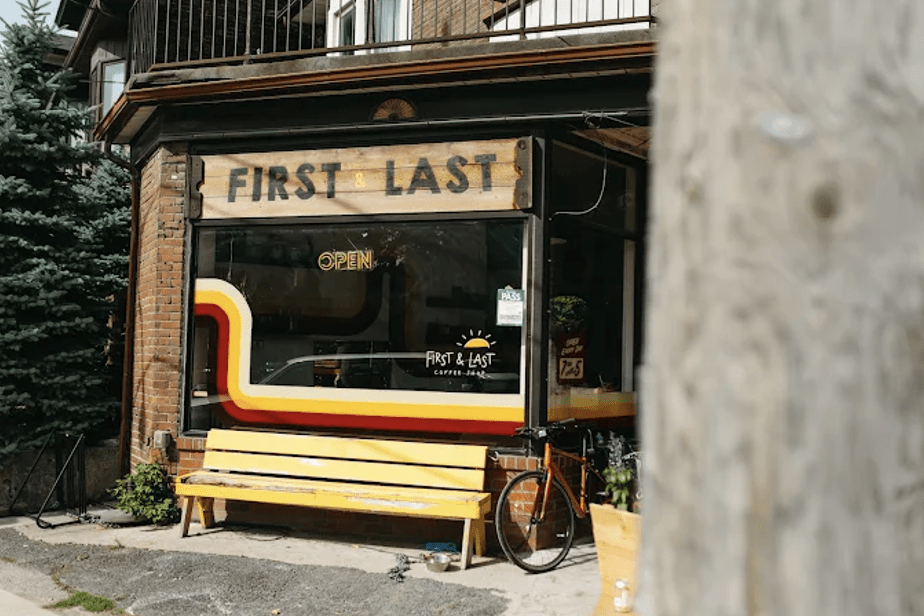
The bell above the door of “First & Last” coffee signals my motion from the leafy, Victorian-lined streets of the Annex into a pocket of calm. The scent of single-origin coffee from a Honduran women’s cooperative, roasted just outside Ottawa in Almonte, Ontario, mixes with the sweetness of La Belle Province butter melting in an oven. A trace of Mexican cinnamon wafts in the air, above neatly stacked copies of the Globe and the Post. The hiss of the steam wand comes from a gleaming Rancilio, straight from Milan Design Week. A curation of partnerships that makes the space feel so local, yet intentionally global. Asserting its own identity.
My exchange with Maya, the fine arts student from George Brown behind the counter, is the epitome of community—understated and warm. “The usual?” she asks, her smile, always a small beacon. “Please,” I say, “and a chocolate croissant before they’re all gone.” Taped to the side of the espresso machine is a faded Lawren Harris print, a stark, blue-and-white northern landscape, my little window of idealized wilderness amidst the urban grind. A moment later, my breakfast is waiting. It’s a small, consistent grace in a world of constant variables — our global brand.
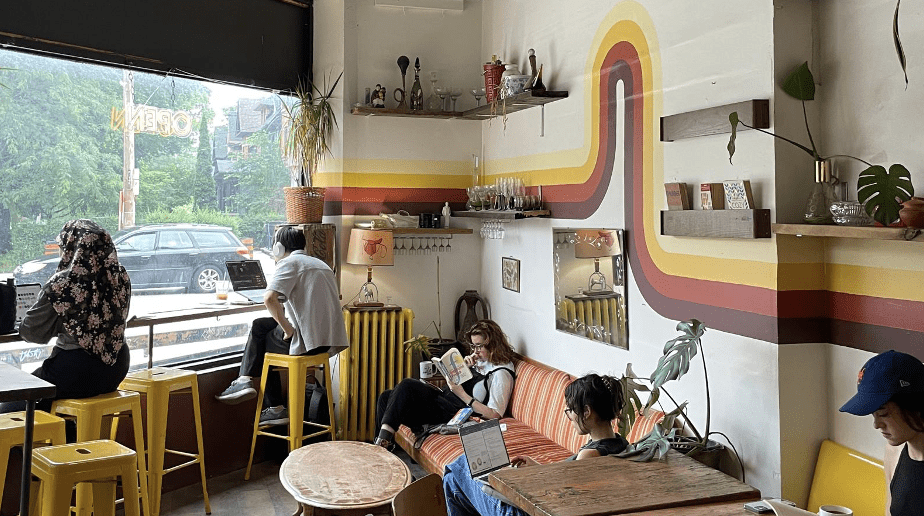
As I sip my double espresso over ice, my gaze drifts across the room, taking in a snapshot of our paradoxes. I see the young man with his physics textbook typing away, a cube-shaped food delivery bag at his side. His hustle is a response to a landscape where even a frozen Ontario tuition of $6,100 at the University of Toronto feels immense. He’s likely working to fend off the average $28,000 in student debt that shadows his peers, a burden so significant that over one in five Ontario graduates needs repayment assistance just to manage.
Not far from him, the young professional in the sharp blazer rehearses her presentation, the very picture of the “invisible middle.” Her $200,000 salary is damn impressive, but after taxes shave it down to about $130,000, the cost of a downtown life with friends spread across the GTA consumes it. With rent easily topping $2,500 a month, her dream of homeownership—requiring a down payment of more than $220,000 for an average GTA home—feels abstract. But she is holding her pen at 80 degrees, locked in on her dream.
I take my seat by the window, looking out at the gorgeous Victorian homes that define the Annex. From the moment I set foot on St. George Street, I wanted one, with earned money. I think of my latest acknowledgement of this land as the traditional territory of many nations, including the Mississaugas of the Credit, the Anishnabeg, the Chippewa, the Haudenosaunee, and the Wendat peoples. It’s a humbling thought that reframes the entire city. The modern anxieties about who gets to live here are just the latest echoes in a long history of displacement. Indigenous legal traditions like the Dish with One Spoon speak of sharing the land’s resources, a stark contrast to a market where these homes command average list prices over $2.1 million.
Behind me on the couch, a young couple with a baby jounces a stroller with one foot while they talk in hushed, anxious tones. I manage to catch the keyword: “waitlist”. They are navigating the city’s daycare crisis. Thanks to the pandemic, fees remain capped at $22 a day, a policy designed to bring relief. But that affordability has fueled overwhelming demand, creating ballooning waitlists that force parents to register their unborn children for a chance at a spot. Their conversation is the sound of a policy success creating a new kind of scarcity, a fresh anxiety for a high-achieving generation stretched thin.
 Spring morning at First and Last/Anil Wasif
Sometimes, grumbling about taxes feels like a national pastime. Yet sometimes, when dusk settles and I see the CN Tower’s lights begin their nightly cycle, I feel a grudging, then growing, sense of pride. This is the quiet promise of the social contract made real. I think of a friend who, after losing his job, was caught by our Employment Insurance system—a single case among 1.37 million claims that paid out $12.8 billion last year alone. I think of another whose car was totalled; she was supported by the layered protections of our health care and insurance systems. Under a “no-fault” model, her own insurer immediately began covering costs not handled by OHIP, a system designed for swift, essential support. Our social safety net caught both of them in mid-air, and like a trampoline sprung them right back up.
Our advantage goes beyond these essential (but aged) systems to other arenas. It’s easy to misread our forthcomingness for dependency. Our might is not for display nor for mass media consumption. It’s demonstrated in the quiet maneuvering of an icebreaker asserting our sovereignty in the harsh Arctic, or the swift, explosive crack of a hockey puck tearing through the ice. Repeatedly challenge our values, our relationships, or our identity, and you’ll find that a nation that perfects the art of a polite queue can also be fiercely protective of its place. It’s a different kind of iron resolve.
One that is forged in places like the quintessential summer cottage trip with friends. Those weekends are communal, boisterous affairs filled with the scent of pine needles and barbecue smoke, the shock of cold water on a cloudy June afternoon, and the easy camaraderie that only seems possible around a crackling bonfire under a canopy of stars. That’s when our great mosaic comes to life, where the complex pieces of our individualities fit together, sometimes awkwardly, sometimes seamlessly, reminding us to preserve each other – through perseverance, our common strength.
As I break off the last piece of my croissant, it’s nearly eight a.m. My pedestrian commute takes me south, down the serene artery of Philosopher’s Walk. Shielded from the city’s noise by the university’s gothic buildings, I pull out my phone. My feet are on a historic Canadian path, but my voice bounces to colleagues in Dhaka, where evening has already fallen. I am one of over 55,000 people of Bangladeshi origin in the GTA—a part of a diaspora I believe to be among the hardest working Canadians you’ll ever meet.
Arriving on Bay Street to start my day as a public servant, the images from the coffee shop linger: the student, the professional, the young parents. Their individual struggles stitch our national fabric. We are all neighbours in a grand, difficult project. It’s the instinct to roll up our sleeves, to argue and to listen, and to hold fast to our beliefs, even when they are challenged.
We are not broken; we are burdened. And the most ambitious thing to do when someone is being difficult is to tell them you love them.
Je t’aime Canada / আমি তোমায় ভালোবাসি.
Policy Contributing Writer Anil Wasif is from Toronto. He sits on the Max Bell School Advisory Board at McGill University and the Governing Council at the University of Toronto. He holds advanced degrees in Economics and Public Policy. He is currently mobilizing support for: “The Social Contract” a collection of interdisciplinary essays on Canada’s missing middle.