
On Being Canadian: The Space We Make for Each Other
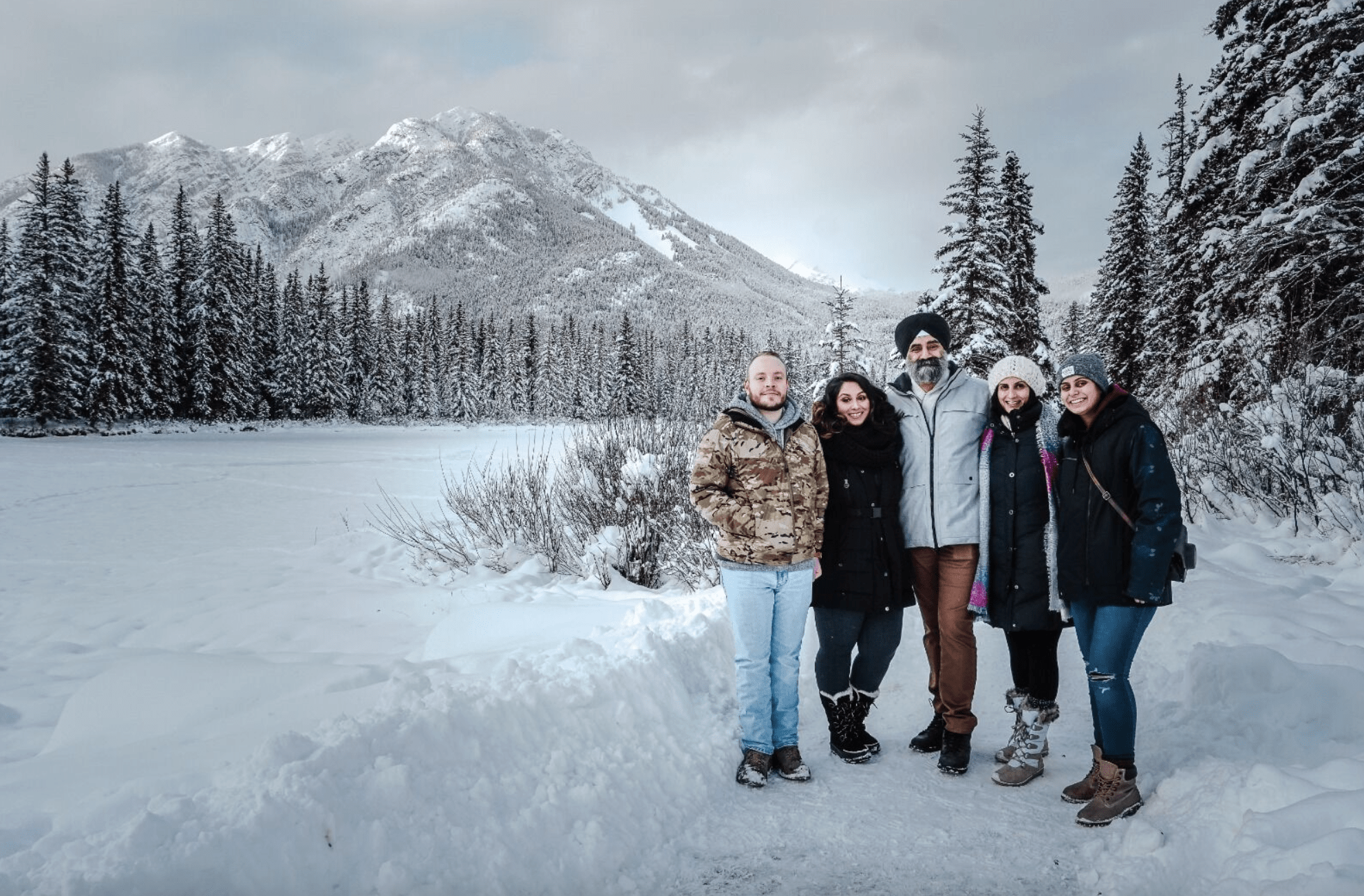 Sen. Baltej Dhillon (centre) with (L-R): Son-in-law Ryan Jorgensen, daughter Onkar, wife Suroj and daughter Rasna.
By Sen. Baltej S. Dhillon
September 3, 2025
The meaning of being Canadian begins with liberty. I knew this even before a turning point in my life became a turning point in the life of the country. If I had not, I would not have felt free to stand up for my freedom.
In Canada, liberty has never meant absolute freedom or unchecked individualism. Instead, it has always been liberty tempered by compassion, guided by reason, and understood as part of a collective project.
My own ancestors were not present at the founding moments of this country. Like many immigrant families, we arrived later. Yet, we inherited the conviction that freedom here is sustained by accommodation, and that belonging carries obligations as well as rights.
I grew up as the child of Sikh immigrants in British Columbia. My family had little in the way of material wealth when we arrived, but we carried with us values that shaped my life: faith, hard work, humility, and resilience.
My parents worked long hours to support our family, but never lost sight of their responsibilities to others. They modeled a life where success was measured not just in personal gain, but in what you contributed to your community.
Through those lessons, I came to understand that identity could be both a source of distance and a source of strength. It was possible to be fully Sikh and fully Canadian — not by setting one aside, but by living in the space where they strengthened one another.
That conviction was tested in my career with the Royal Canadian Mounted Police. When I applied to join the RCMP, I was told that I would have to remove my turban, cut my hair and shave my beard in order to wear the uniform.
For me, the turban and my unshorn hair were not optional. It was an expression of my faith, my values, and my identity. To remove them would have been to erase who I was. I requested permission to wear my turban on duty.
What followed was not a quiet conversation, but a national debate. Some supported me, but many opposed me.
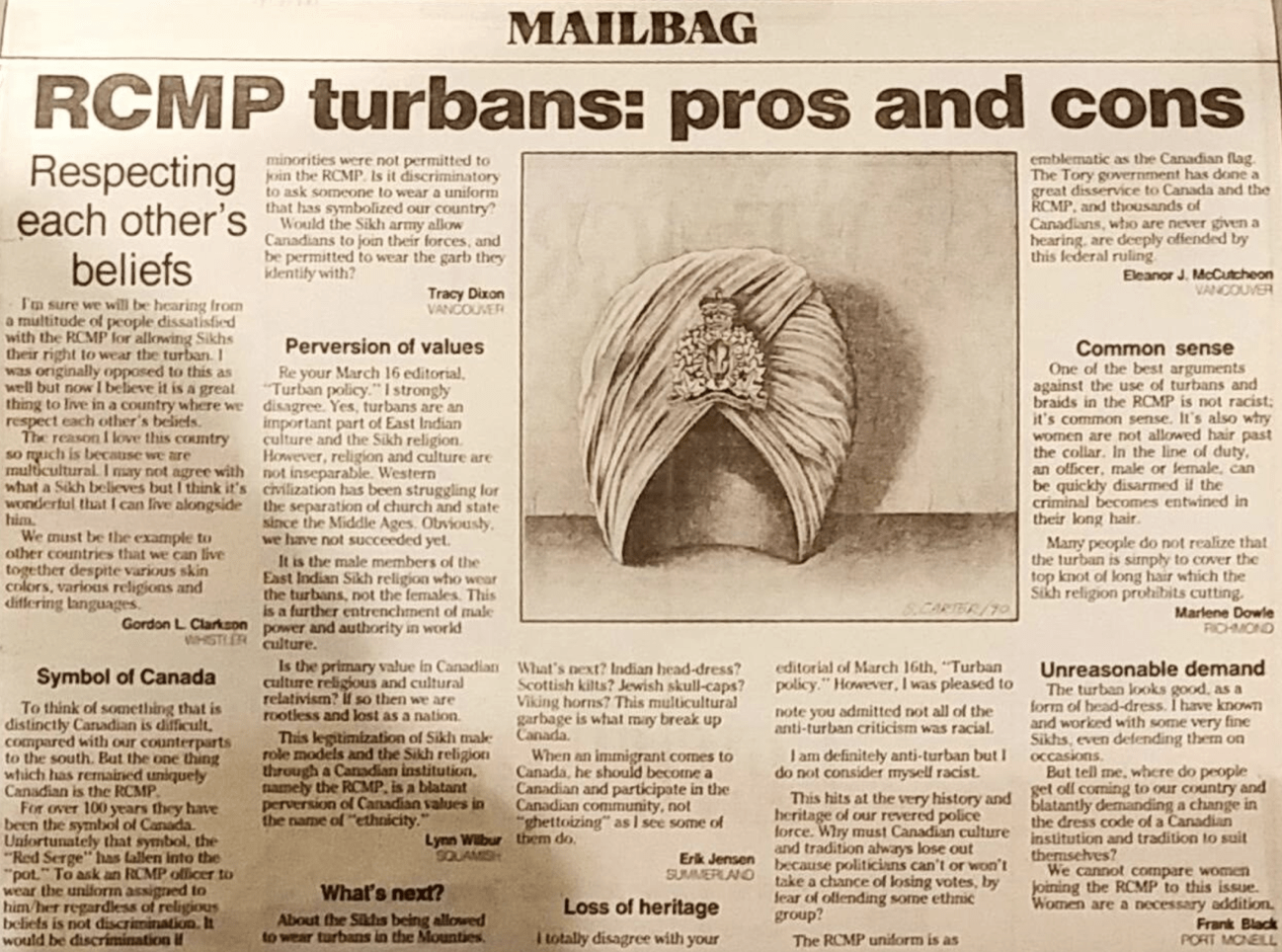 The debate provoked by my request to wear my turban on duty was not a quiet conversation.
There were roadside signs, petitions with hundreds of thousands of signatures, and newspaper ads arguing that I did not belong. In Quesnel, British Columbia, my first posting, there were rumors that a bar went so far as to put up a $5000 bounty for anyone who could knock off my turban. I also received postcards from across Canada that had messages of hate, and threats to me and my family.
It was not easy. Yet I also saw another side of Canada. I saw allies, who stepped forward in solidarity. They understood from their own history that defending the rights of one group was essential to defending the rights of all.
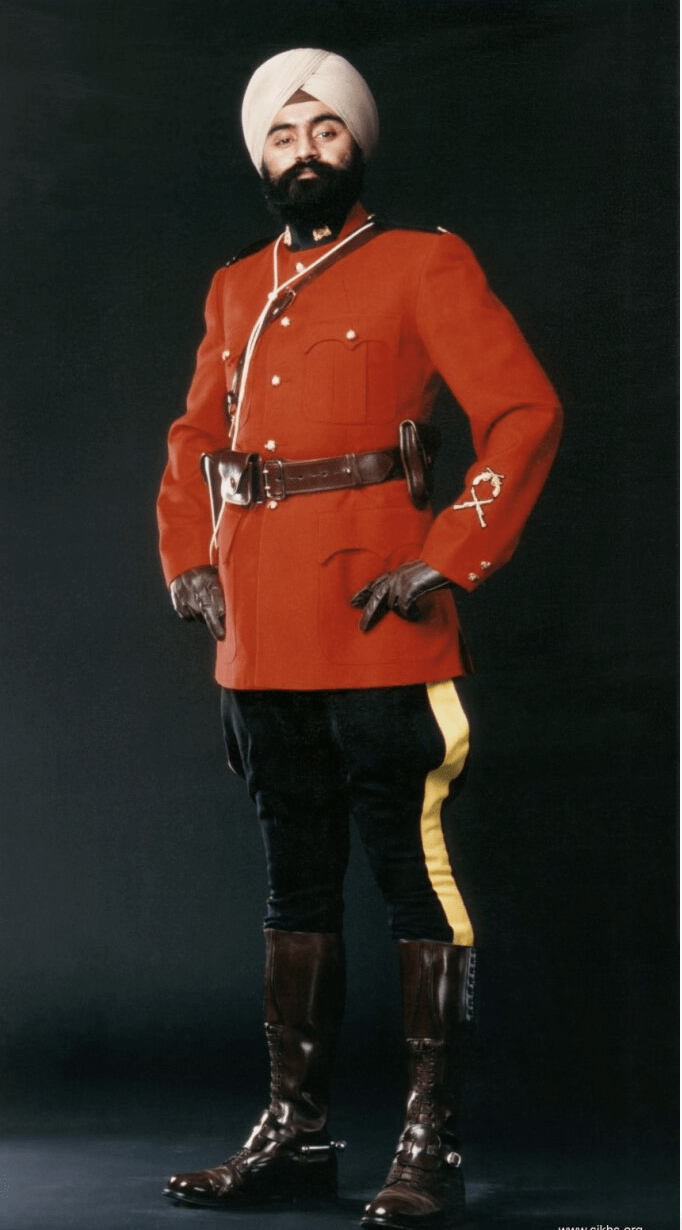
Image commissioned by Sikh community/1993
In 1990, when the federal government ultimately approved the RCMP commissioner’s recommendation to allow Sikhs to wear the turban, it was about far more than just me. It was a reaffirmation of Canada’s promise — a recognition that our institutions must adapt to difference, and that inclusion is not an exception but a principle.
That journey also taught me the difference between tolerance and inclusion.
Tolerance says, “I will put up with you.”
Inclusion says, “I see you. I value you. I welcome you.”
That shift matters. Tolerance may keep a fragile peace, but only inclusion creates belonging. And belonging is what gives Canada its strength.
The law is a powerful tool, but it is only as just as the people who wield it. Our institutions are only as resilient as their capacity to reflect and embrace the diversity of the people they serve.
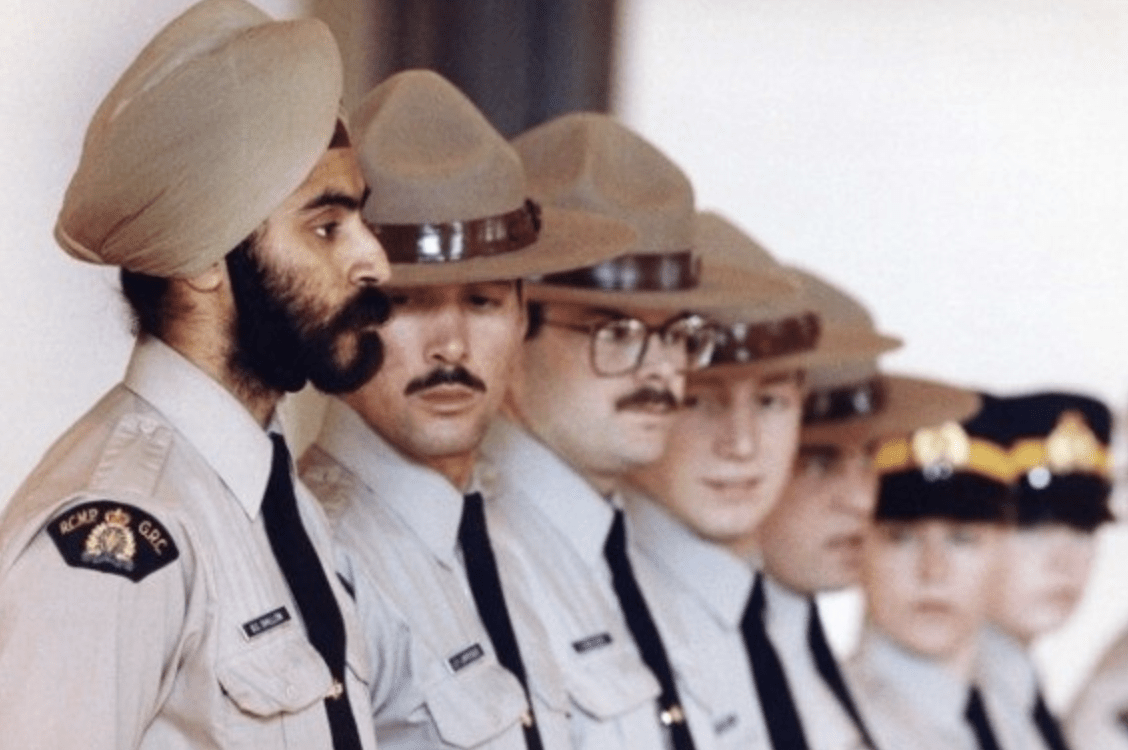
Training in Depot, Regina Saskatchewan, 1991
My years in the RCMP were filled with challenges. I had partners who did not want to back me up when serving alongside me. I had members of the public who refused to be served by me. I faced threats and hostility that tested my resilience.
But I also had colleagues who stood with me. I had communities that welcomed me. And I met young people who told me that by seeing me serve in uniform with a turban, they believed they too could embrace their identity — in all of its elements — without compromise.
That is the ripple effect of inclusion. It does not just change institutions. It changes imaginations. It expands what people believe is possible.
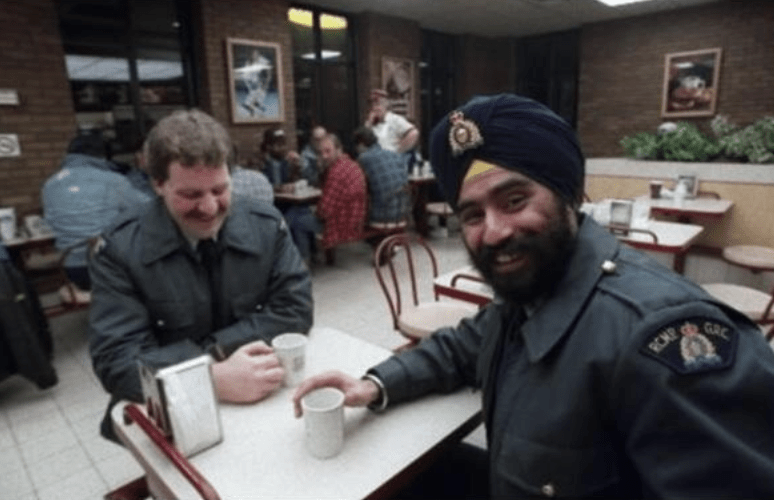
On patrol in Quesnel, B.C., with my partner Cst. Dick Langille
So, what does it mean to be Canadian?
For me, it is not about uniformity. It is about the space we make for each other. It is about turning diversity into social cohesion and ensuring that the freedoms we enjoy are always paired with fairness and responsibility.
Canada’s promise lies in the recognition that liberty is not a solitary pursuit, but a shared one, strengthened every time we accept responsibility for the wellbeing of others.
Our history is far from perfect. It has been marked by exclusion as much as inclusion, denial as much as recognition. But out of those imperfections, we have built resilience. Out of dysfunction, we have forged durability.
To be Canadian is to accept that inclusion is not charity, but necessity. It is to understand that compromise is not weakness, but the foundation of our freedom. It is to see diversity not as a problem to be solved, but as the very source of our strength.
The philosopher John Rawls once argued that the measure of a just society is whether its freedoms are structured to protect the least advantaged. Canada’s history, uneven though it has been, reflects that instinct.
We are a country defined not by perfection, but by perseverance. Not by the absence of conflict, but by the willingness to compromise. Not by the dominance of one group, but by the shared space we make for each other.
That is our legacy. That is our responsibility. And that is what makes me proud to be Canadian.
Sen. Baltej Dhillon is a retired career police officer, a community leader, and a lifelong advocate for diversity and inclusion. He was appointed to the Senate in February, 2025, and is a member of the Independent Senators Group.