Orwellian Light vs. ‘Orwellian’ Darkness: A Moral Method for Moving Forward

By Bob Rae
April 6, 2026
This Policy magazine piece is adapted from a lecture delivered at the Balsillie School of International Affairs on March 31, 2026.
This year opened with an act of imperial illegality. It heads into its second quarter bedevilled by a more reckless and consequential one. After a quarter-century of power realignment, humanity now seems hostage to the compulsions and convulsions of unchecked power.
Populism, isolationism, and demagoguery mislabelled as realism are all diverting our political discourse in ways that only compound and accelerate the damage.
In a recent speech at the Balsillie School of International Affairs, I invoked the writing of George Orwell as ineluctably relevant to this moment — more so than to any previous moment in history since he died, too young, in 1950.
That was six months after Nineteen Eighty-Four was published. Orwell was 46 years old, exhausted, his lungs ravaged by the tuberculosis he had fought for so many years. He did not live to see his book become the most important political novel of the 20th century.
Today, we are living in Orwell’s shadow, but we are also living in the light of what his great admirer George Woodcock called his “crystal spirit”, as well as the penetrating legacy of his conscience.
The rise of autocracy in our own time follows patterns Orwell would have recognized. The playbook is remarkably unchanged: First, corrupt and discredit the institutions that constrain power — the courts, the press, the electoral system, the civil service; second, replace the language of shared reality with the language of tribal loyalty — facts become “fake news,” expertise becomes “elitism,” complexity becomes conspiracy; third, concentrate authority in the executive and dismantle the accountability that liberal constitutions were designed to create.
Today, Freedom House reports that democratic freedoms have declined globally for 20 consecutive years. Over half of the world’s population now lives under authoritarian rule. These are not merely statistics. They are the conditions of life for billions of human beings who did not choose them.
Orwell also understood how autocracy becomes totalitarianism — and why that transition is so hard to reverse. Autocracy consolidates power. It suspends norms. It concentrates authority. But it is still, in a sense, a political arrangement — it can be negotiated with, survived, sometimes reversed.
Totalitarianism is something different. It does not merely dominate — it transforms. It reaches inside the mind. Hannah Arendt, in The Origins of Totalitarianism, argued that totalitarianism was not simply tyranny at scale but a historically new form of rule that attempted to remake human nature itself — to abolish the inner life, to eliminate the capacity for independent thought and spontaneous action.
Orwell showed us the endpoint. Nineteen Eighty-Four is not, at its core, a novel about surveillance or thought police or even about torture, important and horrifying as all of that is. It is a novel about the final page, when Winston Smith, his resistance broken in Room 101, genuinely and finally loves Big Brother.
There was a second and equally deep preoccupation running through everything Orwell wrote, inseparable from his passion for truth: his preoccupation with freedom.
What makes this so relevant — especially in a time when change has been overwhelmingly defined by technology that has transmuted “Orwellian” from science fiction to nonfiction — is that the early stages of this process do not look like jackboots and torture chambers.
They look like something much more familiar to us today: the exhaustion of citizens so overwhelmed by propaganda and manipulation that they stop trying to know what is true; the slow normalization of lies and the calculated weaponization of contempt for institutions — a contempt that, once seeded widely enough, becomes nihilism.
Orwell’s answer to nihilism was stubbornness. He insisted — over and over again — that two plus two equal four. That facts exist. That words matter. That calling things by their right name is a political act.
But there was a second and equally deep preoccupation running through everything Orwell wrote, inseparable from his passion for truth: his preoccupation with freedom.
Not freedom as an abstraction, but freedom as a daily, practical, embodied condition — the freedom to think for yourself, to speak what you believe, to live without the permanent surveillance of power, to have recourse against the state when the state deliberately causes you harm.
These two commitments — to truth, and to freedom — put him at odds with those in power, whether on the right or the left. This is where Orwell connects directly to the oldest and most important idea in the constitutional tradition: the rule of law.
In Nineteen Eight-Four, Winston Smith loses everything — loses truth, loses memory, loses love, loses, finally, the very capacity for resistance — because there are no institutions left to protect him. The Party has abolished the independent judiciary, the free press, the separation of powers, the rule of law. That process begins with the slow, incremental delegitimization of the institutions that stand between the individual and unchecked power.
When I look at the world’s response to such forces today, I see grounds for both encouragement and concern.
Our own prime minister, Mark Carney, has been speaking with unusual clarity. At Davos in January, Carney acknowledged openly that the story of the rules-based international order was, in his words, “partially false” — that the rules applied asymmetrically, that the strongest exempted themselves when convenient.
At the Lowy Institute in Sydney in early March, he continued in the same register, arguing that middle powers — Canada, Australia, European countries, Japan, South Korea — collectively command more economic weight than any single great power, and can therefore shape a new order if they choose to act together. The ambition, as Carney put it, is to “build something better — more prosperous, more just — than what came before.”
The argument for democratic middle-power solidarity is both true and strategically significant. The “principled and pragmatic” framework is a genuine contribution to solving the challenges of this moment.
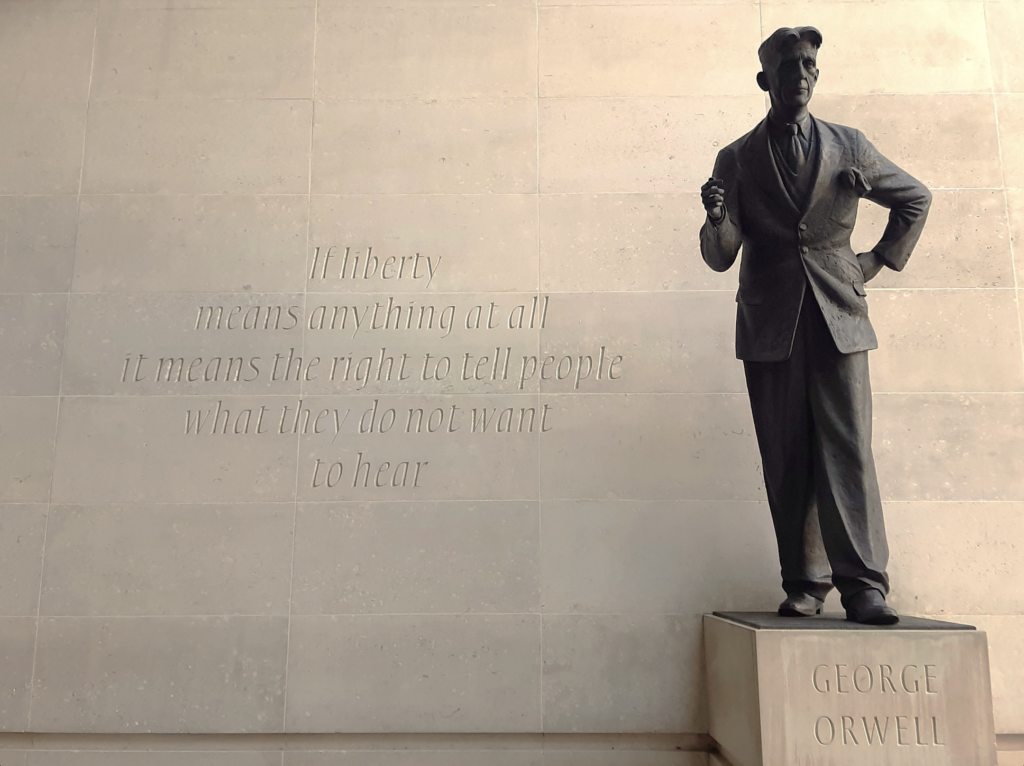 Statue of George Orwell outside BBC Broadcasting House in London/Shutterstock
But here is what I want to add — what I think is missing, and what Orwell’s shadow makes impossible to ignore.
When Prime Minister Carney acknowledged at Davos that the rules-based order was “partially false” — that the rules applied unevenly, that power shaped the terms — he was saying something that the countries of the Global South have been saying for decades. They did not need the rupture of 2025 to discover this. They have known it since Bretton Woods, before the end of the Second World War.
They have known it through every round of trade negotiations that protected subsidies in wealthy countries while demanding open markets from poor ones.
They have known it through sovereign debt crises, through the conditionalities attached to development lending, through Security Council vetoes that blocked accountability for atrocities when great-power interests were at stake.
They have known it through the slow violence of a climate crisis they did not cause and cannot escape.
So, when middle powers now invite the Global South to join a new coalition to defend and rebuild the international order, there are legitimate questions from the other side of the table: Why should we trust that this time will be different? Will our voices actually shape this new order — or are we being asked, once again, to participate in a project designed by others, on terms set by others, for purposes that serve others first?
Those questions can only be answered by doing something that the architects of the old order consistently failed to do: by listening.
Listening, in this context, is not just a polite gesture. It has a purpose.
It means taking seriously the demand for reform of the institutions — the UN Security Council, the IMF, the World Bank — that were designed in 1944 and still reflect that world’s distribution of power. It means genuine debt relief for countries whose development options are foreclosed by obligations they incurred under terms of profound asymmetry.
It means climate finance that matches the scale of the crisis, delivered without the conditionalities that have historically made development assistance more about donor priorities than recipient needs.
Orwell went to Burma and learned to see what imperial certainty had blinded him to — a legacy of violence, oppression and breathtaking resistance still playing out in the Myanmar I know so well. He went to Wigan and to Paris and learned to hear what comfortable distance had deafened him to.
Orwell’s journey — from certainty to listening, from intellectual understanding to political commitment — was not just a personal transformation. It was an intellectual and moral method. It is the method we need now.
A new international order that does not incorporate the voices of the billion people in deep poverty and the 135 million displaced by conflict and climate will not be a better order. It will be the old order with a better press office.
And here I want to be direct about something that tends to get lost in the strategic language of middle-power coalitions and trade diversification: the new order must be explicitly and unambiguously grounded in international law and universal human rights.
Orwell’s journey — from certainty to listening, from intellectual understanding to political commitment — was not just a personal transformation. It was an intellectual and moral method. It is the method we need now.
Not as aspirational decoration. Not as useful rhetoric for building coalitions. But as foundational commitments that constrain what even well-intentioned states are permitted to do in pursuit of their interests.
International law is the rule of law applied beyond borders. It is the principle that states, like individuals, are not permitted to do whatever they are powerful enough to do. It is expressed in the UN Charter’s prohibition against the use of force, in the Geneva Conventions, in the Refugee Convention, in the International Criminal Court.
The Universal Declaration of Human Rights was drafted in 1948 — the same year Orwell was finishing Nineteen Eighty-Four, writing in a bone-damp, windswept cottage on the island of Jura with his lungs failing. It was not a coincidence that both emerged at the same historical moment.
The novel and the Declaration were responses to the same catastrophe: the demonstration, in the most brutal possible terms, of what happens when human beings are stripped of their rights, their dignity, and the protection of any law beyond the will of the powerful.
Eleanor Roosevelt, René Cassin, and Canada’s John Humphrey understood that the Declaration was not a description of how states behaved but an affirmation in the wake of a war on humanity of what every human being deserves as a human being — regardless of nationality, regardless of geography, regardless of which great power happened to be ascendant.
If the new order is to be genuinely better than the one that has prevailed since then — not just more resilient for the countries building it — it must apply these commitments universally. It must apply them to allies as well as adversaries. It must apply them in Gaza and in Sudan, in Myanmar and in Ukraine, in Venezuela and Iran. It must apply them when their application is costly and inconvenient, not only when it is easy and politically useful.
The old order has been ruptured. The new order has not yet been built. And if we are serious — not just principled, but truly serious — about building something better, we need to say what “better” means.
At the very least, it means billions of people no longer invisible to the systems that govern them. It means the displaced and the dispossessed having recourse to institutions that actually function. It means the rule of law applying not just to the weak but to the strong.
It means truth being expressed and defended, even when it is inconvenient. It means courts that work, judges who cannot be bought or purged, and elections whose outcomes are both legitimate and respected. And it means sitting down with the people who have been on the receiving end of our certainties for the past two centuries and asking what they need, what they know, and what kind of world they want to build.
Orwell lived and witnessed the darkest years of the 20th century. Still he fought, and still he wrote. That legacy has never been more valuable than it is right now.
It is now our duty to do the same, stubborn work. With the same unwavering devotion to the same deeply human principles. From indifference to listening. From understanding to political action. From the darkness, through the shadows to the light.
Policy Columnist Bob Rae teaches and writes on law and public policy. He is the Visitor of Massey College, a Distinguished Fellow at the Munk School at the University of Toronto, a Senior Fellow at the Forum of Federations, and a Matthews Fellow in public policy at Queen’s University. He served as Ontario’s 21st Premier, interim leader of the Liberal Party of Canada, and Canada’s Ambassador to the United Nations.