
Our Asia Pacific Foundation of Canada Series on Chinese EV Investment
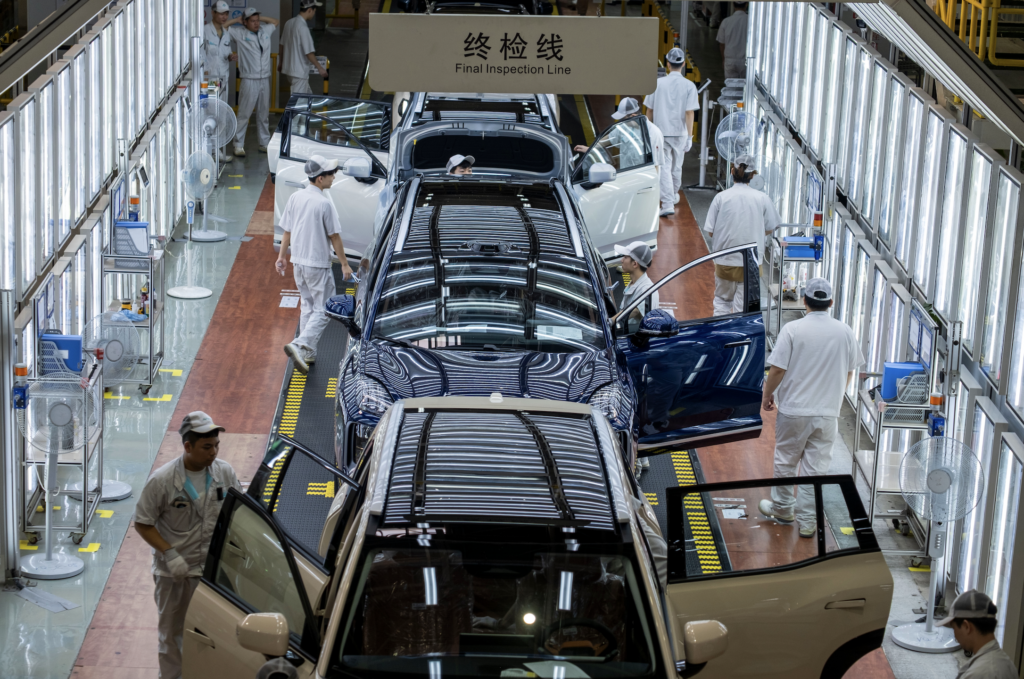

As Prime Minister Mark Carney has thawed Canada’s bilateral relationship with China within his wider policy of diplomatic and trade diversification in the face of an increasingly volatile United States, the question of Chinese electric vehicle investment in Canada has taken on new importance. The Asia Pacific Foundation of Canada’s expertise on this crucial policy issue is unparalleled in Canada, and it informs the following series, including its authoritative explainers on individual Chinese EV manufacturers. With many thanks to the APF Canada team, here’s our package on Chinese EV investment in Canada.
We open with APF Vice-President Research & Strategy and Policy Contributing Writer Vina Nadjibulla framing of the issue via her Policy piece on Canadian Industry Minister Mélanie Joly’s visit to China in June to meet with automotive manufacturers interested in producing EVs in Canada. Joly has identified four conditions for any proposed Chinese EV manufacturing venture: it must take the form of a joint venture that is majority Canadian-owned, respect Canadian labour standards, use Canadian parts and ensure that vehicle software is secure and users’ data protected. Nadjibulla proposes additional precautions. “Before negotiating with individual Chinese manufacturers,” writes Nadjibulla, “Ottawa needs to explain precisely what it is trying to achieve.” Here’s Vina Nadjibulla with Beyond Joly’s Four Conditions: Canada Needs a Strategy for Chinese EVs.
Explainers: Chinese EV Manufacturers
China’s BYD has emerged as one of the most consequential companies in the global automotive transition. Once known primarily as a battery producer, it is now the world’s largest seller of battery-electric vehicles and a major producer of plug-in hybrids, batteries, and energy-storage systems. BYD’s combination of low-cost vehicles, technological innovation, and control over much of its supply chain has helped it expand rapidly beyond China. Here are APF VP Vina Nadjibulla and Elizabeth Donkervoort, Senior Advisor, China Programs, APF Canada, with The Risks and Rewards of BYD’s EV Investment in Canada.
Chery Automobile has become one of China’s most important global automakers. Less well known in North America than BYD or Geely, Chery has nevertheless spent more than two decades building an export-oriented business across emerging and developed markets. But Chery’s business model raises questions that go well beyond market entry. Canadian policymakers must ask not only whether Chery should be permitted to invest, but what Canada wants from such an investment. Here are APF VP Vina Nadjibulla and Elizabeth Donkervoort with Chery, Chinese EVs, and the Future of Auto Investment in Canada.
Geely is a global conglomerate with a diverse portfolio — from cars to satellites — that gains entry into new markets, in particular those where Chinese companies may face resistance, by acquiring a controlling stake in recognizable brands such as Volvo. For Canada, the policy question is not whether Geely cars should be allowed in — they are — but which parts of Geely’s broader ecosystem are entering, how do they integrate with Canadian industries and infrastructure, and what are the implications for other sectors impacted by the technology and data systems controlled by Geely? Here are APF VP Vina Nadjibulla and Elizabeth Donkervoort, Senior Advisor, China Programs, APF Canada, with Explainer: Geely, Chinese EVs, and Canada’s Auto Strategy.
We will be adding pieces to this series throughout 2026.
The Asia Pacific Foundation of Canada is Canada’s only national public-purpose institution dedicated exclusively to Canada-Asia engagement.
Policy magazine serves as an independent, nonpartisan platform for insight and analysis on Canadian, U.S. and international politics and public policy, written by policy and political professionals.