
Policy Alternatives for Solving the Grocery Problem
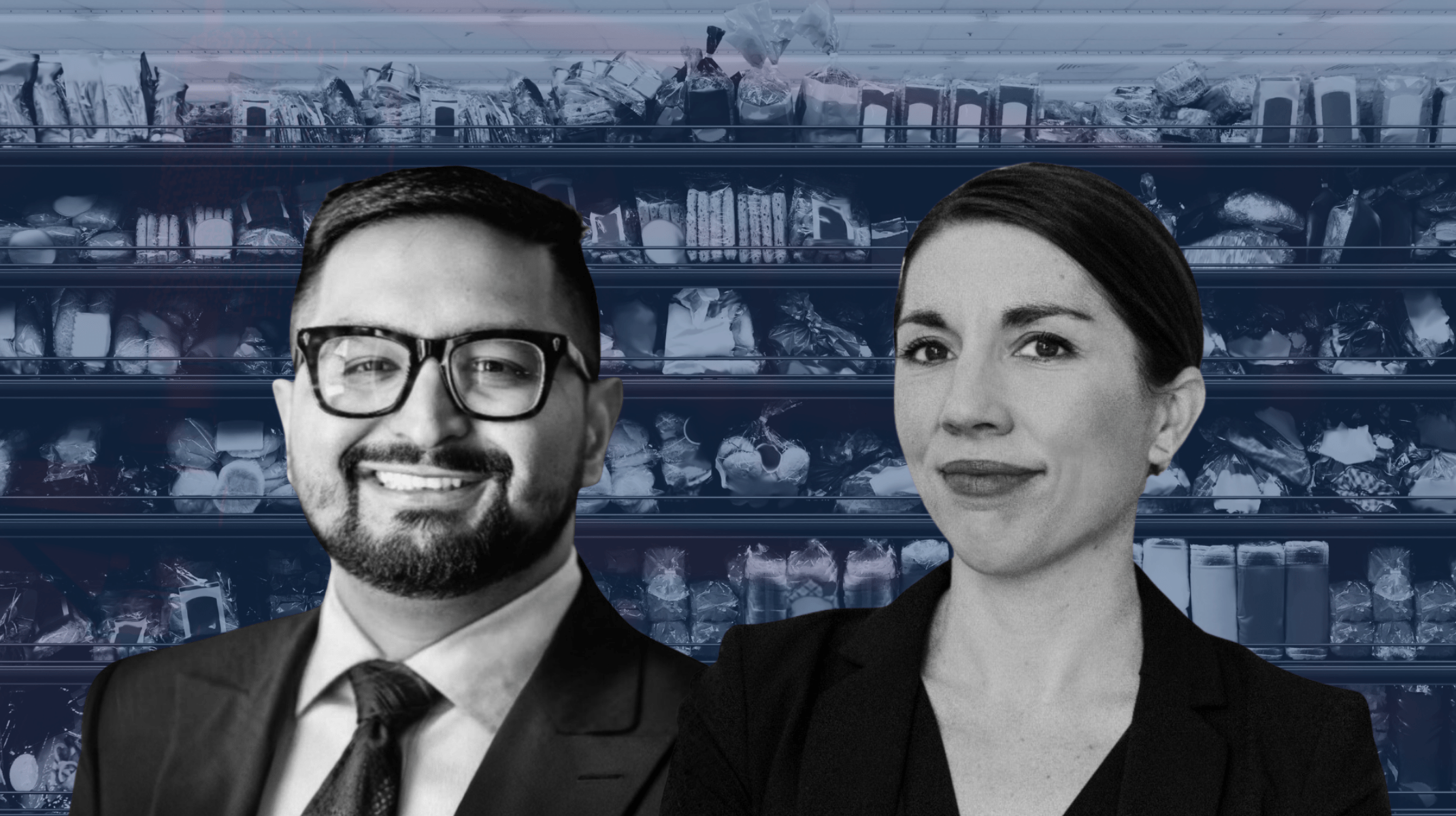 Policy Columnist Anil Wasif and grocery guru Alexina Cather
By Anil Wasif
February 5, 2026
This January, I cooked at home and made my own coffee. My food budget didn’t care.
Coffee is up 30.8% year-over-year. Beef is up 16.8%. The average family is paying $1,600 more a year on groceries than they were before the pandemic. Canada now outpaces the US on food inflation, and five chains still control 79% of the market. The Grocery Code of Conduct that took effect January 1 won’t change that. It governs how retailers treat suppliers, not how they price milk.
With inflation and the cost of living topping Canadians’ concerns by a wide margin in the latest Angus Reid poll and the Carney government exploring solutions, including the new Canada Groceries and Essentials Benefit, it makes sense to seek out what’s working and what isn’t in other jurisdictions.
Alexina Cather served as co-chair of former New York City Mayor Eric Adams’ food policy transition team and spent six years as deputy director at the Hunter College NYC Food Policy Center. Cather — who, as an economic policy expert, I think of as a grocery guru — now directs policy at Wellness in the Schools and serves as deputy chair and chief policy advisor at the Center for Food as Medicine.
When New York Mayor Zohran Mamdani announced his plan for five city-run grocery stores, Cather was among the first to point out it wouldn’t be enough; positing that you’d need something like 20 to move prices.
You need both, but for different reasons.
Prime Minister Carney’s Canada Groceries and Essentials Benefit boosts GST credits to put money in pockets. It is a demand-side play: help people afford groceries without touching the grocery system itself.
NDP leadership front-runner Avi Lewis has made publicly owned supermarkets a centrepiece of his campaign, citing Mexico’s state-owned grocery chain and US military commissaries as models, and proposing federal investment in regional food hubs and local procurement.
The Canadian Centre for Policy Alternatives makes the same case, noting that provinces rolled out cannabis retail with remarkable speed. If we can do it for weed, why not for food?
“Cash in people’s pockets is essential right now,” Cather says. “Rebates provide immediate relief and can prevent hunger today. But they do nothing to shift the underlying structural issues that keep food expensive.” Public infrastructure, by contrast, “can intervene in the market itself, providing competitive pressure and guaranteed access where private grocers choose not to operate.”
The politics and economics of the issue call for a complementary strategy. Focusing only on rebates treats affordability as a short-term cash problem. Focusing only on stores ignores urgent household needs.
But here’s where the Canadian debate gets uncomfortable. Mamdani’s plan calls for five stores. Cather says that’s below every relevant threshold: purchasing power, distribution efficiency, population reach. “Public grocery stores already exist and work, but only where they are large enough to function like real infrastructure.”
Twenty stores is the minimum to negotiate wholesale terms, justify shared logistics, and operate with consistent pricing across neighborhoods. Anything smaller may help customers who walk through the door, but it won’t influence citywide prices.
The distinction that matters is symbolic versus systemic. “The line is crossed when a public option stops behaving like a pilot and starts behaving like a network.”
Prime Minister Mark Carney announcing Canada’s Groceries and Essentials Benefit on January 26, 2026
For Canada, the threshold is higher, as market concentration is national, yet distribution is regional and affordability pressures vary between provinces. “That means dozens of stores at a minimum, coordinated through provincial and national procurement systems with shared wholesale access and distribution hubs. Without that backbone, public grocery risks being politically visible but economically marginal. Proof of concept rather than proof of impact.”
New York already offers a case study. The city operates six public markets through its Economic Development Corporation, including Essex Market and Arthur Avenue. Most New Yorkers don’t know they exist. “Existing public markets demonstrate that civic retail can succeed at access and neighborhood vitality,” Cather said. “But they have not driven down prices broadly because they weren’t designed with rigorous price-mandate infrastructure or scale.”
The lesson for Canada: without intentional infrastructure like shared warehousing, strategic site selection, and integrated logistics, you’re just leasing space and opening doors. “Without those investments, well-meaning public stores can become boutique alternatives instead of affordability levers.”
Scale isn’t about ambition. It’s about whether the math actually works.
And on scale, Canada’s cannabis precedent does not hold, either. Provinces proved they could build retail fast after legalization. But grocery stores are harder. “Cannabis stores don’t deal with thousands of SKUs, spoilage, cold chains, or margins that hover at 1 to 3%. Grocery depends on wholesale access, logistics, and labor. If you can’t aggregate purchasing, invest in distribution hubs, and staff stores sustainably, prices won’t move.”
Mike von Massow, a food economist at the University of Guelph, puts it bluntly: “Large grocery stores are very much like an iceberg. The retail portion is what we see above the water, and it’s that huge infrastructure underneath that really differentiates those big stores”. Food co-operatives have existed in Canada for decades and still held only 4% of the market as of 2020. In Kansas City, a publicly supported nonprofit supermarket recently closed. The pattern is clear: without scale, pilots fail.
Cather has seen this pattern before. She recently critiqued the federal approach of telling Americans to eat less ultra-processed food without defining what that means or ensuring access to alternatives. “We issue strong directives without building the infrastructure that makes compliance realistic. It’s an unfunded mandate disguised as guidance.”
The same risk applies to public grocery. “If governments want public stores to improve affordability, they have to fund the boring, expensive parts: procurement, distribution, workforce, data systems. Otherwise, we’re not setting these interventions up for impact.”
Where does this leave Canada?
Rebates tend to arrive before elections and disappear after them. Public stores make good announcements but rarely survive the math—and Lewis himself admits he doesn’t have “the team and the infrastructure to present you with the 150-page white paper”.
Grocers continue to report that their margins haven’t budged much in years, and the infrastructure that keeps prices high is upstream from the checkout counter. And even the architects of the Grocery Code of Conduct admit it was designed to monitor firm behaviour not address food prices.
If Canada wants a supply-side intervention that actually moves prices, it would need something far larger than what anyone is proposing. Not a pilot; a network. Dozens of stores, provincial coordination, shared procurement, distribution infrastructure.
Is Canada willing to fund the boring, expensive parts? Or will we settle for announcements that are politically visible but economically marginal? That’s the math political staffers should zero in on.
Policy Columnist Anil Wasif is a public servant in the Ontario government. He serves on the University of Toronto’s Governing Council and the Advisory Board of McGill’s Max Bell School. Internationally, he serves on the OECD’s Infrastructure Delivery Committee. He co-owns and manages the global nonprofit BacharLorai. The views expressed are his own.