
Procedural Meets Policy: The New Steve Burrows ‘Birder Murder’ Mystery
By Steve Burrows
Dundurn Press, September 2026
Reviewed by Maureen Boyd
October 3, 2026
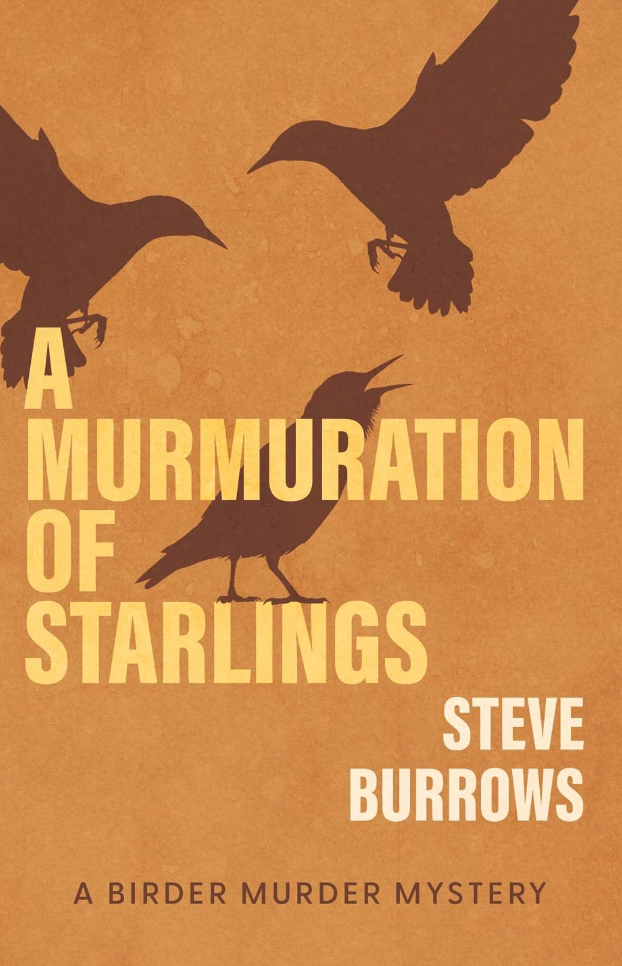
A Murmuration of Starlings, the 10th in Canadian writer Steve Burrows’s Birder Murder Mystery series, uses murder once again to explore environmental conflict — conservation, habitat loss, land use and competing interests.
This time, Burrows also takes on Indigenous perspectives and the legacy of colonialism while his characters investigate two gruesome murders.
Burrows, who lives in Oshawa, has serious credentials in the birding world. A Fellow of the Royal Canadian Geographical Society, he is a former editor of the Hong Kong Bird Watching Society magazine and has written extensively on travel and environmental issues.
He was also named a Nature Writer of the Year by BBC Wildlife. His books have cornered a niche in the “cozy mystery” procedural sub-genre by appealing to readers beyond the birder world.
In Murmuration, Burrows takes us to Western Australia, where DCI Domenic Jejeune (presumed to be an ironic twist on “jejune”, meaning simplistic or naïve, the opposite Jejeune’s dominant traits) — the outsider Canadian detective who is considering whether to leave the Norfolk police — becomes involved in the unofficial investigation of the brutal murder of an Indigenous man.
Along the way, we learn about emus, the consequences of introducing European starlings to Australia, Noongar culture and Australia’s colonial past.
At the same time, back in Norfolk, the dependable Sergeant Danny Maik is investigating another murder, this one involving the head of a lithium-battery company with links to an Australian mining operation. Jejeune’s partner, Lindy Hey, plays a central role in both investigations.
The dual Norfolk–Western Australia setting is the latest expansion of a series that began among the salt marshes and bird reserves of Norfolk.
Burrows has since taken his characters to western Scotland in A Cast of Falcons, Colombia in A Shimmer of Hummingbirds, Canada’s Wood Buffalo National Park in A Dance of Cranes, Antarctica in A Foreboding of Petrels and Singapore in A Nye of Pheasants.
As the series has widened geographically, so have its policy themes. Burrows has written about climate science, conservation, international policing, diplomacy and environmental conflicts across several continents. But the issues rarely overwhelm the mysteries.
His first Domenic Jejeune novel, A Siege of Bitterns, won the 2015 Arthur Ellis Award for Best First Novel and was selected one of The Globe and Mail’s top 100 books of 2014. According to Burrows’ website, the Sunday Times Crime Club declared at the time: “A new genre is born: the ‘birder murder’.”
As the series has widened geographically, so have its policy themes. Burrows has written about climate science, conservation, international policing, diplomacy and environmental conflicts across several continents.
Ten books later, the label has stuck. Jejeune remains an outsider in a quintessentially British institution: annoyingly intelligent, intensely observant, emotionally distant, uninterested in conforming and — to some of his superiors — difficult.
To say Jejeune is interested in birding is an understatement. Observation, habitat, migration, rarity and identification also inform how he thinks about evidence and people. Birds are important in all the books; in some they are integral to solving the mystery.
That is why the birding has never seemed like a gimmick pasted onto a conventional mystery. It reflects Jejeune himself: obsessive attention, patience, knowledge, pattern recognition and an ability to notice an anomaly in a crowded landscape.
And because birds have habitats, migration routes and vulnerabilities, they lead Burrows naturally into questions about conservation, development and the environment.
Jejeune has also evolved over the series. Birding remains central, but the books have become a mixture of police procedural, character study and environmental mystery, increasingly concerned with the consequences of decisions that cross borders.
A Murmuration of Starlings does, however, ask a lot of the first-time reader. Much of the tension depends on relationships and events carried forward from earlier books, particularly those involving Jejeune, his superiors, Maik and Hey, as well as the reappearance of a figure from an earlier book. This is definitely not the book with which to begin the series.
For those who have followed Jejeune from Norfolk to his tenth investigation, however, A Murmuration of Starlings shows how far Burrows has taken what once sounded like an improbable premise: a Canadian detective who would often rather be watching birds than solving murders.
There is more to come. An eleventh birder murder mystery, A Palette of Turacos, is due in 2027, with a twelfth also planned. A development option has also been renewed by Shaftesbury Films, the Canadian producer of Murdoch Mysteries, and Britain’s Company Pictures.
Screenwriter Nick Hicks-Beach, whose credits include Lewis, Midsomer Murders and DCI Banks, is attached to the project.
From an unlikely gimmick elevated by good writing and engrossing characters, Burrows’s “birder murders” have proved to be a genre with staying power.
Policy Contributing Writer Maureen Boyd is chair emerita of the Parliamentary Centre, a nonprofit organization that has worked for the past half-century in more than 70 countries supporting legislatures to better serve their citizens.