
‘Reclaiming Canadian Sovereignty’: A Canada Capable of Choosing
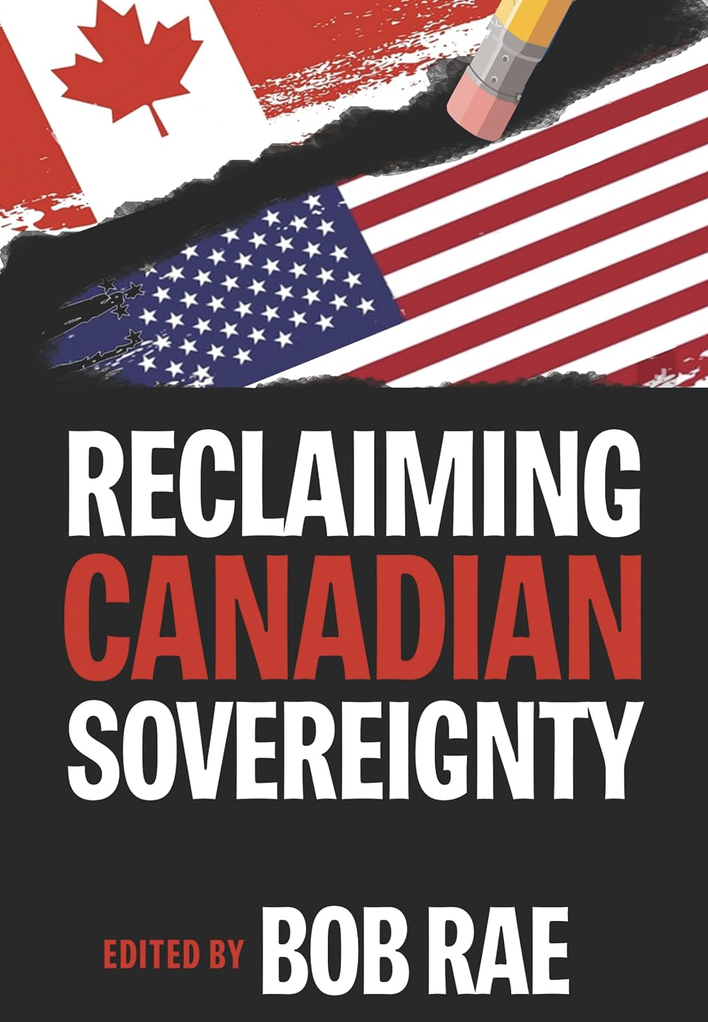
Reclaiming Canadian Sovereignty in a Ruptured World
Edited by Bob Rae
James Lorimer & Company Ltd., September 9, 2026/376 pages
Reviewed by Rupak Chattopadhyay
September 3, 2026
Let me begin with a disclosure. I have known Bob Rae for almost a quarter century — as a boss, a mentor, and a friend.
I first encountered Bob as a mediator grappling with a long-running ethnic conflict half a world away. Over time, I came to know him as a thinker, an interlocutor, and someone instinctively suspicious of conventional answers to difficult policy questions. That backstory inevitably shapes how I read this book. I have watched some of these ideas take form over the years, and I know something of the temperament behind them.
Reclaiming Canadian Sovereignty in a Ruptured World — a compilation of essays by prominent Canadians from Margaret Atwood to Michael Kovrig to Lloyd Axworthy edited and introduced by Bob Rae — arrives at a moment when many long-held Canadian assumptions no longer feel secure. Donald Trump’s return to the White House, his disregard for Canada’s independence, his use of tariffs as pressure, and his transactional view of alliances have forced Canadians to revisit something many had come to take for granted: that the relationship with the United States would remain, if not always easy, then at least basically benign.
Trump, though, is not really the subject of this book. He is the principal accelerant to the conditions it laments.
The deeper question is how a country living beside a much larger power preserves enough room to make meaningful choices of its own. In Rae’s framing, sovereignty is not exhausted by borders or legal independence. It also means the ability to absorb pressure, defend interests, and act when those interests diverge from the interests of a stronger neighbour.
A Bigger Idea of Sovereignty
One of the book’s strengths is that it treats sovereignty as something broader than territorial control. Rae reminds the reader that Canadian sovereignty has always existed in the shadow of American power. What has changed is not geography, but confidence. For much of my adult life, it was easy to assume that Canadian interests and cooperation with Washington were broadly aligned. The United States was our largest trading partner, closest ally, and principal security partner. Few Canadians seriously imagined that the relationship itself might be used coercively. That assumption is now much harder to sustain.
The book widens the discussion accordingly. Sovereignty here includes territorial security, democratic institutions, Indigenous rights, economic strength, technological capacity, and Canada’s ability to act abroad with some seriousness. Chief Allan Adam’s contribution on Treaty 8 is especially important in this respect. It is a reminder that Canadian sovereignty cannot simply be asserted as a flat and uncontested claim over territory. Indigenous political orders predate the Canadian state and remain part of the country’s constitutional reality.
Canada, in other words, has never exercised sovereignty in isolation. It does so through a web of relationships — with the United States, with Europe, with Indigenous nations, and with international institutions. The real question is how much freedom of action those relationships leave when interests begin to diverge.
The Economic Problem
Canada’s dependence on the United States is not a policy mistake. It is the product of geography, scale, and decades of successful integration. American markets are large, close, and deeply embedded in Canadian supply chains and investment patterns. The problem begins when interdependence turns into leverage.
Several contributors to this book — including Arthur Lam, Vass Bednar, Armine Yalnizyan, and Jim Stanford — approach this from different directions, but they converge on a similar point: Canada needs more productive depth at home and a wider range of economic relationships abroad.
That does not mean trying to make everything in Canada. But some sectors are plainly not like others. Critical minerals, energy infrastructure, defence production, telecommunications, and advanced technology carry strategic weight that market logic alone does not fully capture. In these areas, disruption is not just inefficient, it is dangerous. And as I have heard repeatedly from stakeholders, even with new trade agreements in place, shifting Canadian business away from the United States is far easier said than done.
For a long time, Canadian policy put efficiency first and treated resilience as a secondary concern, in part because the United States was seen as a dependable partner rather than a source of pressure or disruption. That comfort is now harder to justify. Markets matter, but they do not price every strategic risk. This is what makes industrial policy so difficult. It is easy enough to compile a list of sectors that sound important. It is much harder to decide which ones merit public support, how much support is warranted, and when the state should stop intervening. To its credit, Reclaiming Canadian Sovereignty does not pretend those choices are simple.
Colin Robertson’s Global Exchange interview with Bob Rae about ‘Reclaiming Canadian Sovereignty’/CGAI
The Limits of Middle-Power Ambition
The foreign policy and defence essays raise a related point. Canada’s middle-power identity has always relied on more than good intentions. Peacekeeping, multilateralism, development assistance, human rights, and institution-building are all part of the Canadian tradition. But none of them substitute for actual capability.
Canada is not going to escape the gravitational pull of the United States. NORAD, intelligence cooperation, continental defence, and trade make that impossible. The realistic goal is not escape, but more room to manoeuvre within the relationship.
That requires credible assets. Canada does not need to become a military great power, but it does need stronger defence capabilities, especially in the Arctic, and the infrastructure to sustain them. Nor can Canada expect influence abroad simply because its diplomats are talented and its reputation positive. Influence depends on what a country can actually bring to the table. Canada has a good deal to work with: energy, critical minerals, agriculture, geography, access to two oceans, strong universities, a sophisticated financial sector, and a population with deep global ties.
What has often been missing is not raw potential, but a clearer sense of how those advantages fit together. Rae’s point is not that Canada can free itself from dependence on the United States. It is that dependence is less risky when Canada knows what it has, what it needs, and what it can credibly contribute.
The Canada Within Canada
Canada’s sovereignty debate becomes less useful when it is reduced to a choice between national unity and regional grievance. Reclaiming Canadian Sovereignty is right to worry about separatist rhetoric, particularly in Alberta. But any serious discussion of sovereignty also has to admit that many Canadians experience Ottawa not as a guarantor of agency, but as a constraint on it. Taking that seriously does not mean endorsing separatism. It means asking whether Canadian strength comes from a stronger centre, or from a federation that works better.
Canada’s strengths are too dispersed, and too varied, for easy centralizing answers. Alberta has energy. Quebec has a distinct cultural and diplomatic capacity. Ontario remains the industrial and financial core. British Columbia gives the country a Pacific orientation. Atlantic Canada matters strategically. Indigenous governments are exercising increasing authority over territory, governance, and development. Canada does not need less diversity to become stronger. It needs institutions that can make use of it.
That is where this collection is most convincing. It is strongest when it ties sovereignty to economic resilience, institutional competence, and the actual workings of the state. As with any edited volume, some chapters are better at diagnosis than prescription. But that is not really a flaw. The choices are difficult, and any serious argument about sovereignty has to end not in sentiment, but in decisions about what Canada is prepared to build, protect, and pay for.
Resilience Without Isolation
Canada’s postwar model served it well. It rested on trade openness, close integration with the United States, modest defence spending, confidence in multilateral institutions, and an international order stable enough to make difficult choices easy to defer. That world is less dependable than it was.
What makes this book timely, in my view, is its refusal to mistake sovereignty for withdrawal. Canada cannot escape geography, and its prosperity will continue to depend on openness, its security on alliances, and its influence on cooperation. But those strengths become liabilities if they are not backed by enough strength at home. The point is not to retreat from openness. It is to ensure that Canada is not left exposed when circumstances shift or when a decision made elsewhere sharply narrows its room for action.
The same logic applies in defence. Canada should focus on the capabilities that matter most to its own security and bargaining position: Arctic surveillance, maritime capacity, intelligence, cyberdefence, ammunition production, infrastructure, and force sustainment. The United States will remain indispensable. But Canada also needs deeper ties with Europe, the Indo-Pacific, and other middle powers.
There is something recognizably Bob Rae in that sensibility. It resists false choices. Among the book’s strengths is its willingness to hold together ideas too often presented as opposites: alliance and autonomy, cooperation and interest, federalism and effectiveness.
That, finally, is what the book gets right. Reclaiming sovereignty is not about pretending Canada can stand apart from the world. It is about making sure that when the world changes, Canada still has choices.
Rupak Chattopadhyay is President and CEO of the Forum of Federations in Ottawa.