
‘Regime Change’ and ‘Betrayed’: A Comprehensive Damage Report on Trump II
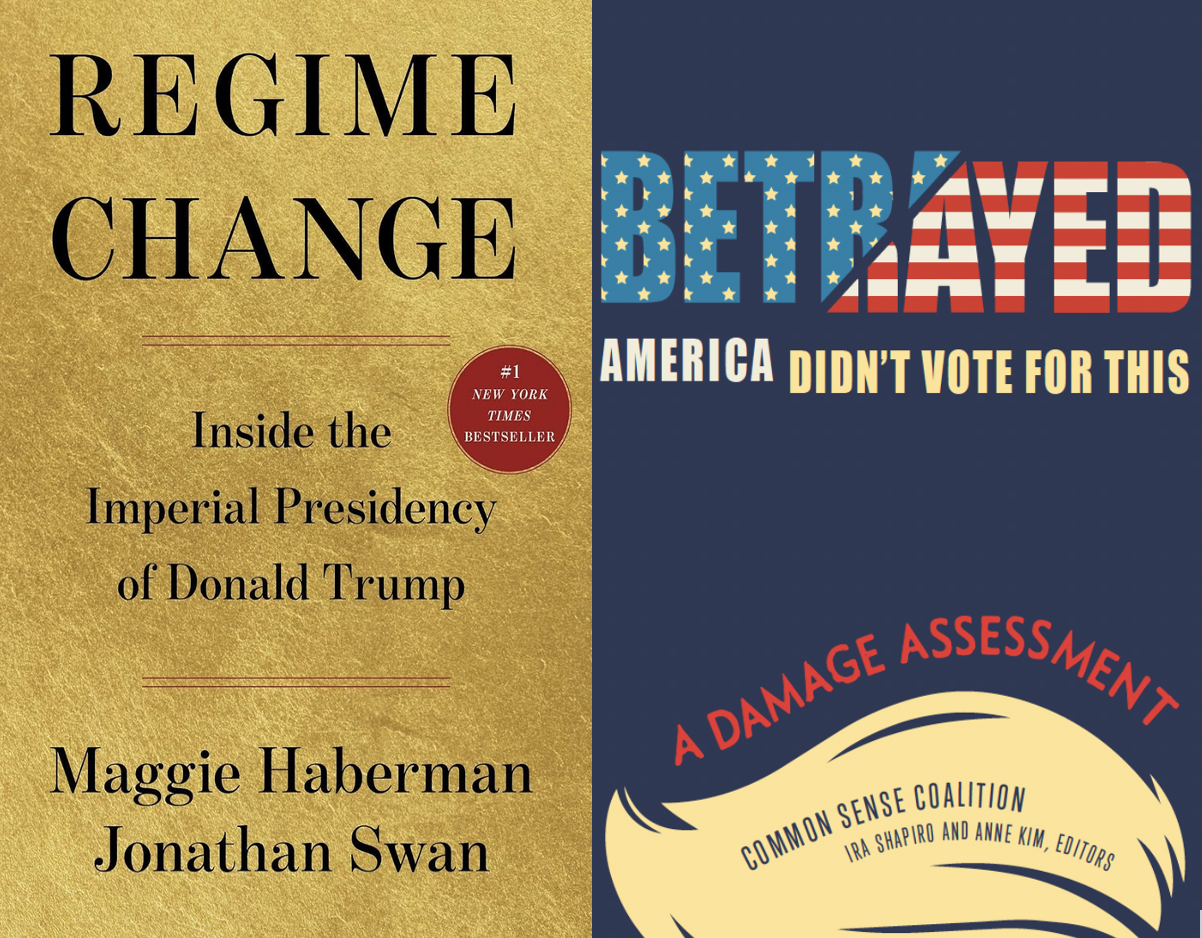
Regime Change: Inside the Imperial Presidency of Donald Trump
By Maggie Haberman and Jonathan Swan
Simon & Schuster, June 2026/496 pages
and
Betrayed: America Didn’t Vote for This
Edited by Ira Shapiro and Anne Kim
The Common Sense Coalition, May, 2026/176 pages
Reviewed by Colin Robertson
July 27, 2026
Few presidencies have generated as much immediate historical interpretation as Donald Trump’s second term. Among the growing literature, two books stand out for their complementary strengths.
Maggie Haberman and Jonathan Swan’s Regime Change: Inside the Imperial Presidency of Donald Trump, offers an extraordinary inside account of how power is exercised inside Trump’s White House.
Betrayed: America Didn’t Vote for This, edited by Ira Shapiro and Anne Kim on behalf of the Common Sense Coalition — a Washington-based bipartisan and nonpartisan group of senior policy experts, former government officials, former military officers, academics, and scholars — explores a different but equally important question: what has Trump done with that power?
The two books approach Trump 2.0 from opposite directions. Haberman and Swan reconstruct the mechanics of executive authority: who makes decisions, how the White House functions, why institutional constraints have weakened, and how Trump returned to office determined to never again be restrained by advisers, Cabinet secretaries, or senior military officers.
Betrayed, by contrast, is a collection of essays by policy experts arguing that Trump’s second presidency has betrayed constitutional government, America’s alliances, fiscal responsibility, national security and the country’s post-war leadership role.
Read together, they provide perhaps the most comprehensive account yet published of Trump’s second presidency. Regime Change explains how Trump governs. Betrayed explains what that style of governing has wrought.
Together they suggest that Trump has not rewritten the Constitution so much as exposed how dependent it has always been upon institutional restraint, constitutional norms and civic virtue.
Read alongside Alexis de Tocqueville’s Democracy in America, Arthur Schlesinger Jr.’s The Imperial Presidency, Yuval Levin’s American Covenant, Steven Levitsky and Daniel Ziblatt’s How Democracies Die, and David Frum’s Trumpocracy, both books point toward the same conclusion: America’s constitutional architecture remains remarkably durable, but the habits that sustained it have become increasingly fragile.
Haberman’s earlier book, Confidence Man, explained Trump largely through biography. Regime Change explains him through power. The outsider who often appeared frustrated during his first administration has become an incumbent who understands precisely where authority resides and how institutional resistance can be minimized.
Regime Changeexplains who was present, how decisions were made and why the second Trump administration operates so differently from the first. That transformation is memorably captured when Trump tells the two New York Times reporters he wants “to be the Napoleon of this period”. He told them he was more powerful than Alexander the Great, Napoleon, Stalin, Mao or Hitler.
Haberman and Swan are especially persuasive in showing that presidential influence now extends well beyond the formal machinery of government. Universities, law firms, media organizations, museums, technology companies and major corporations increasingly calculate how presidential retaliation might affect them.
The result, they argue, is a “chilling effect” in which institutions begin asking themselves not whether they are right, but whether speaking out is worth the risk. Power increasingly operates through anticipation and self-censorship rather than coercion.
Colin Robertson’s interview with co-editor Ira Shapiro and contributor David Weiss about ‘Betrayed’/CGAI
In Betrayed, the Common Sense Coalition, whose name is a tribute to Thomas Paine, performs a different task. Its contributors — including Policy Contributing Writer and Scowcroft Group Principal Kevin Nealer —decry that the concentration and abuse of executive authority has produced constitutional, ethical and strategic failures extending from the rule of law to public administration, scientific institutions, intelligence agencies, and America’s alliances.
Across chapters dealing with higher education, the civil service, immigration, science and democratic accountability, its contributors argue that independent institutions increasingly adapt themselves to political pressure instead of acting as constitutional counterweights.
Their concern is not primarily partisan. It is institutional. Democracies ultimately depend not only upon elections and courts but upon a dense network of independent institutions willing to exercise judgment without fear or favour.
Haberman and Swan describe a White House in which major decisions on Ukraine, Iran, NATO, intelligence and diplomacy increasingly emerge from an extraordinarily small circle surrounding Trump. Cabinet deliberation narrows, congressional oversight weakens and traditional policy processes give way to leader-centred decision-making.
Betrayed demonstrates why this matters strategically. Its contributors argue that alliances have become more transactional, professional diplomacy less influential, intelligence assessments increasingly politicized and America’s reputation for reliability more uncertain. Support for NATO, deterrence of Russia and China, and sustained American engagement abroad are presented not as partisan preferences but as enduring national interests that have served administrations of both parties since 1945.
In this sense, Betrayed provides the policy case studies that reinforce Regime Change’s broader institutional thesis. The weakening of constitutional guardrails does not simply alter domestic governance; it changes the conduct of American domestic and foreign policy itself.
For Canadian readers, this is the most significant shared conclusion of the two books.
Canada’s security and prosperity have long rested upon assumptions about the continuity and predictability of American leadership. Read together, Regime Change and Betrayed suggest those assumptions require reconsideration.
Ottawa must increasingly distinguish between enduring American interests and the policies of particular administrations.
That reinforces the strategic logic behind strengthening continental defence while simultaneously diversifying trade, investing in Arctic security, deepening partnerships with Europe and the Indo-Pacific, and treating Mexico as a genuine strategic partner within North America.
Neither book argues that American democracy has already failed. Elections continue. Courts still function. Congress remains powerful in theory, and federalism endures.
Their common argument is more subtle and therefore more persuasive. Trump’s greatest constitutional achievement has not been to rewrite the Constitution but to expose how much it depends upon restraint, institutional loyalty, prudence and civic character.
Tocqueville understood that constitutional liberty ultimately rests not only on laws but on habits. Haberman and Swan and the contributors to Betrayed report that those habits have weakened.
These books are about Trump 2.0. They are also studies of the resilience—and vulnerability—of constitutional democracy itself.
Haberman and Swan explain how executive power has become increasingly personalized. The Common Sense Coalition demonstrates why that transformation matters for governance, national security and America’s role in the world.
Their lesson for Canadians and fellow democracies is that in an era of a more personalized and less predictable American presidency, prudence, institutional resilience and strategic realism are no longer optional virtues: they are becoming the essential foundations of democratic statecraft.
Contributing Writer Colin Robertson,C.M., C.D, a former career diplomat, is a fellow and host of the Global Exchange podcast with the Canadian Global Affairs Institute in Ottawa.