
Russia has Failed to Dominate Ukraine. That Fact Should Frame Negotiations.
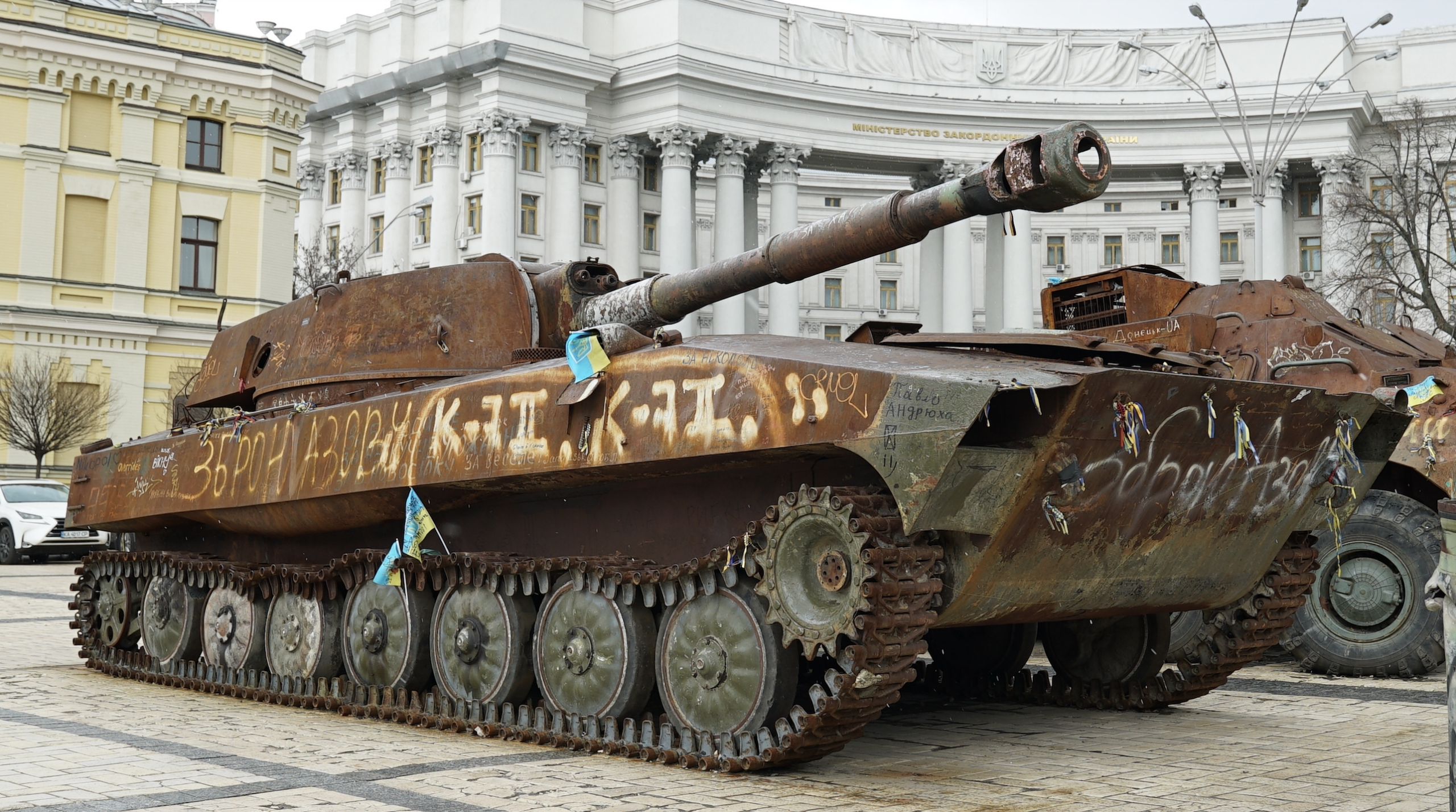 A Russian tank destroyed by the Ukrainian Army displayed in Mykhailivska Square, Kyiv/Shutterstock
By Anastasia Leshchyshyn and Maria Popova
December 16, 2025
Something interesting happened this week in the battle between propaganda and reality that defines public perception of Russia’s war on Ukraine.
Back in November, Russia announced it had captured the town of Kupiansk in its ongoing invasion of Ukraine. Ukraine disputed the news, but much of Western media coverage of the story painted a picture of Russian troops inexorably “pushing forward” in Ukraine, while barrages of drones and missiles battered Ukrainian civilians.
On Friday, President Zelensky live streamed himself in Kupiansk, the same city Russia claimed to have captured, demonstrating yet again not only his own personal bravery, but also the resilience and success of Ukraine’s armed forces.
The episode of Kupiansk illustrates more than the vicissitudes of the war of attrition that the Russo-Ukrainian conflict has become. It notably underscores an imbalance inherent to the Western media’s accounting – Russians push forward, Ukrainians take shelter – one that serves a narrative of the futility of Ukraine’s resistance and the prudence of negotiation.
An equally accurate – and arguably more illuminating – narrative that bears repetition in media reporting is that Russia continues to fail in its efforts to conquer Ukraine. How might repeated emphasis on Russia’s failed offensive – rather than an almost exclusive focus on Ukraine’s strained defence – change our assessments of the war?
If, for four years, Canadians woke up daily to the news that Russia continues to fail in achieving its objectives in Ukraine, more of us might view Russia’s war effort as futile. If we regularly heard about the thousands of Russian soldiers killed as they “push forward” Putin’s imperial fantasies, more of us would reflect on the high cost of each inch gained. More of us would see the aggressor’s willingness to pay it as desperation rather than a sign of Russia’s inevitable success.
If we focus on Russia’s continued failure, we might reassess our restraint in supporting Ukraine and provide it with the weapons and resources it needs to repel Russian troops from its territory while quelling Russian imperialism.
If we focus on Russia’s failure, the Russian-penned settlement effectively demanding Ukraine’s capitulation, which the Trump administration has been pushing for weeks, would not have been taken seriously as “peace talks,” but would have been recognized as Russia’s misleading attempt to ask for way more than battlefield realities imply.
Let’s be clear: despite Putin’s constant bravado, the reality on the battlefield is that Russia tried but failed to take Kyiv in 2022, Russia has been trying but failing to conquer Donbas since 2014, Russia tried but failed to cut off Ukraine from the Black Sea in 2022. Russia has failed to achieve any of the goals it set out for itself even though Ukraine is fighting alone and Russia has gotten North Korean troops to help in its invasion since 2024.
Why does Russia appear so strong in the Western imagination?
The myth of Russia’s power is partly a Cold War legacy. The obstinate narrative is that Russia is a superpower comparable to the US. The only war it could lose is against the US, and there is no way mighty Russia would lose to a smaller neighbour such as Ukraine. This idea also leads to framings that Ukraine is merely a US proxy, rather than a sovereign entity with agency of its own, and with a population whose willfulness to live in freedom and dignity fuels their resistance and induces Russia’s failures.
Also bolstering the myth of Russia’s winning credentials are the Kremlin’s triumphalist narratives of the Russian victory in the Second World War. In Russia, these narratives appeal to and perpetually invigorate a Russian audience haunted by the horrors of the conflict with Nazi Germany, disillusioned by hardships in post-Soviet Russia, and nostalgic for the professed stability of life in the Soviet Union.
Since 2000, Putin’s regime has built a cult to the USSR’s WWII victory, and one of the rare moments Putin became impatient and testy with Trump, was when the American president emphasized US contributions to the Allies’ defeat of Nazi Germany. Trump quickly corrected course, and proceeded to express his admiration for Soviet military prowess and invincibility, and to draw inspiration from Russia’s annual Victory Day Parade to host a lackluster and corporate-sponsored display of US military hardware on the streets of Washington.
In fact, any historian will remind you that Russia has been defeated many times before, from the Crimean War and Russo-Japanese War, to the more recent Soviet-Afghan War and the First Chechen War. Yet Russia’s domestic “victory frenzy” and the wider world’s enduring infatuation with Cold War drama instill a widespread and distorted conviction that Russia can somehow never be defeated on the battlefield.
Ukraine’s successes are underreported and underestimated
In the last several weeks, Ukrainians attacked and put out of action three tankers in Russia’s so-called “shadow fleet,” that were transporting crude in violation of Western sanctions. Around the same time, Ukrainian forces attacked several Russian oil terminals, which were forced to halt operations. The Ukrainian sabotage evidently hurt, as Putin was compelled to acknowledge the events with the threat that Russia would now endeavour to “cut off Ukraine from the sea.”
Although Putin was merely reiterating an objective that Russia hasn’t been able to achieve in four years, his remarks were received in Western reporting as a serious risk that should caution Ukraine in its next steps. Moreover, Ukraine’s successful sabotage is often framed as an act of “desperation,” rather than yet another inventive and resourceful strategy that displays a host of cards that neither Russia nor the West seemed to realize were even in the deck.
Asymmetrical access to events in Ukraine and Russia presents us with ethical conundrums beyond a concern that “both sides” of the conflict won’t be accounted for in equal measure in any given story. The situation is such that we willingly report on the devastation incurred by an autocratic aggressor on a democratic state where there is generous entrée to verify developments, yet we hesitate to report on the industrious efforts of sabotage by a democratic state on the no-go-zone of the autocratic aggressor – and with limited civilian casualties to boot.
Are we uneasy having to rely solely on the word of the underdog, whose agency is regrettably still in question? Do we really expect Putin to offer a daily accounting of his military’s failures, and are his lies and deceptions a valid alternative to balance the story? Is reporting really “objective,” when only one parties’ setbacks and vulnerabilities are broadcast on repeat? In a fog of war made more dense by the propaganda and manipulation expertise of a former KGB agent in the Kremlin, should the definition of “balance” not reflect that undeniable imbalance?
Ukraine’s successes on the domestic front have also been misrepresented in the realm of corruption – a word selectively and carefully used only after due process in reference to misdeeds in the West, but when sniffed in Ukraine, summarily “embroils” Zelensky in the upheavals of scandal. Most recently, allegations of a kickback scheme in Ukraine’s energy industry forced Zelensky’s feet to the fire but demonstrated to Ukrainians the successes of a functioning anti-corruption infrastructure. Ukrainians saw their country’s reputational damage internationally as a cost worth paying for durable transparency at home– even in wartime – which they recognize will strengthen their country’s democratic institutions against the insidious forces of corruption and tyranny.
Russia’s failures explain our “fatigue”
The West’s misguided interpretation of the daily status quo – informed by an unbalanced focus on Ukraine’s defence – is obscuring our ability to see the scope of possible outcomes for the war, while inhibiting our actions in the present. If we focus on Russia’s ongoing failure, we will recognize that the West’s “war fatigue” should not strain our compassion and support for Ukraine, but instead motivate us to help Ukrainians finish the job.
It’s within our ambit to defeat the idea that Russia can’t be beaten on the battlefield, and by Ukrainians, no less. Putin will keep thinking he’s winning if we keep thinking he’s bound to win. Russia’s continued failure to conquer Ukraine should make us think otherwise.
Maria Popova is Associate Professor of Political Science at McGill University and Co-Director of the Jean Monnet Centre Montreal. With Oxana Shevel, she recently published a book titled Russia and Ukraine: Entangled Histories, Diverging States.
Anastasia Leshchyshyn is a PhD Candidate in Political Science at McGill University. A comparative politics specialist, she works on the intersection of policy, law, and society, with a focus on Europe, the European Union, and Canada.