
Spies Like Us: America and the Covert War on Democracy
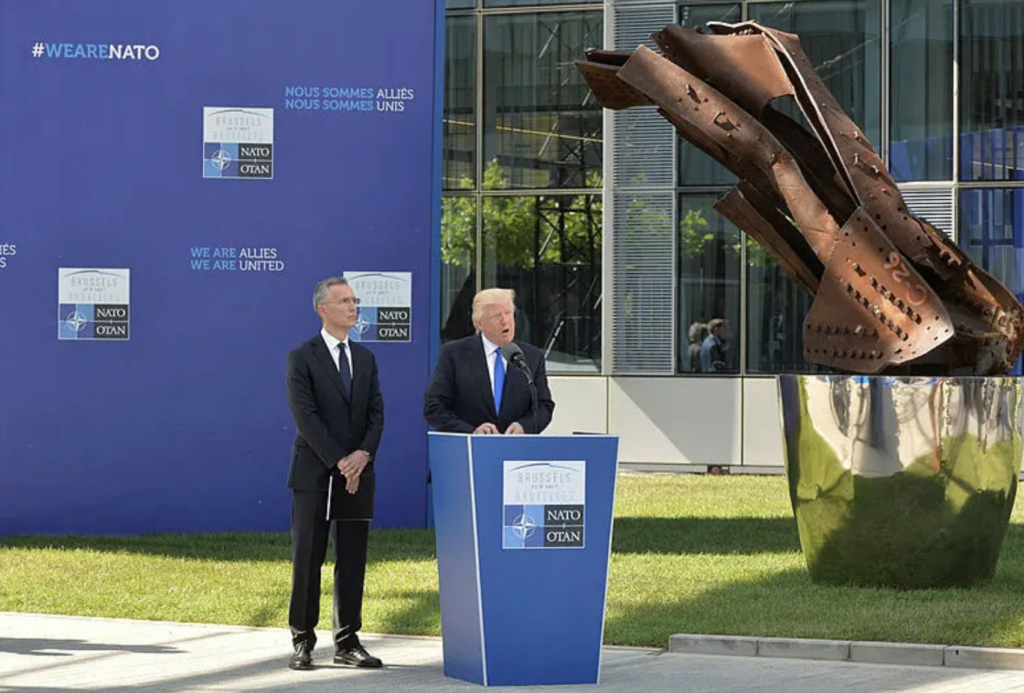
While the United States deals with apparent foreign meddling in a presidential campaign that needed no help in degrading public trust, the world airs its discombobulation.
By Lisa Van Dusen/For The Hill Times
February 21, 2018
In his address to the Munich security conference last weekend, NATO Secretary General Jens Stoltenberg reminded attendees that in front of the new NATO headquarters in Brussels are two memorials. “One is a section of the Berlin Wall and the other, a twisted girder from the wreckage of the Twin Towers in New York,” the former prime minister of Norway said, adding that, together, they symbolize NATO’s “steel hard commitment” to our collective defence.
A little over an hour later in Washington, the Department of Justice dropped a reminder that war isn’t always about rubble and rebar when it announced that a grand jury had indicted thirteen Russian individuals and three Russian companies for “what they called information warfare against the United States,” with the stated goal of “spread[ing] distrust towards the candidates and the political system in general.” (Which, given the cynicism of the 2016 campaign and what both candidates themselves did to further those goals, seems like bringing espionage coal to Newcastle.)
The world war going on now, like the conflicts that brought down the Berlin Wall and the World Trade Center, is a war of ideas. This time, the divide isn’t ideological or religious. The divide this time is between interests — both geopolitical and non-state actors — who see democracy as an existential threat or an obstacle to greater power and enrichment and, on the other, pretty much everyone else.
The weapons include the classic intelligence arsenal — immeasurably amplified by the internet — of subterfuge, sabotage, misinformation, misdirection, misrepresentation and outright fictionalization that define covert operations, attempt to redefine reality and produce the political chaos we’ve been witnessing in the United States, Europe and elsewhere. Because the most powerful weapon pro-democracy interests possess is truth, truth has been a target of degradation and obliteration, most notably but not exclusively by the current president of the United States — the nation that, as the world’s flagship democracy, is the highest-value geopolitical target of anti-democratic interests, domestic and foreign.
Because the effects of this brand of warfare are division, disorientation and destabilization, the Munich security conference produced, at times, the impression of a circular firing squad, or perhaps a New World Order Shock Syndrome support group, with many ostensibly capable and powerful people either finger-pointing or helplessly lamenting. This was largely due to not just the absence of American leadership at the head of government level (or, as outgoing German Foreign Minister Sigmar Gabriel put it, “We no longer recognize our America”) but to the current occupation of the White House by a man who brazenly gives every indication of being an asset of the other side in this war.
In Munich, it was a man notable for his absence who made the most eloquent call to arms. Here’s Senator John McCain’s statement, read by his wife Cindy, on being receiving the Ewald von Kleist Award for his services to transatlantic relations and the Munich Security Conference:
“I am counting on all of you, my friends, to honor the precious, beautiful things that are still entrusted to our care. I am counting on you to be brave. I am counting on you to be useful. I am counting on you to keep the faith, and never give up—though the true radiance of our world may at times seem obscured, though we will suffer adversity and setbacks and misfortune—never, ever stop fighting for all that is good, and just, and decent about our world, and each other.”
That’s the America that the people who tore down the Berlin Wall were for, and that the people who brought down the Twin Towers were against.
Lisa Van Dusen is associate editor of Policy Magazine. She was Washington columnist for the Ottawa Citizen and Sun Media, international writer for Peter Jennings at ABC News, and an editor at AP National in New York and UPI in Washington.