
The Alberta Referendum, Winners and Losers
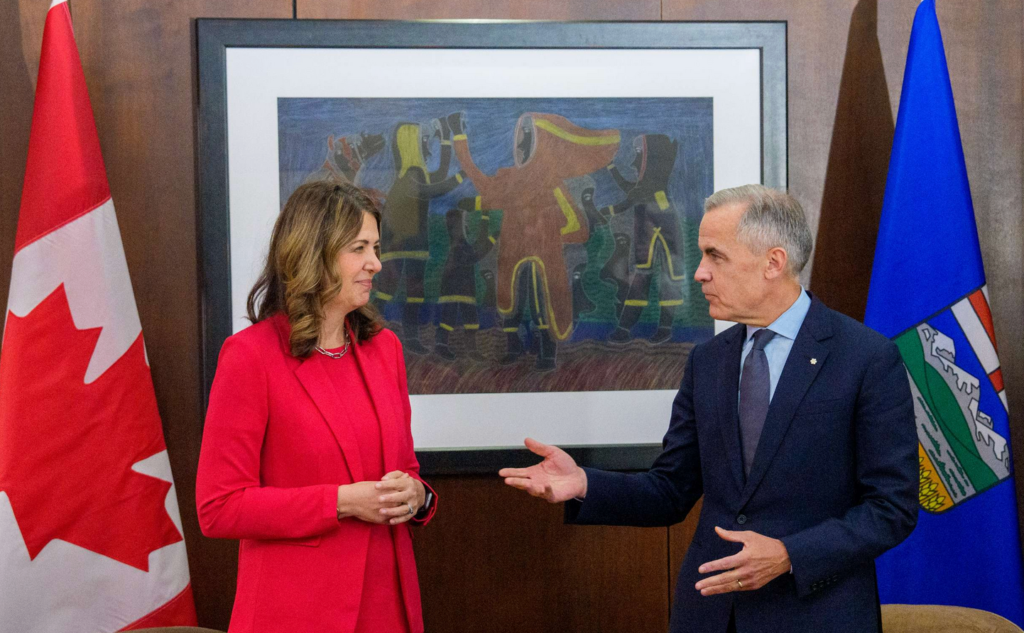
Alberta Premier Danielle Smith and Prime Minister Mark Carney in October, 2025/Carney X
October 21, 2026
In the aftermath of the significant defeat of the separatist option of holding a binding referendum in Alberta, the discussion has begun about the impact of the October 19th vote.
There have been a lot of comparisons between the Alberta referendum and the Quebec referendums of 1980 and 1995. They are, of course, very different. Quebec has its own language, its own legal system — the civil code — a provincial police force and its own political culture.
Both Quebec referendums were launched by governments that had campaigned for election on the promise to hold them, while there was nothing in the last Alberta election that suggested that the government might hold a referendum, let alone a referendum on holding a referendum
But there is one striking similarity.
The “Yes”/“Leave” campaigns in both Quebec and Alberta operated on the assumption that if they won, they would win, and if they lost, they would lose nothing. Their motto, in effect, has been “If at first we don’t succeed, try, try again.”
In fact, Quebec lost a lot from its referendums. There was the loss of population — an estimated quarter of a million people left the province — and companies of all sizes shifted their operations from Montreal to Toronto. The fade of Montreal as Canada’s financial and cultural metropolis that began in the 1970s coincided with the emergence of Toronto as the country’s biggest city and financial hub.
There was also the amount of energy expended on the issue that could have been spent on something else. This is a cost to referendum battles that tends to be overlooked by the public but which — especially in a time of vexingly complex policy challenges — can be enormous.
In the months following the 1980 referendum, I spoke with the late Michel Bélanger, the former senior public servant who was then the head of the Banque Nationale.
“What I find tragic is that a whole group of intelligent people have spent this crazy amount of energy for at least four years all focused on a referendum,” Bélanger told me. “If a tenth had been put into discussing real problems, complex, boring, difficult problems of the evolution of Quebec society, the evolution of government, all the myths that plague us…if all that intelligence had been put into something concrete, dammit! Just think of what we could have done to show the rest of the world!”
But there was also a significant loss in political power. The two referendums weakened Quebec, weakened the National Assembly and, most ironically of all, weakened Quebec nationalism.
The two referendums weakened Quebec, weakened the National Assembly and, most ironically of all, weakened Quebec nationalism.
Before the 1980 referendum, it was taken for granted that Quebec had the power to decide who could attend English minority schools. After the changes to the constitution, which were only possible in the aftermath of the “No” victory in Quebec in 1980, that power was taken away and entrenched in the Charter of Rights and Freedoms.
Then, following the 1995 referendum, the Supreme Court delivered its landmark 1998.
“In the 131 years since Confederation, the people of the provinces and territories have created close ties of interdependence (economic, social, political and cultural) based on shared values that include federalism, democracy, constitutionalism and the rule of law, and respect for minorities,” the Court declared. “A democratic decision of Quebecers in favour of secession would put those relationships at risk. The Constitution vouchsafes order and stability, and accordingly secession of a province ‘under the Constitution’ could not be achieved unilaterally, that is, without principled negotiation with other participants in Confederation within the existing constitutional framework.”
In other words, there is no right to unilateral separation, there is an obligation to negotiate, and a formal constitutional amendment is required. That ruling placed the bar high for any future referendum.
So, who won and who lost in the Alberta referendum?
Obviously, Mark Carney and, to a certain extent, Pierre Poilievre have emerged as winners, as has Alberta’s NDP leader Naheed Nenshi. But Danielle Smith?
Smith has been presiding over a federalist-separatist coalition in which both sides of the divide thought she agreed with them. To pursue the Quebec comparison, this was the situation that the late premier, René Lévesque, was in.
The Parti Québécois was originally a coalition that brought together conservatives and social democrats, moderates and hardliners on the question of independence. Each group believed that Lévesque favoured them and tolerated the others.
When Lévesque opted for the conservative, moderate position of postponing another referendum after 1980, the hardliners left the cabinet and the party. The result was Lévesque’s resignation and a defeat for the PQ in the following election, in 1985.
Smith shocked some of her separatist members by coming out in favour of voting “No” on holding a binding referendum; they had hoped she would at least remain neutral, above the fray. Since Monday, she has claimed that Albertans gave her a clear mandate with the referendum result.
Smith has threaded the needle between political pragmatism and risk by sticking to majority sentiment in her province while legitimizing the separatist faction in her party’s base. That calculation got her through 2026, but we have yet to see the effects of this exercise.
Today, Smith said in her first post-referendum news conference that separatists are not welcome to run as candidates for the UCP and that anyone hoping to make it a “vehicle for the independence movement” should leave. Meanwhile, those same separatists are reportedly planning a takeover of the UCP board. That conflict could produce either her rejection by the United Conservatives or the creation of a new separatist party.
History suggests that there is a price to be paid for referendums. And while this was not, in the end, an Albrexit, it could yet lead to an exit for Danielle Smith.
Graham Fraser is the author of René Lévesque and the Parti Québécois in Power and covered both of the Quebec referendums as a reporter.