
The Canada-EU Romance: Friends with Benefits or Cautionary Fairy Tale?
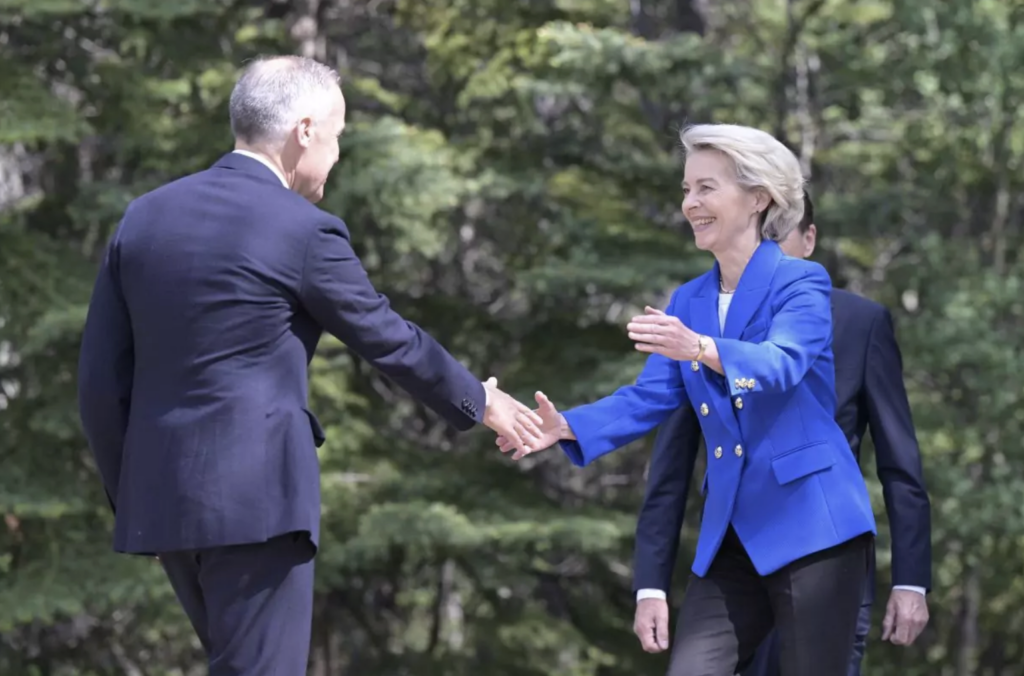 Prime Minister Mark Carney and European Commission President Ursula von der Leyen/EU image
This piece is part of Our Policy Series on the Canada-EU Relationship.
May 12, 2026
It’s been so long since we had a geopolitical couple to get excited about — was it German reunification?! — that amid all the rupturing, aggression, alliance shifting, and blockading, it’s no wonder The New York Times has framed Canada’s heady European Union commingling in the language of Montagues and Capulets.
Canada and the European Union Are in Love. Where Can It Lead? read the headline on Matina Stevis-Gridneff’s piece posted after Mark Carney’s appearance at the European Political Community Summit in Yerevan on May 4th — the first non-European head of government invited to the twice yearly gathering — portraying the next-level relationship as if both parties had been found holed up in an Armenian love nest.
The missing potboiler word in that headline was “possibly” — as in, “Where could it possibly lead?”
As both an editor and columnist, I can attest to the difficulty in labelling Canada’s new, closer relationship with the EU, and so appreciated the Times‘ creativity as much as the reporting.
The problem with describing the evolution in the Canada-EU relationship in strictly diplomatic terms is the following: it’s not a rapprochement because there was never a breach, and it’s not regular EU accession because there’s an ocean between us.
In seeking to solve this problem, I asked Policy Contributing Writer Sen. Peter Boehm, whose diplomatic expertise over six G7 Sherpa gigs, multiple foreign postings and time served as chair of the Senate Committee on Foreign Affairs and International Trade seemed a good place to start.
“Friends with benefits,” was Sen. Boehm’s suggestion. That seems apt.
The Times piece itself didn’t go overboard, it just painted the evolving relationship status of the 27-member economic and political bloc and the most convenient of Trumpian gaslighting targets as a crush but with a pragmatic, diplomatic purpose.
“E.U. leaders seem to want to hold Mr. Carney closer through this tumultuous phase,” Stevis-Gridneff wrote. “Several mentioned his now-famous Davos speech as a turning point in their own understanding of the changes U.S. policies mean for the rest of the world.”
The love story metaphor reflects the “emotionalization” of foreign policy more broadly since Donald Trump careened onto the world stage in 2017 and began to provoke and harangue America’s allies based on a range of emotional justifications. It also makes for a refreshing break from geopolitical horror stories.
Indeed, it would be nice to think that somewhere, Jean Monnet — the midwife if not the father of Europe (that title conferred by acclamation on Robert Schuman) — is winking.
The geopolitical love story metaphor reflects the ’emotionalization’ of foreign policy more broadly since Donald Trump careened onto the world stage in 2017 and began to provoke and harangue America’s allies based on a range of emotional justifications.
Monnet, who fell madly in love with the young artist Silvia Giannini at a dinner party in Paris in 1929, promptly whisked her off to Moscow for a quickie divorce and remarriage, and remained happily married to her for the remaining 45 years of his life, was a romantic.
He was possibly even more romantic about Europe than he was about Silvia, to whom he was devoted. Monnet was the scion of a Cognac family who left school at 16 to apprentice in business. His vision for a postwar European union forged first in coal and sealed by the belief that enmeshed economic interests would act as a bulwark against war birthed the post-Holocaust phoenix that became the European Union.
It’s not hard to get romantic about Canada’s relationship with Europe. Spend a day in the Canadian cemetery at Beny-Sur-Mer in Normandy among the boys from Nova Scotia and Manitoba and Prince Edward Island who died on D-Day, or witness the annual May 5th commemorations in a Dutch town liberated by the Canadezen, and it’s clear that the bonds go deeper than ancestry.
The cultural and linguistic melting pot of Schengenia has made Parisian waiters more tolerant of Quebec French. The shared story — now collective history — of immigration-forged pluralism has evolved from a transatlantic epic into a global one.
At the same time, to reality-check this Strategic Partnership meadow run (the film trope in which two romantic leads gambol into each other’s arms in a field of wildflowers) let’s be clear that it’s also festooned with red flags.
For starters, America was Canada’s staunchest ally, friend, neighbour, and gargantuan conjoined twin for more than two centuries until Donald Trump’s highly weaponized second term took — to swipe the 2026 Munich Security Conference term — a wrecking ball to the bilateral relationship along with every other component of the geopolitical and global trade status quo.
And, Newton’s third law of geopolitical romance dictates that every action produce a reaction. The Davos theory of variable geometry as a response to the actions of predatory hegemons makes perfect sense under the circumstances.
But the circumstances being the means to an endgame of 20 years of covert and overt democracy obliteration and autocratic power consolidation, it’s worth considering a reaction whereby those predatory hegemons — representing 90% of the planet’s total nuclear weapons and having deliberately alienated and in turn been alienated from the remnants of the rules-based order — take action that produces unintended consequences.
Being newly unconstrained by the multilateral institutions they’ve degraded, by the conventional alliances they’ve exploded, by the diplomacy they’ve marginalized, by any pretense at democracy or even by the global supply chains that long represented Monnet’s best deterrent to war, the new superpower throuple of China-America-Russia may finally indulge — rationalized by all the variable geometry going on behind its backs — greater authoritarian overreach in the name of securing the world’s resources; a process apparently already underway.
Whatever ends up in the window of the Donald Trump-Xi Jinping summit in Beijing this week, Trump has spent a decade elevating China by degrading America. That shift in the world order has been based on much more than the role of one man’s personality.
You might call it friends with benefits, just not very romantic ones.
Policy Editor and Publisher Lisa Van Dusen has served as Washington bureau chief for Sun Media, Washington columnist for the Ottawa Citizen, international writer for Peter Jennings at ABC News, and as an editor at AP National in New York and UPI in Washington.