
The Canada-EU Shared Sense of Purpose: Years in the Making, Now Free to be Unleashed
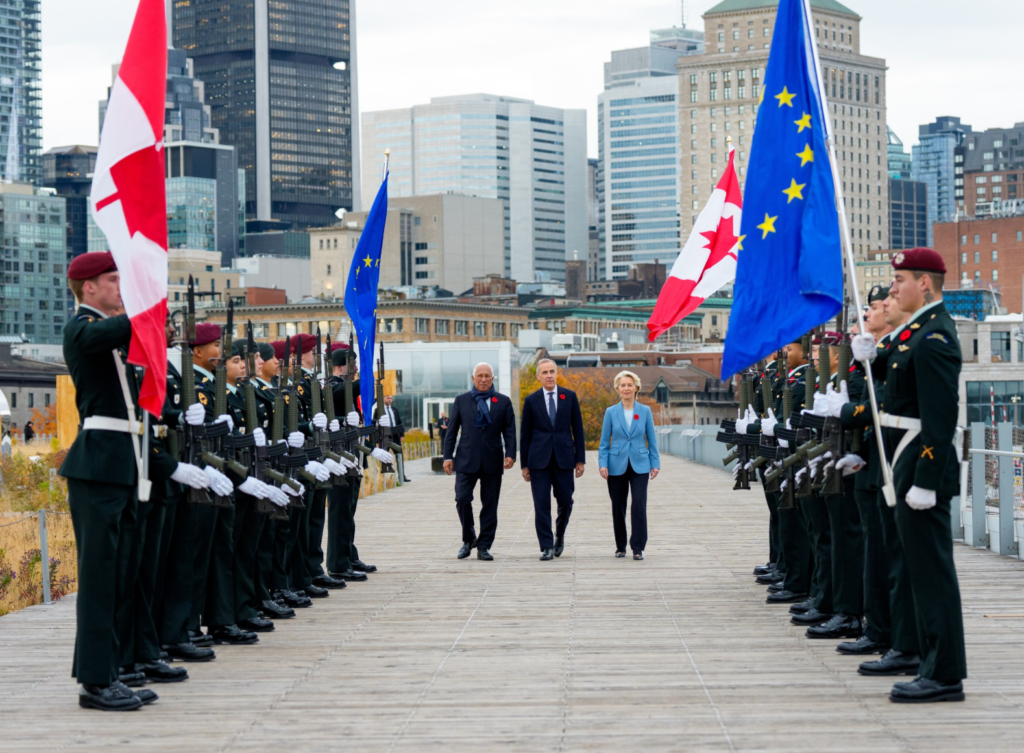 European Council President António Costa, Prime Minister Mark Carney, and European Commission President Ursula von der Leyen at the Montreal Canada-EU Summit, October 30, 2026/PMO
November 3, 2026
In Green Park in London, a few hundred yards from Buckingham Palace, a monument honours the “nearly one million” Canadian and Newfoundland soldiers who passed through the UK on their way to Europe’s battlefields in World Wars I and II.
More than 100,000 died. It was a remarkable commitment from a country whose population in 1914 was only 8 million, and 11.3 million in 1939.
A century later, the history of engagement with Europe, which propelled Canada’s inclusion in 1949 in NATO, is being re-imagined as an “Alliance for the Future,” between Canada and the 27-member European Union.
Prime Minister Carney and European leaders agreed at Canada/EU Summit in Montreal to an almost unique “strategic alliance” in cooperative purpose, anchored in the plan for Canada to become the EU’s first “associate member.” (JK: That wording more accurately reflects the status quo at writing absent any countervailing information)
This is a geopolitical bonding of real consequence. Some may consider this a defensive reaction to the dramatic change in U.S. predatory nationalism that has treated both Canada and European allies essentially as adversaries, while upending the architecture of international cooperation established 80 years ago under US leadership.
Mark Carney’s now-celebrated assertion at Davos that the rules-based international order is “ruptured,” and his call for like-minded democracies to form coalitions to sustain multilateral cooperation, assumed from the start enhanced solidarity between Canada and the EU. Foremost from the Montreal Summit is the joint intention to scale up bilateral economic partnership to privileged heights of strategic significance.
There is a lot of history behind the effort. Canada has always tried to balance our bounty as immediate neighbour to the world’s most buoyant market against risk that over-dependence on the North-South pull could become a vulnerability if the U.S. ever used its leverage as the far bigger partner to coerce Canada into dependence.
In his 1947 Gray Lecture, then Foreign Minister Louis St. Laurent declared Canadian foreign policy to be founded on two guiding priorities: managing our relations with our US neighbour; and pursuing “humanistic” policies toward the rest of the world.
(You can read Policy Contributing Writer Thomas Axworthy’s piece Two Crossroads, Two Speeches: Carney at Davos and St. Laurent’s Gray Lecture for an analysis of the two most important Canadian foreign policy speeches of the past century).
Constructive multilateral activism was both a statement of internationalist conviction and a protective hedge against over-reliance on the U.S., by institutional binding of parties to free and fair trade and other international undertakings. But it wasn’t adequate: diversification of economic relations was always in the cards, and Europe was always a target for partnership.
By the 1970s, the U.S. capital investment that fuelled Canadian growth had reached a perceived danger point. In 1972, the Gray Report on FDI in Canada warned that such levels of US corporate control could reduce Canada to a “branch-plant economy” and compromise national economic sovereignty. The previous year, U.S. President Nixon had abruptly imposed a 10% global surcharge on all imports, without forewarning or consultation. Canada’s assumption of a “special relationship” crashed.
Pierre Trudeau’s government adopted in response the Third Option policy to “pursue a comprehensive long-term strategy to strengthen the Canadian economy and other aspects of our national life and in the process to reduce the Canadian vulnerability…” It was a domestic re-boot but had the adjacent purpose of diversifying trade relations.
In the spring of 1972, Canada sent a high-level government mission to scope out with what was then the original Common Market of six European countries to try to devise some sort of institutional special relationship. While talks were somewhat inhibited by French reticence — a hangover from the impact of the late President De Gaulle’s 1967 “Vive le Quebec libre!” exhortation — both parties agreed to a “contractual link” to encourage growth in the trade and investment relationship.
As European Community membership progressively enlarged in chunks, bilateral consultations deepened and expanded into other areas of foreign policy, and we regularized a partnership dialogue that, decade after decade, has advanced further toward a strategic partnership.
Canada has reinforced its leverage against overexposure to a single coercive partner, while strengthening national assets to better equip the country for a more secure North American vocation.
Canada seemed the demandeur in the relationship because the EC (which became the EU) was so absorbed in its internal project of widening membership and deepening integration. But as the ambit of EU common policy spread into other areas of international cooperation, Canada’s activism as a proponent of human security initiatives, and as a co-advocate of the Kyoto and Paris accords on climate, earned recognition as one of six “strategic partners” of the EU.
By the time the Liberals took office in 1993, NAFTA had taken hold. The 1988 general election had nominally settled the debate over closer integration via a Free Trade Agreement with the US. PM Chretien had become supportive of NAFTA but remained wary of over-dependence. he sought a balancing connection with the EU, not in quantitative terms, but to assert natural and historic affinity to the European project.
He instructed me as Ambassador to the European Union to explore receptivity to a Canada-EU Free Trade Agreement with the EU.
The EU Commission exercises on behalf of member states the EU’s stature as a world trade superpower. The World Trade Organization (WTO) Doha Round of global trade talks launched in 2001 were (and have remained) stalled over core differences between the EU and the bloc of developing countries. EU Trade Commissioner Pascal Lamy surmised it would be a terrible look for the EU to undertake then a bilateral trade agreement with a fellow developed partner.
But Lamy imagined the merits of the Canadian proposition could be extended well beyond issues of trade access. He counter-proposed a much more expansive “21st-century” trade and economic agreement. Through the next decade and launching formally at the 2009 Canda-EU Summit in Prague, Liberal, Conservative, and again Liberal governments negotiated the CETA, a uniquely wide-ranging comprehensive economic and trade agreement, that certified the bilateral economic relationship’s strategic potential.
But it took the re-election of Donald Trump and his aberrant behaviour toward trading partners, allies, and ethical norms to create a sense of alarm. Initially, many governments responded to his reckless imposition of punitive tariffs with palliative attempts in the interest of economic predictability to make costly concessions. In Canada also, some in the business community urged an early deal.
Even in the Canadian government, an undertow of bowing to a perception of inevitability at the expense of Canadian sovereignty has lurked. It has reminded me of one trade-policy wag quipping 25 years ago in response to reports that our exports to the US had reached 84%, “Only 16 to go!” Trump’s unreliability and aggressiveness made such insouciance, even the notion of a “fortress North America,” seem an invitation to vassalization.
Mark Carney’s analysis in speeches at Davos and in Australia in February that warned of a return to competitive nationalism and economic coercion, a dilution of global norms, and the evisceration of the rules-based international order led to intensive Canadian diplomacy to channel intentions toward sustaining multilateralism.
Those consultations with the EU Commission, member states and other allies are reflected in the agreements in the Montreal Canada-EU Summit communique to build “the deepest possible partnership short of accession”. EU Commission President Ursula von der Leyen described the first-ever Associate Member status for Canada as “the highest-possible membership for a non-EU member.”
The meeting promised a host of project commitments across the board of Canada/EU economic activity, including digital trade, advanced research, supercomputing, satellites, nuclear energy, and critically, capital projects to maximize benefit from complementarities in critical minerals and energy processing and infrastructure, to defence procurement and to facilitate their financing.
The agreements anticipate people-to-people initiatives on student exchanges and enhanced sectoral access for skilled labour.
Beyond such bilateral objectives are commitments to strengthen multilateral solidarity on such vital challenges as climate, the global public health crisis, and regulation of artificial intelligence.
The defence of Ukraine is the mutual security commitment, anticipating an enlarged EU security community that would include the UK, Norway, and other partners, such as Australia, or South Korea as well as Turkey and Ukraine. An earlier proposal supported by the EU and Canada announced at the UNGA would stretch cooperation inter-continentally to include such partners as Brazil India, and Kenya.
Canada has reinforced its leverage against overexposure to a single coercive partner, while strengthening national assets to better equip the country for a more secure North American vocation.
The Canadian pivot to the EU, which Carney has now characterized as “our closest ally” constitutes a shift of real potential consequence for the geopolitically inclined EU Commission under Dr. Von der Leyen. That some EU member states are facing internal political challenges from far-right nationalists is the way of the world.
The remarkable outcome thus far is the extent to which EU countries and Canada see a sense of purpose in a shared future. It has been many years in the making, now free to be unleashed.
Policy Columnist Jeremy Kinsman served as Canada’s ambassador to Russia, high commissioner to the UK, ambassador to Italy and ambassador to the European Union. He is a Distinguished Fellow of the Canadian International Council.