
The Canada-Mexico Pivot: From Allies of Convenience to True Partners
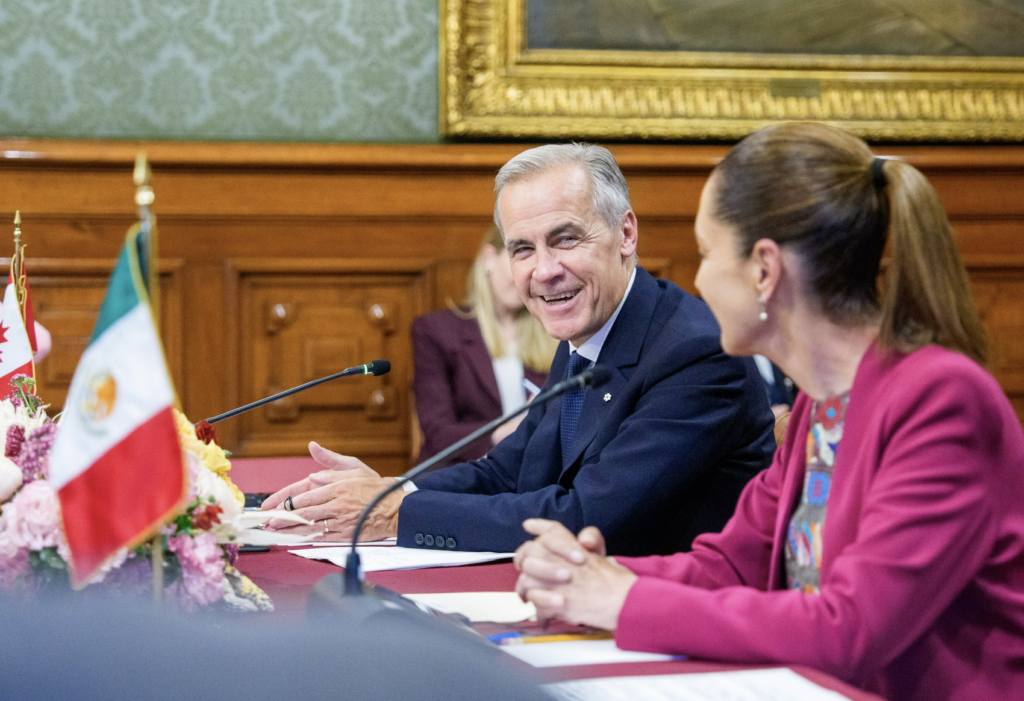 Prime Minister Mark Carney and President Claudia Sheinbaum, Mexico City, Sept. 19, 2025/Mark Carney X
August 23, 2026
The collapse of Canada-U.S. tariff negotiations has added urgency to an argument that Canadians should already understand: whatever happens to CUSMA, Canada needs a much stronger relationship with Mexico.
Prime Minister Mark Carney suspended negotiations Friday after what he called unfair and uneconomic last-minute changes in the American terms. The United States has now imposed 50-per-cent tariffs on roughly $28-billion of Canadian goods, and Carney has promised to respond dollar for dollar by September 8th.
Mexico will be watching closely. Economy Minister Marcelo Ebrard had described Mexico City’s negotiations with Washington as parallel rather than competitive with Canada’s and hoped for comparable outcomes, particularly on steel, aluminum and integrated North American supply chains. The next U.S.-Mexico negotiating round is scheduled for September.
On Thursday, August 20th, Carney spoke with Mexican President Claudia Sheinbaum. According to the PMO readout:
“The Prime Minister and the President discussed ongoing developments affecting North American trade. They underscored the importance of renewing the Canada-United States-Mexico Agreement (CUSMA) as soon as possible to provide greater certainty for North American businesses and workers. The leaders discussed the progress between Canada and Mexico on cross-border trade. They emphasised that strong bilateral cooperation is essential to shared continental security and prosperity.”
Emphasizing renewal of CUSMA over the tariff negotiations that were still more than 24 hours away from cratering underscored a crucial point in the current trilateral dynamic: The danger is that Washington negotiates two bilateral bargains and then imports the tougher provisions into CUSMA.
Canada and Mexico have different economies and different vulnerabilities, but they share a fundamental interest: preserving North American content rather than allowing continental integration to become American-only production.
This is particularly important for autos. Washington wants more production located in the United States; Canada and Mexico should defend rules of origin that reward production across all three CUSMA partners.
A coordinated approach need not mean identical positions. It means recognizing where our interests coincide before Washington defines them for us.
The guiding principles should be straightforward: consult first, coordinate where interests coincide and never be surprised by the other’s ultimate positioning.
For too long, Ottawa has viewed Mexico primarily through the prism of Washington. Whatever emerges from these negotiations, Canada should elevate Mexico into the front rank of its foreign policy. Canadian prosperity, continental security and our ability to navigate an increasingly transactional United States depend on it.
A saying commonly attributed to Porfirio Díaz captures Mexico’s enduring predicament: “Poor Mexico, so far from God and so close to the United States.” Under Donald Trump, Canadians understand it rather better.
Yet our relationship with Mexico has too often consisted of bursts of energetic diplomacy followed by strategic neglect. We seek Mexico’s support when Washington threatens CUSMA, then allow the relationship to drift when the crisis passes. That must end.
The guiding principles should be straightforward: consult first, coordinate where interests coincide and never be surprised by the other’s ultimate positioning.
Prime Minister Carney and President Sheinbaum laid the foundation at their September 2025 summit with the Canada-Mexico Comprehensive Strategic Partnership and Action Plan 2025-2028. Implementation has begun.
In February, Canada’s Team Canada Trade Mission to Mexico included nearly 400 delegates representing more than 240 businesses and organizations and produced 23 commercial announcements and partnerships. In May, Economy Secretary Ebrard led 240 Mexican companies to Toronto and Montréal. More than 1,800 business meetings produced over 10 agreements and major investment commitments, including Grupo Bimbo’s $200-million expansion in Canada.
The challenge is to turn momentum into habit.
First, Canada and Mexico need much closer political coordination. North America is more than a free-trade agreement. It is a continental production platform built on infrastructure, investment, skills and predictable rules. Ottawa and Mexico City should routinely exchange political intelligence and consult before—not after—major negotiations with Washington.
Second, build a continental economic strategy. Direct Atlantic and Pacific shipping links would reduce dependence on U.S. land routes. A Canada-Mexico Critical Minerals and Energy Compact could strengthen supply chains while helping manufacturers meet CUSMA rules of origin using Canadian and Mexican inputs. Cooperation through CPTPP, APEC and WTO reform should complement our North American agenda.
Third, invest in the human infrastructure of the relationship. Governments negotiate agreements; people make partnerships endure.
For more than six decades, the Seasonal Agricultural Worker Program has brought thousands of Mexican workers annually to help Canadian farmers, especially in Ontario. This summer, Mexican firefighters again travelled north to help British Columbia fight wildfires. These are practical demonstrations of neighbours helping neighbours.
We should build on them through professional mobility, mutual recognition of credentials, student exchanges and joint university and college programs. Nurses, engineers, veterinarians, welders and heavy-equipment operators are among the professions where cooperation makes sense. Canada should also invest much more seriously in Spanish-language education.
Fourth, security must become a larger part of the relationship. Cooperation should encompass policing, customs, cyber-security, money laundering, organized crime, municipal policing, emergency management and military education.
Institutions matter too. Canada and Mexico should establish a secure leaders’ communications channel, expand working groups under the Strategic Partnership and create permanent province-state relationships.
Then there is China. Washington increasingly wants North American trade rules to reduce Chinese participation in supply chains, critical minerals and advanced manufacturing. Both Canada and Mexico will face intense American pressure. Our circumstances and relationships with China differ, so common positions will not always be possible. But consultation should be automatic.
The breakdown of Canada’s negotiations makes that imperative immediate. Mexico should learn from Canada’s experience; Canada should learn from Mexico’s negotiations. Neither should allow Washington to turn parallel negotiations into a competition over which neighbour will concede more.
Canada cannot determine what Washington does next. It can determine how well prepared it is.
The first anniversary of the Carney-Sheinbaum partnership should therefore be more than another diplomatic commemoration. It should mark the moment Canada recognizes Mexico not simply as its CUSMA partner but as a permanent strategic partner in building a stronger North America.
For too long, Ottawa has viewed Mexico through Washington. It is time we looked directly at each other.
Contributing Writer Colin Robertson, C.M., C.D., a former career diplomat, is a fellow and host of the Global Exchange podcast with the Canadian Global Affairs Institute in Ottawa.