
The China-Japan Standoff: A Hardening of Hostilities with no Off-Ramp in Sight
 Shutterstock
This piece is part of our Emerging Voices program, which provides an editorial platform for students in public policy.
By Brian Wu
June 16, 2026
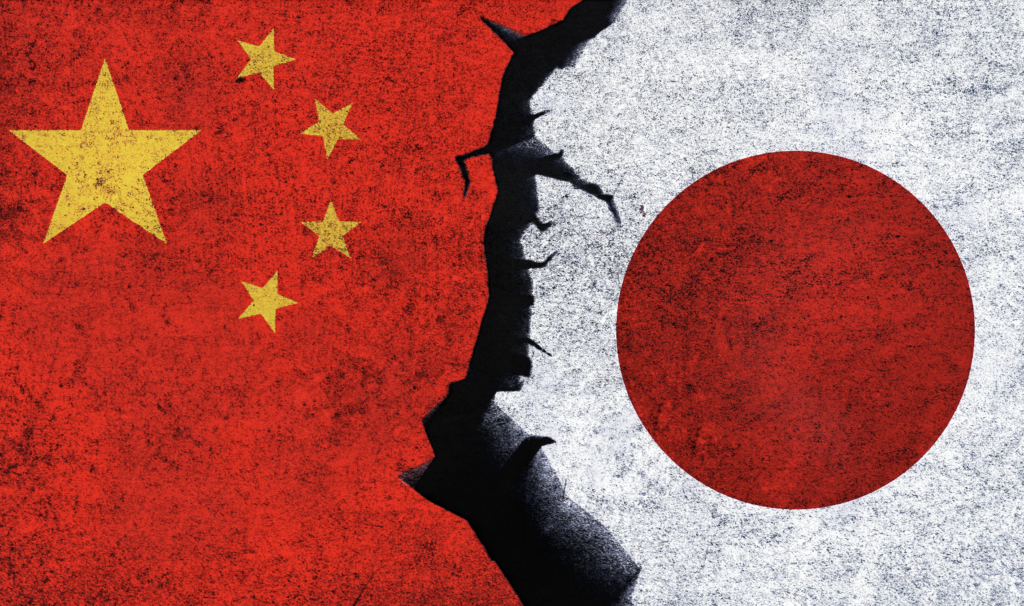
Among other consequences of the geopolitical ructions Prime Minister Mark Carney has been both navigating and narrating since his election, relations between China and Japan are arguably at their worst since the normalization of ties in 1972.
The current diplomatic crisis was precipitated by a statement Japanese Prime Minister Sanae Takaichi made during a televised National Diet session on November 7, 2025, when she said that a hypothetical Chinese naval blockade of Taiwan would qualify as a “a situation threatening Japan’s survival,” justifying its deployment of military force to exercise “collective self-defence”.
Takaichi’s comments did not signal a radically new position for the Japanese government. However, recent prime ministers have been more reticent, largely avoiding definitive statements on Taiwan in favour of strategic ambiguity.
By contrast, Takaichi’s reportedly unscripted remarks followed in the tradition of her mentor and former prime minister Shinzo Abe, who stated in a keynote speech in 2021, seven months before his assassination, that “a Taiwan emergency is a Japanese emergency.”
China has responded to Takaichi’s November statement with an unrelenting pressure campaign, restricting Japan-bound tourist groups, canceling concerts featuring Japanese artists, suspending academic and business exchanges, and imposing a series of export controls on dual-use items such as rare earths.
Beijing has also escalated its military threats, with an unprecedented incident in December 2025 when Chinese fighter jets locked their missile radars onto Japanese fighter jets near Okinawa while ostensibly on a training exercise.
It is well-established that China views foreign involvement in Taiwan as an absolute red line. Few other issues occupy a more important place in Beijing’s strategic calculus. But the magnitude of the current crisis eclipses previous instances of bilateral tension in 2010 and 2012 over the Senkaku/Diaoyu Islands territorial dispute, among other frictions.
A key factor is Chinese antagonism toward Takaichi’s history of pro-Taiwan positions, exemplified by her visit in April 2025 prior to becoming prime minister, when she met Taiwanese President Lai Ching-te, whom Beijing views as a dangerous “splittist”.
Since Takaichi became prime minister, China has latched onto her hawkish background from the right wing of the ruling big-tent Liberal Democratic Party (LDP) and her history of revisionist views on Japan’s wartime conduct. From China’s perspective, it needed to send the Takaichi administration a strong message to check her hawkish agenda.
It’s clear that the tempo of the standoff is being set at the highest echelons in Beijing, in particular by Xi Jinping himself. According to the Financial Times, during the closed-door meeting between Xi and Trump in May, the otherwise calm and poised Xi shocked the U.S. officials present by launching into a vocal, agitated castigation of Takaichi for Japan’s recent “remilitarization.”
Xi’s outburst follows a spate of attacks launched by the Chinese Foreign Ministry in recent weeks at Japan’s recent passage of a record defense budget for the 2026 fiscal year, putting it on track to hit its 2% of GDP target two years ahead of schedule.
While that rearmament — a trend that dates back more than a decade in Japan — now echoes defence budget increases among NATO allies, including Canada, in the face of a newly belligerent United States and a rising China, Japan’s postwar constitution entrenched pacificism as a national policy.
There seems to be a lack of appreciation in Beijing for the extent to which their tactics are backfiring.
Beijing claims these developments “show that Japan’s ‘country for peace’ mask is coming off and it is slipping towards neo-militarism.”
However, China’s caustic approach is ultimately counterproductive. There seems to be a lack of appreciation in Beijing for the extent to which their tactics are backfiring and creating the political space for Takaichi to pursue her ambitious agenda to transform Japanese security policy.
Takaichi has so far refused to retract her comments on Taiwan, and robust popular support for her approach suggest that she will not soon face public pressure to give ground to Chinese demands.
Opinion polling from March showed that 74% of the Japanese public is supportive of strengthening Japan’s military capabilities and 58% support increased military spending.
Takaichi is pushing ahead to create the conditions to fulfill her longstanding goal of revising Article 9 of the Constitution. While revising Paragraph 1, which renounces war, still faces formidable hurdles, other changes to formally recognize the Japan Self-Defence Forces (SDF) enjoy close to 50% of public support and could be within reach for the current administration.
Similarly, the ruling LDP is advancing discussions on revising Japan’s policy of three “non-nuclear principles”: that Japan should not 1) possess, 2) produce, or 3) host nuclear weapons on its soil. These principles have been in place since 1967 and remain anchored in public anti-nuclear sentiment. However, here too, recent opinion polls point to a gradual erosion in popular opposition to their revision.
In March, Japan deployed domestically produced Type-12 missiles with an unprecedented operational range of 1,000 km at an army base in the country’s southwest, enabling it for the first time to strike bases on the Chinese mainland.
In April, Japan removed a decades-long export restriction on lethal arms. Under the new rules, its defence companies can sell weapons to 17 countries with whom Japan has defence agreements.
The closure of the Strait of Hormuz, through which Japan imports 93% of its crude oil, will have reinforced Tokyo’s sense of vulnerability as an island nation dependent on major global maritime waterways. It will undoubtedly underscore for Japan why it must maintain a firm stance on peace in the Taiwan Strait, through which 32% of Japanese imports and 25% of exports transit.
More recently, the Trump administration’s unprecedented pause of $14 billion in arms sales to Taiwan and Trump’s willingness to leverage the sale as a bargaining chip with China has cast renewed doubt on the strength of U.S. commitment to the region.
This is combined with the U.S. warning to Japan in May that scheduled deliveries of 400 Tomahawk missiles could be delayed by two years due to depleted stocks from the war in Iran. This will increase pressure for Japan to invest in domestic defence capacity and strengthen security relations with regional partners, which is certain to further inflame relations with Beijing.
As a result, between China’s hardline approach to Takaichi’s Taiwan remarks and the latter’s increased appetite to hold firm after her party’s landslide election victory in February, the two powers appear set for a long-term standoff with no off-ramps in sight.
Brian Wu is pursuing a master’s in international affairs at the Norman Paterson School of International Affairs, Carleton University. His research interests focus on economic security, international defence cooperation, and Indo-Pacific geopolitics. His work has been published by the CDA Institute, the Yale Review of International Studies, and The China Project. His policy proposal, Stronger Middle Powers: Opportunities in Canada-Japan relations, has been selected as one of the winners of Global Affairs Canada’s 2026 International Policy Ideas Challenge.