
The Great Rebound: How Donald Trump is Accelerating the Canada-India Rapprochement

August 24, 2026
The collapse of Canada–U.S. trade negotiations has imbued Prime Minister Mark Carney’s diversification agenda with a new sense of urgency. Among the partners crucial to that agenda is India.
In his address to Canadians the morning after Canada’s 11th-hour August 21st pullout from the talks over Donald Trump’s tariffs, Carney reinforced just how central diversification is to Canada’s economic strategy.
“Building at home and diversifying trade abroad is not our Plan B,” Carney said. “It has been our Plan A from the start.”
Canada’s existing trade agreements already provide access to 1.5 billion consumers. Over the next six months, he said, the government intends to double that reach through new agreements “from ASEAN to India.”
Since Carney became prime minister, Canada–India relations have already undergone a remarkable transformation. A little more than a year ago, they were at their lowest point in decades. Since Carney’s G7 Kananaskis invitation to Indian Prime Minister Narendra Modi in June 2025 opened the door to renewed engagement, both governments have pursued a deliberate, step-by-step reset of the relationship.
Foreign Minister Anita Anand’s visit to New Delhi last October established a roadmap for renewed cooperation, and Carney’s visit to India in March moved the relationship from diplomatic stabilization toward a much more ambitious agenda, encompassing energy, critical minerals, technology, talent, defence and security.
Donald Trump has accelerated the rapprochement. Canada and India are both managing greater uncertainty in their economic relationships with Washington, giving them compelling reasons to widen their economic options, diversify supply chains and deepen relationships with other consequential partners.
India matters to Canada because it combines geopolitical weight, scale, growth, and demand in a way few other partners do.
But converting the momentum of the past year into a durable strategic partnership will require more than economic agreements. It will also require rebuilding trust and demonstrating progress on national security, foreign interference and transnational repression, the very issues that drove the relationship into crisis in the first place.
Both the promise of the relationship and the challenges that could still undermine it will be on display this fall, through a series of bilateral engagements expected to culminate in a planned visit by Prime Minister Modi in December.
Indian Finance Minister Nirmala Sitharaman’s visit to Canada this week particularly significant. Sitharaman will be in Toronto on August 26-27 for the inaugural Finance Ministers’ Economic and Financial Dialogue. The agenda includes ongoing global economic developments, financial-sector cooperation, investment and economic growth priorities.
Canada needs to think about diversification not simply in terms of selling more goods to more markets, but of becoming embedded in the industrial strategies and economic-security priorities of its partners.
Canadian direct and indirect investment in India already exceeds $110 billion, while fintech, payments modernization, capital markets and cross-border financial connectivity offer considerable room for deeper cooperation.
The Finance Ministers’ Dialogue is part of a much broader effort to put the economic relationship on firmer footing. At the centre of that effort is a Comprehensive Economic Partnership Agreement. Negotiations on the Canada-India CEPA resumed last year and three rounds have already been completed. More talks are expected this fall, with both governments aiming for conclusion by year-end.
The breakdown in Canada-U.S. trade relations should add political momentum, but the case for the CEPA goes well beyond the current crisis.
India has changed considerably since Canada last seriously pursued a comprehensive trade agreement with the world’s most populous democracy. New Delhi’s trade diplomacy today is far more ambitious, with recent agreements concluded with the United Kingdom, the European Free Trade Association, New Zealand and the European Union, building on earlier agreements with Australia and the United Arab Emirates, while negotiations with Washington continue.
A modern Canada-India agreement therefore cannot be approached simply as an unfinished tariff negotiation from a previous era. It needs to address services, investment, digital trade, regulatory barriers, professional mobility and the supply chains that increasingly determine economic security.
More broadly, Canada needs to think about diversification not simply in terms of selling more goods to more markets, but of becoming embedded in the industrial strategies and economic-security priorities of its partners.
This is where India’s own economic ambitions become especially relevant.
Modi’s Independence Day address this month offered a useful window into the priorities shaping India’s next phase of development. Self-reliance, industrial capability and technological advancement were at the centre of his vision of a developed India by 2047 (100 years after Indian independence). He called for India to build complete manufacturing value chains and establish itself as a reliable centre of global supply chains.
Defence featured prominently. Modi noted that Indian defence production has increased almost fourfold over the past 12 years and argued that India must move beyond being primarily a market for foreign defence companies to becoming a global supplier of next-generation technologies.
AI and skills were equally central. He announced a goal of training 10 million young Indians in AI skills over the coming year and highlighted aviation, drones, semiconductors, critical minerals and energy security as foundations for the country’s next stage of growth.
For Canada, these priorities amount to a map of potential complementarities.
Canada has energy and uranium, critical minerals, sophisticated pools of capital, expertise in aerospace, mining and clean technologies, globally competitive AI research, and colleges and universities capable of contributing to skills development and applied innovation. India offers scale, engineering and technology talent, a rapidly expanding market and growing industrial capacity.
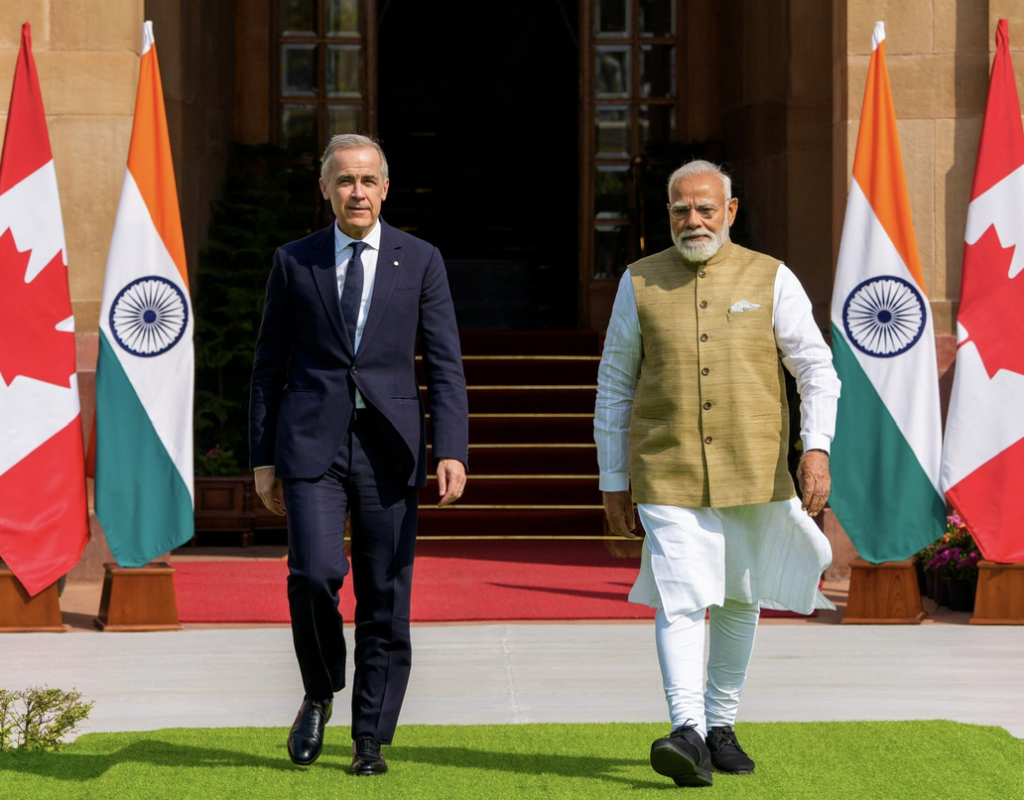 Minister Mark Carney and Prime Minister Narendra Modi in Delhi on March 2, 2026/PMO
The Team Canada trade mission to India in October will be an early test of whether Canada can translate those complementarities into commercial relationships. Its focus on aerospace and space, clean technologies and energy, AI, cybersecurity, semiconductors, life sciences, forestry and agri-food closely tracks both India’s priorities and sectors Canada increasingly regards as central to its own economic security.
India’s expanding civil and defence aerospace industries in particular offer opportunities for Canadian suppliers, technology companies and dual-use capabilities.
There is a geopolitical logic to this deeper economic relationship as well. Carney has argued that middle powers need to build greater agency, leverage and strategic autonomy, including through purpose-built coalitions with countries willing to cooperate where interests converge.
India has practised its own version of strategic autonomy for decades — since Prime Minister Jawaharlal Nehru helped found the Non-Aligned Movement in the early 1960s to avoid the polarization of the Cold War. It is not a middle power in the Canadian sense; it is increasingly a major and bridging power, able to work simultaneously with Western countries, the Global South and governments with which Canada has profound differences.
Ottawa and New Delhi will not agree on every geopolitical question, nor should that be the test of the relationship. Their convergence is not based on alignment so much as shared interests.
Both want more diversified trade and investment relationships and more resilient energy and critical-mineral supply chains. They are also seeking greater room for manoeuvre in a world increasingly shaped by U.S.–China competition and economic coercion. They have shared interests in shaping the rules around emerging technologies and making multilateral institutions more effective and representative.
If Modi visits Canada later this year, he and Carney should use the occasion not simply to celebrate the bilateral reset or the expected conclusion of CEPA negotiations, but to begin defining a longer-term strategic agenda around those areas of convergence.
Still, the ability to pursue an agenda of that ambition rests on a fragile foundation of trust. Canada–India relations are, in effect, moving on two tracks. The diplomatic and commercial track is public, active and producing increasingly tangible results. The security and law-enforcement track is less transparent, even though foreign interference and transnational repression were at the heart of the rupture in the relationship.
National-security advisers resumed engagement in 2025, and Canada and India have since established a security workplan and liaison mechanisms to improve information-sharing and cooperation on organized crime, extortion, cybercrime, financial fraud and other threats. These channels are intended to manage serious security concerns without allowing them to overwhelm the broader relationship.
Ottawa and New Delhi will not agree on every geopolitical question, nor should that be the test of the relationship. Their convergence is not based on alignment so much as shared interests.
What is still missing is a clearer public account of what that engagement has achieved. There are obvious limits to what governments can disclose about intelligence and active investigations, but Ottawa should be able to explain whether information-sharing has improved, whether the threat environment has changed, how the security dialogue is functioning and, at a strategic level, what accounts for the difference between the RCMP’s extraordinary public statement in 2024 linking agents of Indian government to serious criminal activity in Canada and its more qualified language since.
India’s High Commissioner has said publicly that Canada no longer regards India as involved in foreign interference activities. The Canadian government has rejected that interpretation and says its broader assessment has not changed. CSIS continues to identify India, alongside China, Russia, Iran and Pakistan, among the principal perpetrators of foreign interference and espionage against Canada. India has consistently denied involvement in transnational repression in Canada, so its position is unsurprising. But Canadians should not have to rely on a foreign government’s representative to understand the evolution of their own government’s national-security assessment.
That clarity matters because the political sustainability of the reset depends on public trust and perception. Pew Research Center found this month that 51 per cent of Canadians had a favourable view of India and 40 per cent an unfavourable one. But perhaps more important than the favourability numbers is the knowledge gap underneath them. An Angus Reid survey last year found that only 32 per cent of Canadians said they had at least some knowledge of India.
That is a strategic weakness at a moment when India is becoming more consequential to Canadian interests. India is still too often understood in Canada through a handful of narrow lenses: as a trade opportunity, a source of students and immigrants, a diaspora political issue, or a national-security challenge. Each captures part of the relationship. None is sufficient for dealing with a country of India’s scale, complexity and growing influence.
Canada therefore needs to invest in its own India competence across government, business, universities, media and the policy community. Better understanding would help Canadian decision-makers identify opportunities, assess political and regulatory risks, understand India’s strategic choices and manage inevitable disagreements with greater sophistication.
If India is to become a meaningful part of Canada’s diversification strategy, Ottawa will need to sustain the economic momentum already underway. That means concluding an ambitious CEPA, and using the October trade mission to build durable commercial relationships in areas such as energy, critical minerals, food, AI, aerospace and defence — sectors where Canadian capabilities align with India’s long-term economic and industrial priorities.
But economic ambition must also be matched by sustained progress and clearer communication on security and law enforcement issues. A deeper economic relationship with India cannot come at the expense of Canadian sovereignty or the safety of Canadians. Sustaining that ambition through future periods of friction will also require continued investment in Canadian expertise in India and in the institutional relationships and trust that underpin the partnership.
Canada and India have rebuilt their relationship a great deal in little more than a year. The challenge now is to turn that momentum into something more durable: an economic partnership that gives Canada greater room to manoeuvre, a security dialogue equipped to manage genuine differences, and a deeper reservoir of knowledge and trust capable of sustaining both.
Policy Contributing Writer Vina Nadjibulla is co-founder and CEO of the Centre for Strategic Statecraft and a Balsillie Scholar at the Balsillie School of International Affairs.