
The HFX 2025 Nobel Laureate Essays: Tawakkol Karman with ‘Democracies Defeat Dictators’
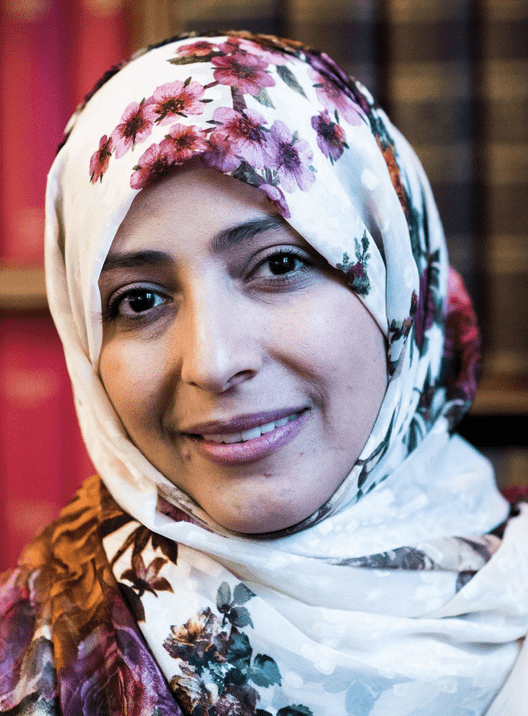
2011 Nobel Peace laureate and co-founder of Women Journalists Without Chains
From the Policy Magazine HFX 2025 Nobel Peace Laureate Essays on Democracy Series
November 19, 2025
Before discussing the crisis of democracy in our world today, we must begin with an undeniable truth: there is no alternative to it.
Vladimir Putin’s charisma may seem appealing to some in these turbulent times, but what lesson can we learn from a ruler who has turned his country into a vast prison in the name of “national greatness?”
In the Arab world, we have long lived through the era of the “eternal ruler.” We have known Gaddafi, Hafez al-Assad and his heir Bashar, Ali Abdullah Saleh, and Saddam Hussein. These regimes prepared our peoples for the same abyss: failure, sectarian division, and the rise of extremist groups. Whether you are an Arab living in one of the Arab Spring countries punished by civil wars, cross-border conflicts, terrorism, military coups, and militias — or a citizen of one of the world’s strongest democracies — there is no alternative to a pluralistic democratic system founded on public oversight and fair competition over programs that reflect people’s aspirations.
Today, democracy is often portrayed as a tired idea undergoing a global crisis. After the Arab Spring, sectarian powers and regional regimes exploited turmoil to claim that freedom leads to chaos, and that only an “iron fist” can “protect the state.” Yet the devastation we see in our countries was not caused by democracy but by its absence — by regimes that ruled to subjugate, not to serve. Some are now trying to turn global unrest into an intellectual movement hostile to democracy, freedom of expression, and the people’s right to choose their leaders and determine their destiny.
In my country, Yemen, the civil war erupted as an act of vengeance waged by an authoritarian regime and a sectarian, racist militia — the Houthi militia — backed by Iran, alongside regional counter-revolutionary powers Saudi Arabia and the United Arab Emirates. Since 2013, they have led a regional campaign to abort every nascent democratic experience and extinguish every spark of change. Yet the Arab Spring was not a failure — it merely stumbled. It continues in its dream, its struggle and its sacrifices for freedom, dignity, and the rule of law. True revolutions are born from humanity’s deep need for dignity and from peoples’ longing for a life free from fear.
It is true that democracies themselves are going through a crisis. We have witnessed, even in the oldest democracies, university presidents dismissed and students expelled for their opinions, shrinking freedoms across Europe and America, the rise of populist right-wing movements, and — since Russia’s invasion of Ukraine — a retreat from free trade and return to protectionism and tariffs. Even more dangerous is the betrayal of democracy by the West itself, when it chose to ally with tyrants in the Middle East under the pretext of “stability” or “counterterrorism.” Western governments have supported regimes that oppress their peoples and plunder their nations’ resources — all while preaching freedom and human rights. This hypocrisy not only undermines the West’s credibility. It weakens democracy itself across the globe.
When democracy betrays the values of freedom and justice, putting interests above principles and profit above humanity, it loses its moral compass, its stability and its national security. The rise of extremism, division, hatred and early signs of authoritarianism within democratic societies are all proof of this decay. We see this vividly in the unconditional support given by many democratic nations to despotic regimes in our Arab region — and in their complicity with the Israeli occupation and its crimes in Gaza. This moral collapse is not merely a stain on conscience; it is a strategic failure that fuels instability and undermines the foundations of democracy.
For democracy to survive, it must defend itself from within. It must pursue justice both domestically and internationally. The corrupt must be held accountable and prevented from occupying high office. Justice must prevail — especially for war criminals and all those complicit in crimes against humanity. Only then can democracy regain its moral authority and sustain its promise of peace and human dignity.
Democracy is not merely a system of governance — it is the highest form of organizing the relationship between state and society. The state was never meant to be a power above society but an institution created by the people to serve them — to secure education, health, safety, and dignity. Democracy is not limited to ballot boxes; it is a spirit that places the human being at the center. It means that the citizen is not a follower or a number but a partner in decision-making, responsible for his own destiny. It alone makes the state accountable, fair, and capable of self-correction.
Tyranny, even when masked as rescue, is pure evil. It sows fear among people and weakness within the state. It kills creativity, turning all living energy into anxious silence.
Tyranny has inverted this order — turning society into a servant of power and the state into private property for those who seize it. This inversion is the essence of despotism — the disease that has condemned our region to perpetual failure and oppression. I write from a country that has known every form of absolute rule. I cannot believe that our salvation lies in returning to another “savior ruler”. Tyranny, even when masked as rescue, is pure evil. It sows fear among people and weakness within the state. It kills creativity, turning all living energy into anxious silence.
I have seen what tyranny does — how it turns people into ghosts walking their streets, afraid of their own shadows; how it destroys belonging and reduces the homeland to portraits of rulers on walls. I have seen rulers so obsessed with power they ally with the devil, destroy their own countries, and hurl their people into the inferno of civil war. Freedom is not a luxury but the condition of life itself. A creative society cannot be built on fear, nor can a nation thrive when ruled by a corrupt elite standing above the law.
When the legacy of tyranny is heavy, democracy stumbles, for it requires a historic transformation and assumes free and responsible citizens, not subjects awaiting orders. The state derives its legitimacy from the social contract that binds it to the people — a covenant granting it the right to manage public resources, collect taxes and form armies and police forces, not to oppress, but to protect. The state, in this sense, is not separate from society but the institutional expression of its collective will.
The danger begins when rulers forget that they are merely members of society, temporarily entrusted with managing its affairs. When public office becomes a means of accumulating wealth and power, the social contract is lost and governance devolves into tyranny. The citizen ceases to be a partner in governance and becomes merely a subject in the ruler’s court.
The democratic system was created precisely to shield society from this deadly decline. The separation of powers prevents the concentration of authority in one hand; regular elections allow citizens to hold leaders accountable or replace them; freedom of expression and the press ensures public oversight; and political pluralism guarantees representation for all. Through these mechanisms, democracy may not produce utopia — but it prevents the catastrophe of tyranny.
Today, the world stands divided between two confronting camps: the camp of tyranny, led by repressive regimes in Russia, China, and Iran, joined by Arab autocracies that buy legitimacy through repression and wealth; and the camp of democracy, which embodies the universal dream of freedom, citizenship, justice, and the rule of law. This confrontation is existential. The defense of democracy in the West is not only a domestic matter — it is a global duty and humanity’s last line of defense against the advance of despotism.
Free citizens in the world’s major democracies must stand together to counter waves of hate, racism, xenophobia, and hostility toward democratic institutions. If democracy fails to protect itself at home, the camp of tyranny will triumph across the world.
The struggle between democracy and dictatorship is not an administrative or economic dispute — it is a battle over the very meaning of humanity. Is the human being free and responsible for his destiny, or a submissive subject whose fate is decided by others? Democracy may stumble and weaken at times, but it remains the only path worthy of humankind.
2011 Nobel Peace Prize recipient Tawakkol Karman was the first woman from the Arab world awarded the prize. She shared the honor with Liberian activists Ellen Johnson Sirleaf and Leyman Gbowee for their work advancing women’s rights. She is the founder of the press freedom advocacy group Women Journalists Without Chains.
With many thanks to the Halifax International Security Forum.