
The Hormuz Trap: How Iran is Remaking Global Energy Demand, to its Own Detriment

April 8, 2026
On April 7, the United States and Iran agreed to a two-week cease-fire, with the U.S. pausing direct attacks in exchange for Iran reopening the Strait of Hormuz.
Markets rallied, with oil falling below $100. Within 24 hours, the truce began to fray. Iran responded to Israeli strikes on Lebanon by once again disrupting shipping through the Strait of Hormuz and striking targets in the UAE, Saudi Arabia, Bahrain, Kuwait, and Qatar, causing material damage, fires at energy sites, injuries, and regional alerts.
The renewed attacks have sharply highlighted the deep uncertainty and unreliability of global oil and gas supplies routed through the Strait of Hormuz. The strait normally carries about 20% of the world’s traded oil and a significant share of liquefied natural gas (LNG). Even brief disruptions or threats trigger immediate volatility in energy markets, higher prices, and supply chain risks for importers worldwide.
The shock of that reality check has exposed the fragility of fossil fuel dependence — and accelerated the transition away from it. Ironically, Iran’s leveraging of access to the strait could ultimately backfire as its principal source of revenue is replaced in key markets by less geopolitically vulnerable alternatives.
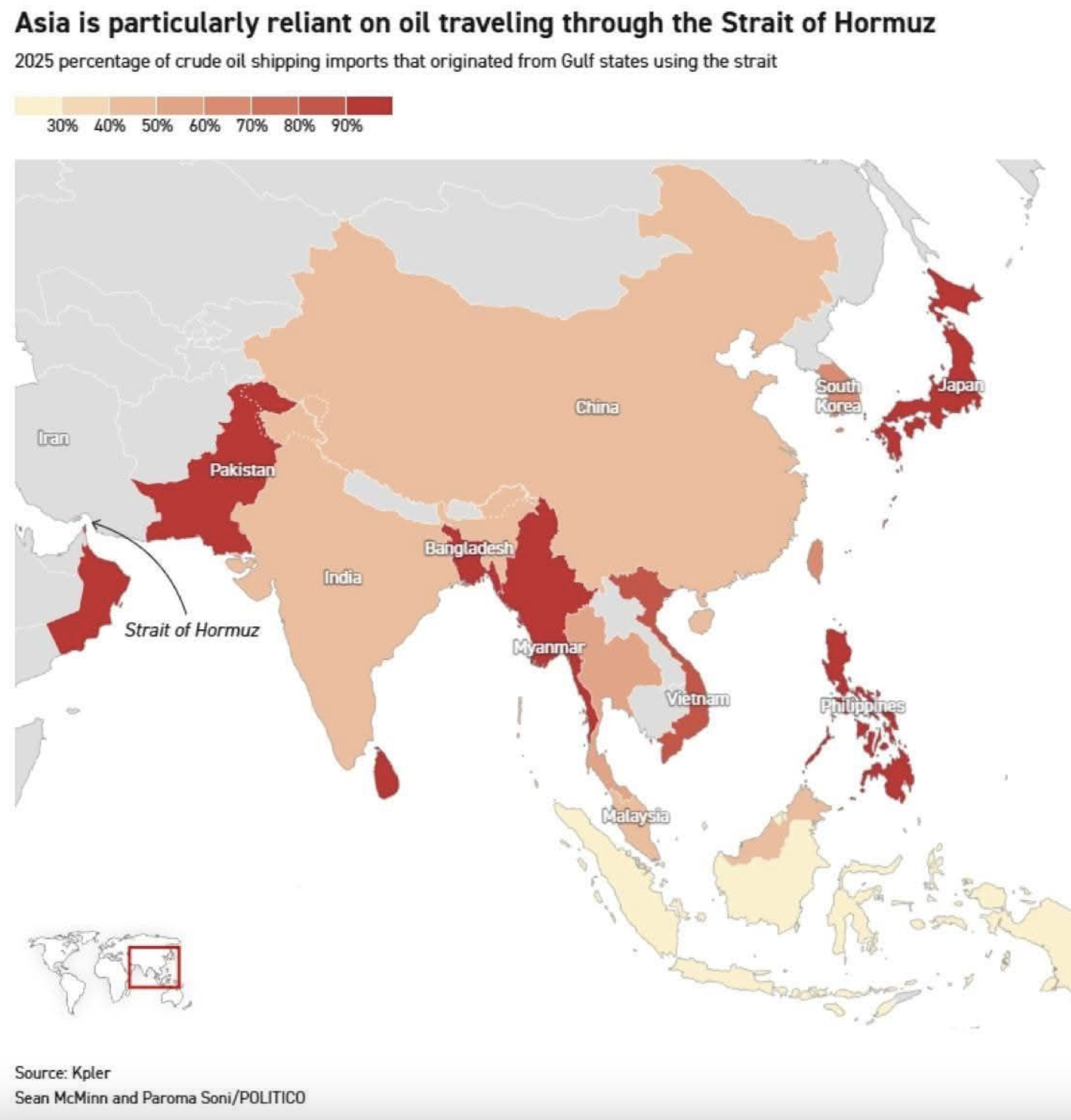
Critically, the burden of this disruption falls overwhelmingly on Asia. Approximately 84% of the crude oil and 83% of the LNG exported through the Strait of Hormuz is destined for Asian markets. China, India, Japan, and South Korea account for most of this demand, making the region the primary engine of Gulf hydrocarbon consumption.
Paradoxically, the region most exposed to the shock is now best positioned — and most strongly incentivized—to accelerate its shift away from oil and gas dependence. The crisis is not only disrupting current flows; it is accelerating the transformation of the very markets that have long sustained them.
Unlike past disruptions, this shock is not merely cyclical. It is catalyzing structural demand destruction and accelerating a permanent realignment of the global energy system.
High prices and physical shortages have forced rationing, curtailed industrial output, and triggered behavioral changes that could make pre-war demand unrecoverable. Reduced commuting, expanded remote work, and aggressive efficiency measures are lowering oil and gas consumption in ways unlikely to reverse.
As in the oil shocks of the 1970s, price signals are driving durable shifts — fuel switching, technological adoption, and policy reform — but today these responses are faster and more decisive. Mature alternatives such as nuclear power, solar energy, and electrification are no longer experimental; they are ready to scale.
Energy security, in this context, is no longer about securing supply lines, but eliminating reliance on them altogether.
Nowhere is this transformation more visible than in Asia, where the loss of Qatari LNG has forced rapid substitution. Japan, historically one of the world’s largest LNG importers, has been particularly exposed. Prior to the crisis, LNG accounted for roughly one-third of Japan’s electricity generation, much of it sourced from Qatar and other Gulf exporters.
The disruption of these flows has created immediate shortages, prompting emergency measures such as increased coal utilization and fuel stock releases.
However, the most consequential response has been nuclear. After more than a decade of post-Fukushima caution, Japan is accelerating the restart of its nuclear fleet. The reopening of reactors at facilities such as Kashiwazaki-Kariwa — one of the largest nuclear power plants in the world — marks a decisive shift in policy and strategy. The impact on LNG demand is substantial.
Each gigawatt of nuclear capacity operating at high utilization can displace roughly 0.7 – 1 million tonnes of LNG annually in power generation. With Japan moving toward restarting 15-20 GW of nuclear capacity over the next few years, LNG demand could fall by 10-15 million tonnes per year — equivalent to roughly 15-20% of its pre-crisis imports.
In effect, a significant portion of what was previously supplied by Qatar is being permanently replaced by domestic nuclear generation. Energy security, in this context, is no longer about securing supply lines, but eliminating reliance on them altogether.
Across the region, similar dynamics are unfolding. China continues to scale both coal-to-chemicals and renewable energy at unmatched speed. South Korea is increasing coal utilization while reconsidering nuclear phase-out policies. Southeast Asian nations are diversifying their energy mixes under pressure.
Because these economies are heavily import-dependent and acutely vulnerable to maritime choke points, the economic logic is clear: domestic, secure energy sources — whether coal, nuclear, or solar — are now strategic imperatives.
In the short term, coal has emerged as the indispensable bridge fuel. Across Asia, countries facing LNG shortages have turned to existing coal infrastructure to stabilize power systems. This resurgence is not ideological regression but crisis-driven pragmatism: coal plants are already built, supply chains are less exposed to choke points, and dispatchable power remains essential when gas is unavailable or prohibitively expensive.
Coal’s role is even more critical in agriculture, through ammonia production. Natural gas provides the hydrogen feedstock for most global ammonia, making fertilizer supply highly vulnerable to gas disruptions. The shutdown of Qatari export capacity — responsible for a significant share of global urea trade — has tightened markets dramatically, driving up prices and threatening food security in import-dependent regions.
In response, India is increasingly following China’s long-established model of coal-to-chemicals production. Faced with both high LNG prices and supply uncertainty, India is expanding coal gasification pathways to produce ammonia and urea domestically. This mirrors China’s approach, where coal-derived syngas substitutes for natural gas in fertilizer production, ensuring supply continuity even under external shocks.
At the same time, India is advancing a longer-term nuclear strategy that could further reduce fossil-fuel dependence. The operationalization of its prototype fast breeder reactor (PFBR) — marks a significant milestone. Fast breeder reactors generate more fissile material than they consume, enabling a closed fuel cycle that dramatically extends resource availability.
For India, this is particularly important given its limited uranium reserves and substantial thorium potential. Over time, a scaled breeder program could provide reliable, low-carbon baseload power, complement renewables and reduce dependence on both imported gas and domestic coal.
This dual-track strategy — coal for immediate resilience, nuclear for long-term independence — captures the broader logic of the current transition. Globally, nuclear power is reemerging as a cornerstone of energy security. Its advantages are uniquely suited to a fractured geopolitical environment: high energy density, stable and stockpilable fuel, and minimal reliance on vulnerable shipping routes.
The crisis has reframed nuclear from a politically contentious option to a strategic necessity.
Across Asia, Japan’s reactor restarts are being mirrored by policy shifts in South Korea and rapid expansion in China. In Europe, renewed LNG shortages have prompted leaders to emphasize nuclear alongside renewables as essential infrastructure. Small modular reactors (SMRs) promise to accelerate deployment and expand access.
At the same time, solar energy is advancing even more rapidly. Its appeal lies in its simplicity and resilience. Solar requires no imported fuel, no shipping lanes, and no exposure to choke points. It is inherently decentralized and scalable, making it ideal for a world where energy security is paramount. Pakistan, which imports 99% of its LNG from the Gulf has seen solar’s share in the country’s energy mix increase from 2.9% in 2020 to a whopping 32.3% in 2025.
The concept of creative destruction is central; demand destruction is already evident and likely permanent.
The crisis has strengthened solar’s economic case dramatically. High fossil fuel prices improve its cost competitiveness, while supply disruptions have pushed governments to prioritize domestic energy generation. Across Asia and Europe, solar deployment is increasingly framed not as environmental policy, but as national security strategy.
Crucially, solar also enables a long-term solution to the fertilizer crisis. Renewable electricity can power electrolysis to produce green hydrogen, which in turn can be used to manufacture ammonia without fossil fuels. While still scaling, this pathway offers a structural exit from dependence on both natural gas and coal in agriculture.
What emerges from the Gulf disruption is a dual dynamic.
In the short term, coal expands to fill immediate gaps in power and fertilizer production. In the long term, nuclear and solar displace fossil fuels altogether. This is not contradiction—it is transition under constraint.
The concept of creative destruction is central; demand destruction is already evident and likely permanent. Behavioral changes reduce transport fuel demand. Industrial systems are being redesigned for efficiency. Most importantly, capital is being reallocated: investments in nuclear plants, solar farms, and electrification infrastructure will lock in lower fossil fuel consumption for decades.
For Gulf exporters, the implications are profound. The immediate loss of export revenue is compounded by a structural decline in future demand. As Asia—their largest market—accelerates diversification, the global market for Gulf hydrocarbons shrinks. The region that once anchored global demand is becoming the epicenter of its erosion.
Comparisons to the 1970s remain instructive but incomplete. Then, oil shocks drove efficiency gains and nuclear expansion. Today, the transformation is broader and faster. Solar costs have fallen dramatically, nuclear technologies are advancing, and energy systems are more flexible and responsive.
Risks remain. Increased coal use could raise emissions in the near term, potentially delaying climate targets and worsening air quality. Inflation and economic strain may constrain clean energy investment, particularly in developing countries already facing food and energy insecurity.
Yet the long-term direction is clear. The crisis has exposed the vulnerability of centralized fossil fuel systems dependent on narrow choke points. In contrast, nuclear and renewable energy offer resilience through diversification and localization.
The Gulf disruption of 2026 is not just a crisis but an inflection point.
Even if the Strait of Hormuz fully reopens, the world will not return to its previous supply-and-demand equilibrium. History may ultimately judge 2026 not as the moment energy markets broke, but as the moment they fundamentally changed.
Rupak Chattopadhyay is President and CEO of the Forum of Federations in Ottawa.