
‘The Irish Unity Dividend’: The Pragmatic Case for a United Ireland
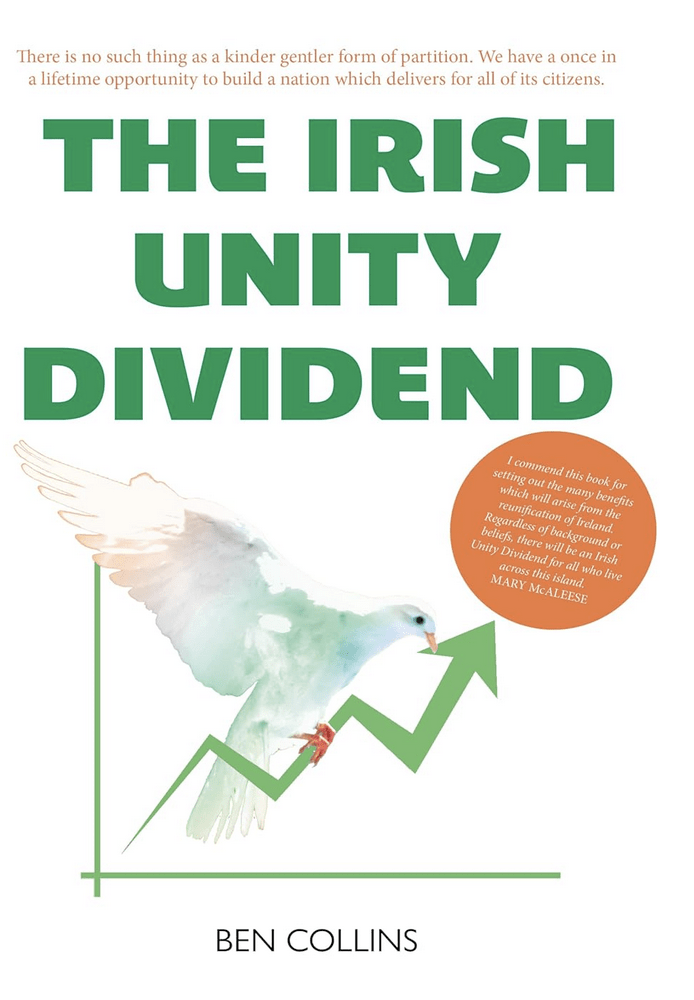
By Ben Collins
Luath Press, 2025/246 pages
Reviewed by Colin Robertson
October 14, 2025
A nation once again, a nation once again
and Ireland long a province be a nation once again.
From the popular Irish nationalist song by Thomas Osbourne Davis.
I’ve always enjoyed Irish ballads and the rousing nationalist songs, especially those played by the Chieftains and sung by Tommy Makem and the Clancy Brothers, whom I saw years ago when they played in Greenwich Village.
The central theme of all this music is about Irish independence and a united Ireland. Ben Collins, in The Irish Unity Dividend, argues that the time is now right for a united Ireland.
For nearly a century, the world was accustomed to watching the cause of Irish Unity waged as a war — with guns, bombs and casualty counts. After more than a quarter-century of relative peace following the Good Friday Agreement, Collins — a Belfast-based lawyer, political consultant and Policy contributor — is marshalling facts and reason to make the pragmatic case.
With politics, demographics, and institutions shifting across both Ireland and in Westminster, Collins argues that the time has finally come for Irish reunification. This would unite the six counties in the north and the 26 in the south with a combined population of just over seven million, about a million fewer than Quebec and slightly smaller in land than New Brunswick.
Describing himself as the product of “a strongly pro-unionist and pro-British background in East Belfast”, Collins says his evolution as an advocate for reunification reflects the post-Brexit generational reassessment of Northern Ireland’s future.
Grounded in identity, history and economic and social reckoning, The Irish Unity Dividend complements and builds on Collins’ 2022 book, Irish Unity: Time to Prepare.
At the heart of The Irish Unity Dividend is his belief that partition has failed the people of Northern Ireland. Citing various data including the April 2025 Economic and Social Research Institute report, Collins notes that “in 2004, the expected lifespan of people on both sides of the border was equal. Now, a child born in 2021 in the South can expect to live for 82.4 years—two years longer than someone born at the same time in Northern Ireland.” Collins argues that gap is symptomatic of deeper systemic failures ranging from health to education to housing.
Northern Ireland, Collins writes, is underperforming if not failing its citizens: Infant mortality is 71% higher than in the Republic and a third of 15- to 19-year-olds in the North are not in the education system. For Collins, these indicators demonstrate “a clear link between poor health outcomes and low educational achievement; between early school leaving and recruitment into paramilitarism and anti-social activities.”
Éire, by contrast, has surged ahead economically and socially. In 2000, Collins points out: “The Republic of Ireland had the same level of GDP per capita as the UK—at the time of writing, the Republic’s GDP per capita is now more than double that of the UK.” Productivity at parity in 2000 is now a 40% gap between Ireland and Northern Ireland.
The broader “dividend” to reunification, argues Collins, includes a better public health system, higher education standards, and “arts funding… more than four times higher in the Republic than the North.” He paints a portrait of two diverging states: a modern, prosperous, and globally integrated Éire and a stagnating Northern Ireland under a Westminster that has other priorities.
For Collins, Brexit is the catalyst for reunification. Brexit has undermined the Good Friday Agreement and exposed Northern Ireland’s peripheral status within the UK. “The harsh fact,” writes Collins, “is that Northern Ireland will always be an afterthought at best in the context of UK political thinking.”
Policy’s Colin Robertson interviews Ben Collins for his Global Exchange podcast/CGAI
The case for Irish unity is reinforced by its increasing alienation from the UK’s political direction. Britain has seen its slowest economic growth since 2010 and faces a “spending black hole”. In contrast, Éire is a destination for foreign direct investment, ranking sixth globally for United States FDI. For Collins, the UK, post-Brexit, is a “sinking ship,” and if Northern Ireland wants to control its destiny across Ireland, “then we need to be separated.”
Brexit has also complicated practical governance. For example, in health care, Collins notes that “Northern Ireland relies on health care staff from outside the UK and Ireland—there are almost 12,000 immigrants working in the health and social care sector in the North.” Brexit restrictions have made recruitment harder, contributing to a system in “crisis”.
Collins stresses the cultural potential of a reunited Ireland, where diversity is seen as strength: He praises the all-Ireland nature of sports like rugby and boxing as “evidence of de facto unity”.
Former Irish President Mary McAleese, in her foreword to the book, asserts that “reconciliation can only be fully achieved through reunification,” provided it includes “respect and safeguards for all cultures and the wonderful diversity which exists across Ireland.”
In an era of hybrid warfare and global turbulence, Collins also argues that Ireland must rethink its neutrality. Noting the vulnerability of undersea data cables—75% of which pass through Ireland’s Exclusive Economic Zone—he warns that “Ireland’s neutrality cannot protect us from potential interference or malicious damage.”
Canadian readers may be surprised by Collins’s emphasis on the Canada-Ireland relationship. Irish Canadians make up over 12 percent of Canada’s population; the third-largest ancestry group. Collins is a keen observer of Canadian politics and a proponent of closer economic and cultural links between Canada and Ireland.
Canadian General John de Chastelain was critical in arms decommissioning. Collins notes Mark Carney has Irish grandparents and played a key role in securing preferential terms for Ireland’s repayment of its loans to the troika following the global financial crisis. With €5.2 billion (roughly $8 billion CAD) of Canadian investment in Ireland and €3.6 billion flowing the other way, Collins sees the potential for a closer bilateral future, a prospect underscored by Taoiseach Micheál Martin’s visit to Ottawa last month amid Prime Minister Carney’s push for trade diversification and a refresh of Canada’s relationships with non-US allies.
In the final chapters, Collins looks ahead. He cites former Taoiseach Leo Varadkar’s statement that “Irish Unity should be an objective rather than aspiration” and notes that his immediate successor, Simon Harris, described a United Ireland as “a legitimate aspiration but not a priority”. For Collins, such hedging no longer suffices. The facts on the ground—economic, political, demographic—tilt in favour of unity.
But are data and economics enough to override generations of resistance in the north? The Irish Times has warned that “economic comparisons, while useful, cannot paper over identity.” Then there are the practical hurdles of currency, taxation, and governance.
The Irish Unity Dividend is timely. But in a time of global shifts, how much appetite is there in Éire, let alone the United Kingdom and its Northern Ireland province, to begin planning, imagining, and preparing for change? To quote the last verse of ‘A Nation Once Again’:
For thus I hoped some day to aid
Oh, can such hope be vain
When my dear country should be made
A nation once again
Contributing Writer Colin Robertson, a former career diplomat, is a fellow of the Canadian Global Affairs Institute in Ottawa and host of the CGAI’s Global Exchange podcast. He is Policy’s principal global affairs book reviewer.