
The Message About Power in Louise Arbour’s Appointment
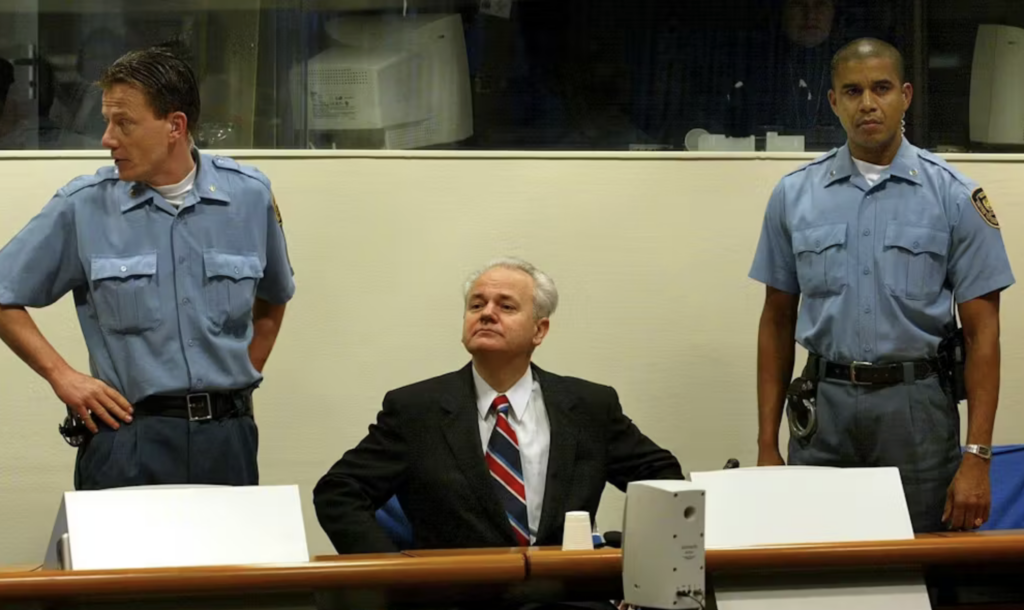 Slobodan Milosevic on trial at The Hague, February, 2002/EPA/pool
May 8, 2026
I spent much of 1998-99 on a Washington wire desk editing stories about the consequences of Slobodan Milosevic’s perverse relationship to power.
Those stories — from the White House, from the State Department, from the United Nations, from NATO headquarters in Brussels, from Pristina, from Belgrade, from Rambouillet, and from brave stringers writing about village after village, town after town, where Milosevic’s thugs had shown up to massacre the men, and, gradually, the women and children of Kosovo — chronicled a genocide, dateline by dateline, as well as the international efforts to stop it.
At The Hague on May 27, 1999, International Criminal Tribunal for the Former Yugoslavia (ICTY) Chief Prosecutor Louise Arbour publicly announced the indictment of Slobodan Milosevic and four other individuals for crimes against humanity.
The charges on 66 counts were as follows: Genocide; complicity in genocide; deportation; murder; persecutions on political, racial or religious grounds; inhumane acts/forcible transfer; extermination; imprisonment; torture; willful killing; unlawful confinement; willfully causing great suffering; unlawful deportation or transfer; extensive destruction and appropriation of property, not justified by military necessity and carried out unlawfully and wantonly; cruel treatment; plunder of public or private property; attacks on civilians; destruction or willful damage done to historic monuments and institutions dedicated to education or religion; unlawful attacks on civilian objects. Further charges of violating the laws or customs of war, grave breaches of the Geneva Conventions in Croatia and Bosnia and genocide in Bosnia were added in 2001.
Roger Cohen’s New York Times piece on the indictment captured the exceptional nature of Arbour’s recourse to the rule of law while the international community was still bargaining with Milosevic, the uphill battle of bringing him to justice amid a byzantine political and geopolitical context, and the “BOOM” effect of the indictment’s timing.
“In effect, the charges branded the Yugoslav Government as a criminal regime, an extraordinary development,” wrote Cohen. “But the arrest of Mr. Milosevic, whose tenacity in holding onto power is by now notorious, appeared highly unlikely in the short term.”
That Milosevic was arrested two years later and ended up in the defendant’s dock at The Hague was a turning point in international justice; a high point, as it turned out.
That KLA leader and former Prime Minister and President of Kosovo Hashim Thaçi is now at The Hague awaiting the verdict in his own war crimes trial for “superior responsibility” in the deaths of 102 civilians during the KLA’s battle to repel Milosevic’s forces is a once unimaginable postscript to that high point.
The propaganda and misinformation that fed the fear-driven social and political license for Milosevic to industrialize evil as a power consolidation tool is significantly easier to manufacture, scale up and spread today than it was then.
As Policy Columnist and former United Nations Ambassador Bob Rae put it in a recent University of Toronto talk, the world has turned upside down.
Indeed, the propaganda and misinformation that fed the fear-driven social and political license for Milosevic to industrialize evil as a power consolidation tool is significantly easier to manufacture, scale up and spread today than it was then.
For Milosevic, mass manipulation by narrative weaponization began on the “Field of Blackbirds” at Kosovo Polje on June 15th, 1989. That day, in the notorious Gazimestan speech, he excavated and amplified the festering national grievance of the Battle of Kosovo on that same field 600 years earlier (read Robert Kaplan’s Balkan Ghosts) by implying that the Serb defeat by the Ottoman Turks could be avenged (in the couched language of “armed battles”) by reclaiming Kosovo — the majority-Muslim/ethnic Albanian, autonomy-seeking province of Serbia — as the cradle of Serb culture and nationalism.
Over the decade that followed, as Milosevic amassed political power by terrorizing 20% of his fellow citizens in Bosnia and Kosovo, in part to keep the rest enthralled, amenable and obedient by using Muslims as both a common enemy and a deterrent to dissidence, the mass graves spread until there were more than 1,600 in Bosnia, followed by 520 in Kosovo after the Dayton Accords of 1995 failed to curb the bloodbath.
Since then, the use of lies and propaganda as a means to otherwise implausible or impossible ends has become a viral, global phenomenon. It has decimated democracy, corrupted elections and referendums, destroyed lives and careers, ravaged multilateral institutions, and rationalized perpetual chaos.
Today’s monsters don’t look like monsters, but then neither did Milosevic who, like so many psychopaths, was described as charismatic, charming, and terribly persuasive. It’s one of the reasons so many people, including his victims, thought he’d never face the justice Arbour delivered.
I have no idea what kind of Governor-General Louise Arbour will be and, I imagine, neither does she, yet. But by choosing her, Mark Carney has delivered two messages to the world: Canada remembers, and the rule of law matters.
By accepting, Ms. Arbour will be filling a role in a global public sphere lately dominated by the devaluation of humanity through not just systematic disenfranchisement but relentless political belligerence and contempt for the truth. She will be filling that role as someone who has, time and again, taken the side of human beings against sometimes formidable unhinged power.
“The measure of her career,” Carney said in his statement at their joint news conference this week, “is neither in the offices she has held nor in the awards she has received. It’s in the lives she has changed through her service.”
In her life as a jurist and investigator, Louise Arbour has done much more than indict Slobodan Milosevic. But as one of those people who remembers just how impossible that act seemed until the very moment it happened, I’ll observe her own caution against cheerleading and simply say, “May her tenure at Rideau Hall be a peaceful one.”
Policy Editor and Publisher Lisa Van Dusen has served as Washington bureau chief for Sun Media, Washington columnist for the Ottawa Citizen, international writer for Peter Jennings at ABC News, and as an editor at AP National in New York and UPI in Washington.