
The Permanent Joint Board on Defence and the Slide from FDR to Trump
By Bob Rae
May 20, 2026
I recently taught an intensive course to Queen’s University graduate students on the origins of the current crisis in the relationship between Canada and the United States, after teaching a similar course at the Munk School in Toronto. It’s been a great experience, and fun to be back in the classroom.
My stay in Kingston included an enjoyable visit with an old friend, Art Milnes — historian, journalist, speech writer, and a source of continuing inspiration. Art asked me to join him one afternoon on a walking tour of the university. Our first stop was right outside the School of Policy Studies, where I was teaching.
Next door were the grounds of the old Richardson Stadium where Franklin Delano Roosevelt received an honorary degree on the afternoon of August 18th, 1938. The speech marked such a key moment in history that Art used it as the anchor of his book, In Roosevelt’s Bright Shadow: Presidential Addresses About Canada from Taft to Obama in Honour of FDR’s 1938 Speech at Queen’s University.
That day, FDR was joined by Prime Minister Mackenzie King and the Governor General of the day, Lord Tweedsmuir, better known as the writer and scholar John Buchan (author of The 39 Steps, which became an Alfred Hitchcock film).
Roosevelt had not had to travel far, just a short trip up the Hudson Valley from Hyde Park. Roosevelt knew Canada and Canadians well, especially from his summers in New Brunswick, on Campobello Island.
Consider the context. Roosevelt could see the European dictators taking land and tearing up the Versailles Treaty. The League of Nations was weak. He was no fan of Chamberlain or appeasement. He could see Europe sinking into deeper conflict. Just a few weeks later the Munich Agreement was signed.
As a younger man, Roosevelt had been a strong follower of President Woodrow Wilson and a supporter of the League of Nations. He was the vice-presidential candidate of the Democratic Party in 1920, an election he lost to an isolationist Republican Party led by Warren Harding, who would go on to lead one of the most corrupt presidencies in American history (I said “one of the most” — we’ll get to the “most” in a moment.)
That day at Queen’s, Roosevelt strode to the podium, flashed his famous grin and said: “The Dominion of Canada is part of the sisterhood of the British Empire. I give to you assurance that the people of the United States will not stand idly by if domination of Canadian soil is threatened by any other empire.”
Roosevelt said many wise things in his speech at Queen’s that stand in marked contrast to the Trumpian rhetoric of today.
Yes, the contrast with our current bilateral dynamic is inescapable.
At the time, Roosevelt’s comment made many headlines because it signalled that he was trying to penetrate the prevailing isolationist mindset and speak directly about the common interest between our two countries. He knew Canada was seen positively in the United States and could use that bridge to prepare Americans for what was to come.
Roosevelt said many wise things in his speech at Queen’s that stand in marked contrast to the Trumpian rhetoric of today.
“Civilization, after all, is not national — it is international,” Roosevelt said as the most uncivilized chapter in human history loomed, “even though that observation, trite as it is to most of us, seems to be challenged in some parts of the world today.”
Addressing what now seems like the downright rudimentary role of lies and propaganda in the rise of fascism, Roosevelt articulated a paradigm that, factoring in technological innovation, could just as easily apply today:
“Ideas are not limited by territorial borders, they are the common inheritance of all free people…of all the devastations of war none is more tragic than the destruction it brings to the processes of men’s minds. Truth is denied because emotion pushes its aside. Forbearance is succeeded by bitterness. In that atmosphere, human thought cannot advance.”
Roosevelt also took the time to stress the importance of openness and candour in the conduct of diplomacy between our two countries. He emphasized that “We maintain our own rights with frankness because we refuse to accept the twists of secret diplomacy, because we settle our disputes by consultation and because we discuss our common problems in the spirit of the public good.”
There would be differences, and expressions of opinion on all sides.
“We cannot prevent our people on either side of the border from having an opinion in regard to wanton brutality, in regard to undemocratic regimentation, in regard to misery inflicted on helpless peoples, or in regard to violations of accepted individual rights…that is what we mean when we say that public opinion ultimately governs policy. It is right and just that this should be the case.”
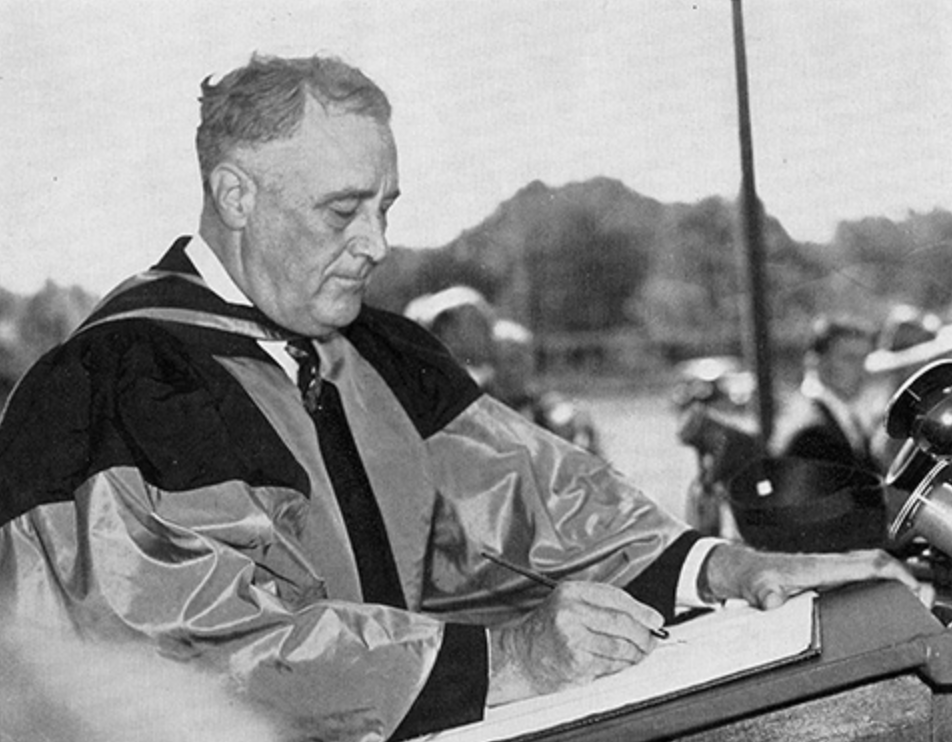 Franklin Delano Roosevelt at Queen’s University on August 18th, 1938/Queen’s University
Roosevelt’s great challenge was moving American public opinion to a deeper understanding of the fascist threat in Europe. He was confronting the America First movement led by Charles Lindbergh, and that prevented him from doing more to stop the outbreak of war in September of 1939.
But bilateral diplomacy between Canada and the United States deepened at this time and led to a bold move between Roosevelt and King, and their governments.
On September 10th, 1939, Canada declared war on Germany following Hitler’s unilateral invasion of Poland.
Every effort was being made to overcome the low defence expenditures that marked the years between 1918 and 1939, but mobilization was facing its challenges. King and Roosevelt decided to build on what Roosevelt had discussed publicly in his Kingston speech, and what both sides had been discussing privately since then.
On August 17th, 1940, nearly two years later to the day from Roosevelt’s address at Queen’s, Prime Minister King was driven down to Ogdensburg, New York, 100 km south of Ottawa.
There, he was met by Franklin Roosevelt and his Secretary of War, Henry Stimson, who had come up by train. They talked through dinner in Roosevelt’s private railway car, and kept going through the evening.
The conversation was cordial and practical. Roosevelt made it clear that he wanted to make good on the commitment he had made in Kingston two years before, and that he had specific ideas on joint efforts to protect the St. Lawrence River, the security of Newfoundland and the Eastern Seaboard of both Canada and the United States.
A Gallup Poll taken in November 1940 revealed that 83.8% of Americans supported the establishment of the Permanent Joint Board on Defence.
They then proceeded to draft five short paragraphs on what should happen next. This would be known as the “Ogdensburg Declaration”. It was released on Sunday, August 18, 1940, the second anniversary of Roosevelt’s Queen’s convocation address.
Here is the wording:
“The Prime Minister and the President have discussed the mutual problems of defence in relation to the safety of Canada and the United States.
It has been agreed that a Permanent Joint Board on Defence shall be set up at once by the two countries.
This Permanent Joint Board on Defence shall commence immediate studies relating to sea, land, and air problems including personnel and material.
It will consider in the broad sense the defence of the north half of the Western Hemisphere.
The Permanent Joint Board on Defence will consist of four or five members from each country, most of them from the services. It will meet shortly.”
The American Institute of Public Opinion in Princeton New Jersey had been following closely the evolution of public opinion on the war. Coincidentally, my father Saul had, after completing his doctorate at the London School of Economics on “Public Opinion and Its Measurement” and doing a post-doc term at Oxford, joined George Gallup in Princeton to work on precisely this subject from 1939 to 1940, when he joined the Department of External Affairs in Ottawa.
A Gallup Poll taken in November 1940 revealed that 83.8% of Americans supported the establishment of the Permanent Joint Board on Defence, which followed a June 1940 poll where 81% of Americans supported sending troops to Canada in the event of a foreign attack. It is important to recognize, by way of contrast, that in April of 1941 two thirds of Americans polled opposed sending troops to Great Britain.
After the Pearl Harbor attack of December 7, 1941, President Roosevelt said “a state of war exists” between the United States and the Japanese Empire. Germany soon declared war on the United States, not the other way around.
We are now a long way from the spirit of Ogdensburg.
The announcement this week from the Trump administration that it is unilaterally “suspending” its participation in the Permanent Joint Board on Defence (or Defense, to Americans) after 88 years opens a new source of contention between our two countries.
Above all, it serves as a potent reality check from a country whose geopolitical loyalties have been shifting for years from the rules-based order that reflected Roosevelt’s values to the autocratic one that offends them all.
Policy Columnist Bob Rae teaches and writes on law and public policy. He is the Visitor of Massey College, a Distinguished Fellow at the Munk School at the University of Toronto, a Senior Fellow at the Forum of Federations, and a Matthews Fellow in public policy at Queen’s University. He served as Ontario’s 21st Premier, interim leader of the Liberal Party of Canada, and Canada’s Ambassador to the United Nations.