The Private Pearson: A New Perspective on Power
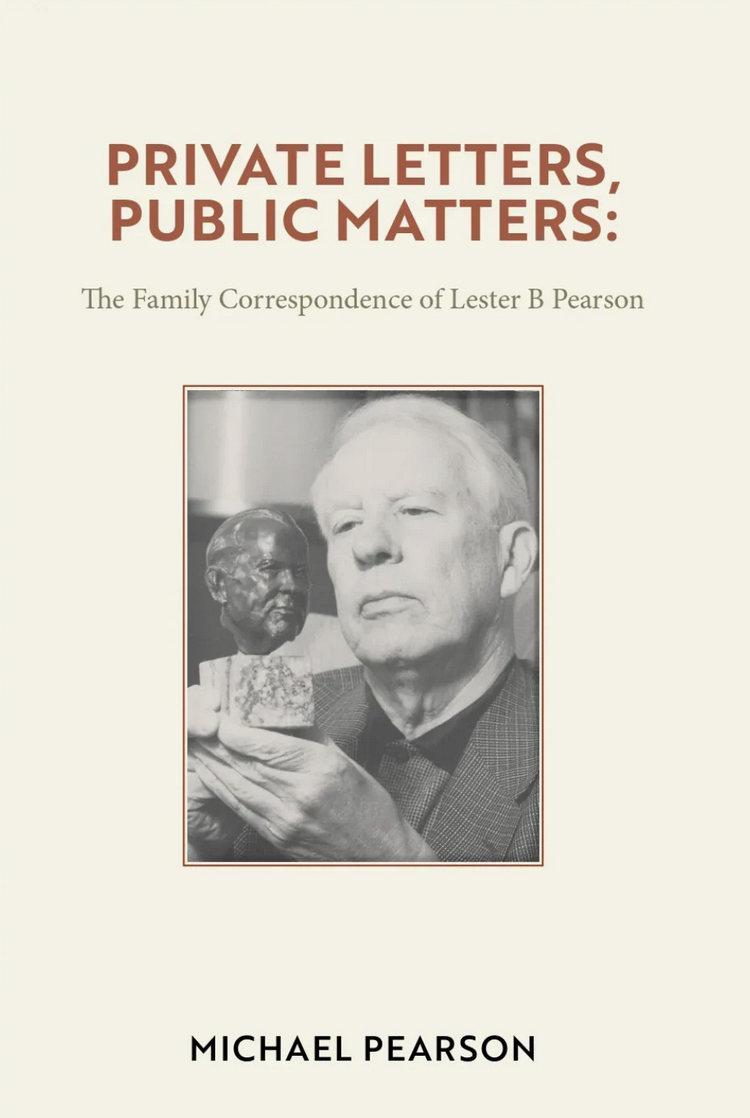
Private Letters, Public Matters: The Family Correspondence of Lester B. Pearson
By Michael Pearson
Bellwoods Press, April 2026/350 pages
Reviewed by Colin Robertson
April 14, 2026
Once again, Canada is searching for its place in a harsher, less forgiving world.
Private Letters, Public Matters: The Family Correspondence of Lester B. Pearson is an insightful biography of former Prime Minister Lester B. Pearson, written by his grandson, Michael, and landing at what could not be a more opportune moment in that search.
The book describes how this exceptional Canadian understood power: not as dominance, but as influence earned through judgment, timing, and trust.
The author draws on biographies, scholarly sources and original documents, including from decades of correspondence between Pearson and his son Geoffrey, Michael’s father, who was also a diplomat.
We see not the myth of Pearson the sainted peacekeeper, but the reality of “Mike”: shrewd, ironic, often distant, but always engaged with the world as it was—not as he wished it to be.
Pearson, a master of diplomacy, rarely indulged in sentiment at home. His son recalls an “emotional distance,” a tendency to deflect feeling with humour or anecdote. This was not coldness so much as discipline. Pearson belonged to a generation shaped by war and scarcity, men who believed that feelings and their personal lives were private, but responsibilities were public. They took policy development and execution seriously.
Pearson’s sense of responsibility was expansive.
From London and Washington during the Second World War, he grasped what many in Ottawa were slow to accept: the British world was fading, and Canada’s future lay in North America. Canada must remain, he wrote, “a separate national entity… while making concessions to our ‘manifest destiny’ as a North American state.”
Yet, he also understood the danger. The United States was indispensable—but not infallible. Canada’s task, he wrote, was to stand up for its own interests, “without destroying the especially close relationship” with its neighbour.
That balancing act became the essence of Pearson’s statecraft.
It found institutional form in what came to be known as functionalism: the idea that countries should have influence in proportion to their capacity and contribution. For a middle power like Canada, this was strategy disguised as principle. It opened doors — to the United Nations, to NATO, and to the alphabet soup of postwar institutions where Canada had interests.
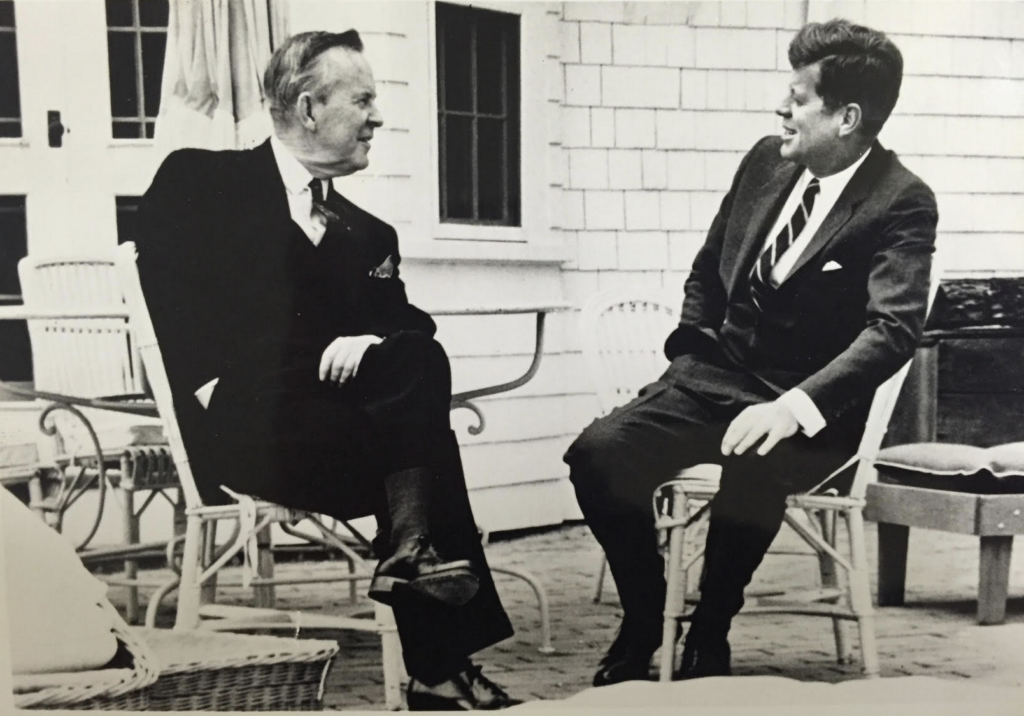 Lester Pearson with John F. Kennedy at Hyannis Port in May, 1963/CP
Pearson was not just present at the creation; he was, as his son notes, a midwife. He helped shape the UN system and NATO, championed international development through agencies like the FAO, and insisted that cooperation — however imperfect — was the only alternative to chaos. As he warned in 1947, a beautifully designed international order without great-power buy-in would be “a motor car without an engine.”
That insight feels uncomfortably current.
Pearson’s greatest test came in 1956, during the Suez Crisis. With Israel’s collaboration, Britain and France, clinging to imperial illusions, invaded Egypt.
President Eisenhower and the United States, furious but cautious, sought a way out. Into the breach stepped Pearson, proposing a United Nations peacekeeping force—the first of its kind—to separate combatants and defuse the crisis.
It was classic Pearson: pragmatic, inventive, and perfectly timed. “Diplomacy,” he liked to say, “is the art of letting someone else have it your way.”
Suez earned him the Nobel Peace Prize and gave Canada a role on the world stage that exceeded its relative weight. The correspondence and retrospective reflections in this volume highlight the qualities that enabled his success: “Fear, trust, humility”.
For LBP, all three were instrumental in his success during the Suez crisis. Fear can be a great motivator remarked Pearson: “The alternative to peace now is not war; the alternative to peace is global destruction.”
Colin Robertson in conversation with Michael Pearson/CGAI
Pearson was no naïve idealist. On nuclear weapons, he lived with contradiction. He accepted deterrence as necessary while arguing for disarmament. He resisted pressure to make Canada a nuclear power, warning that proliferation would weaken global stability. He understood, as we are relearning, that security is rarely a choice between purity and compromise.
Pearson’s approach to the United States was equally clear-eyed. “Marching with the United States,” he argued, “does NOT mean being pulled along.”
In Washington, Pearson learned the art of influence without power. He recalled his first experience “protecting Canadian rights against American encroachment,” sparked by an aggressive U.S. maritime incursion into Canadian territory chasing a fishing boat. Canada, he observed, could “stand up for our own rights without destroying the especially close relationship.”
This insight —balancing autonomy with partnership — became a defining feature of his approach to Canada – U.S. relations.
It also influenced his approach to national unity and federal-provincial relations, especially in his attitude to Quebec in the wake of la revolution tranquille and his belief that Canadian national unity depended on a “deeper unity based on the recognition of differences”. He formalized federal-provincial engagement. In 1965 alone, there were 125 conferences on issues like Medicare, pension reform and equalization.
Today, that confidence feels in short supply.
Pearson’s critics, then and now, accuse him of ambiguity — of saying no in a way that sounded like yes. His own son noted that diplomatic habits did not always translate well into politics.
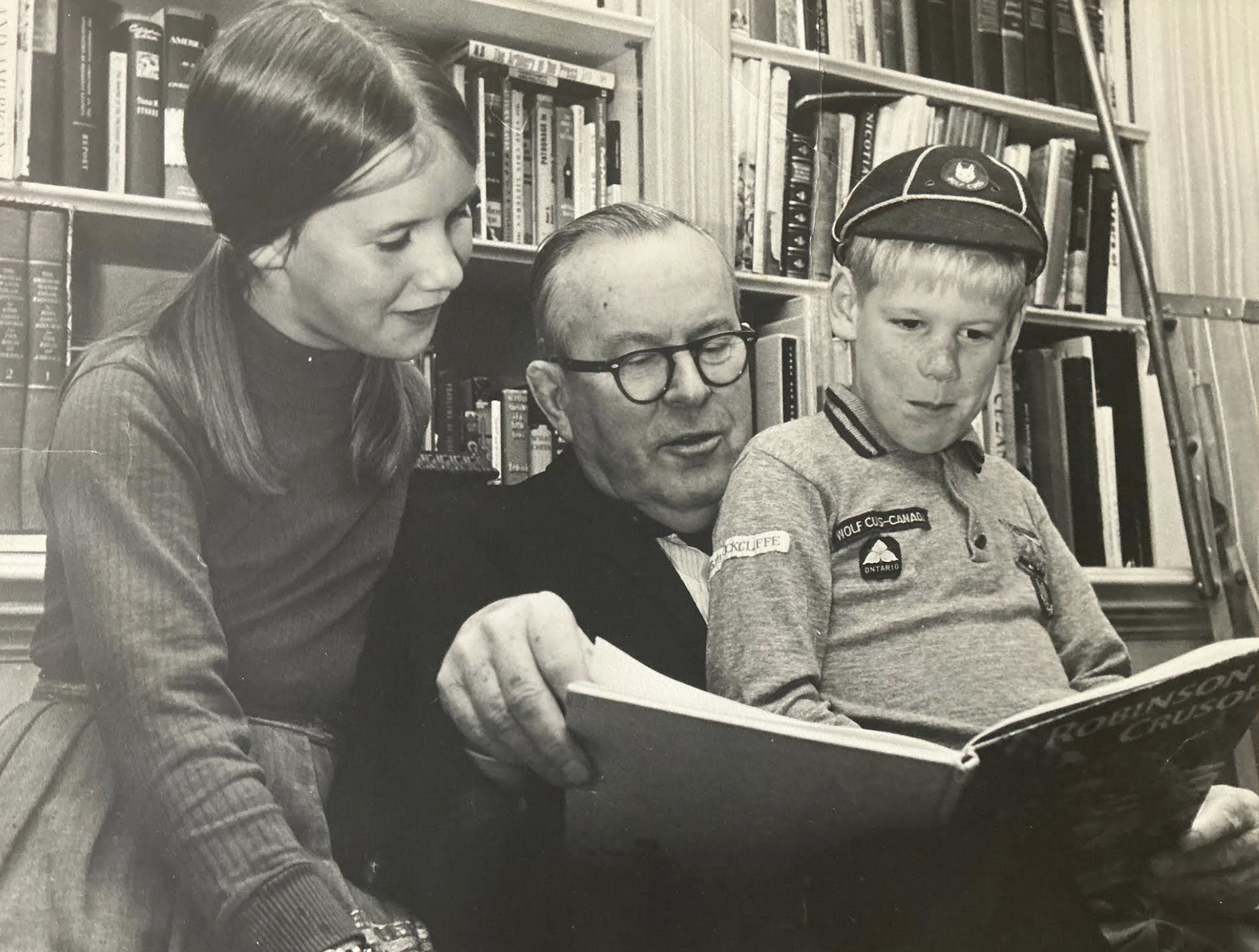 Lester Pearson with grandchildren, Katherine and Michael/Pearson family
Yet, that ambiguity was often a form of flexibility, a refusal to be trapped by false choices. As one colleague put it, Pearson moved “crabwise” —sidestepping obstacles, circling back, finding solutions where others saw dead ends. It helped make his minority governments remarkably successful in legislative achievement: Medicare, a labour code, pension reform and the ‘Pearson pennant’; our maple leaf flag.
It is a style ill-suited to the age of social media, but perhaps exactly what today’s moment demands.
What makes Private Letters, Public Matters so compelling is not just the portrait of a statesman, but of a relationship. The correspondence between father and son is marked by warmth but especially by intellectual engagement.
Pearson encourages, teases, advises: “You have a gift, my boy, for short, sharp, verbal analysis,” he told Geoffrey, “which should make you a great success in External Affairs—if it doesn’t get you fired!”
Geoffrey emerges as “an acquired taste… acerbic and difficult” at first encounter, yet possessed of “shrewd intelligence, sharp wit, and exceptional generosity.” I can attest to those qualities, as he was my boss when I joined the Foreign Service.
The correspondence between father and son is, in its way, a diplomatic exchange — measured, probing, respectful. There is affection here, but it is understated. Pearson was often absent, his life consumed by the demands of diplomacy and politics. Yet, the letters sustained the bond. They remind us that public service, at its highest level, is rarely compatible with ordinary family life.
Private Letters, Public Matters is an important study of our greatest diplomat. Well-written and well-researched, it has insight and pace. Reading it reminds one that public service — as civil servant or legislator — is still a high calling, vital to national success.
So, what should we take from Pearson now?
Not nostalgia. The world he helped build is fraying, and the conditions that made his approach possible—American leadership, institutional stability, a broad consensus on liberal order—no longer hold.
But his method still matters.
Pearson understood that middle powers cannot coerce, but they can convene. They cannot dictate outcomes, but they can shape them. They must work through institutions, build coalitions, and—above all—maintain credibility. Influence, in his world, was earned through consistency and judgment.
Above all, he believed that peace required effort. “Peace,” he wrote, “was a policy as well as a prayer.”
In our age of uncertainty, Pearson’s example —balancing principle with pragmatism, national interest with international responsibility — would serve us well.
Contributing Writer Colin Robertson, a former career diplomat, is a fellow and host of the Global Exchange podcast with the Canadian Global Affairs Institute in Ottawa and Policy’s principal foreign affairs book reviewer.