
‘The Revolutionary Center’: Defying Illiberalism and its Discontents
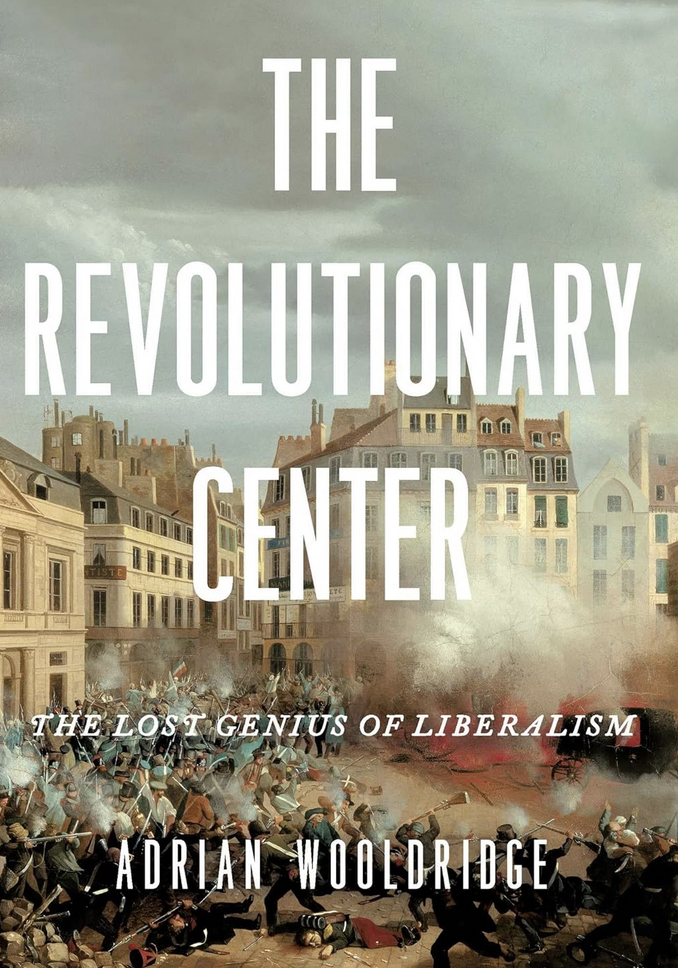
The Revolutionary Center: The Lost Genius of Liberalism
By Adrian Wooldridge
Pegasus Books, April 2026/416 pages
Reviewed by Colin Robertson
May 6, 2026
Liberalism is “under mortal threat” but it can still be restored. So argues Adrian Wooldridge in The Revolutionary Center: The Lost Genius of Liberalism.
A respected journalist and author, former political editor and Jack-of-all-unsigned-columns — Lexington, Bagehot, Schumpeter — for The Economist, Wooldridge is now Bloomberg global business columnist.
He has written a book that is variously a work of intellectual history, a polemic, and a reform manifesto. The Revolutionary Center traces liberalism from its intellectual origins in early modern Europe to the contemporary crisis of democratic capitalism.
It offers both a warning and an opportunity for reform that should appeal to Prime Minister Mark Carney in his pursuit of ‘values-based realism’ both at home and in a geopolitical environment of ‘variable geometry’.
Wooldridge argues that liberalism’s survival depends on rediscovering its adaptive, moderate and problem-solving character. His central insight is simple: liberalism was never a fixed doctrine; it is “a set of solutions to a set of concrete, real-world problems…It is dynamic rather than dogmatic.”
Liberalism solved the problems of arbitrary power, religious coercion and economic stagnation in the 17th and 18th centuries. It adapted to industrial capitalism in the 19th. It reinvented itself again in the 20th through welfare states and antitrust regimes.
Liberalism’s “revolutionary” aspect lies in its willingness to challenge entrenched interests and adapt institutions. Liberalism, declares Wooldridge, “is an argument not a catechism.” At its core, liberalism rests on several enduring principles: individualism; freedom; pluralism; scepticism; and constraint on power.
Liberalism survived, says Wooldridge, because it changed. But today, liberalism is failing because it stopped adapting to changing circumstances created by geopolitics, cultural shifts, and technological innovation.
Globally, liberalism faces what Anne Applebaum calls ‘Autocracy, Inc.’, led by China and Russia, a network of regimes that “share technologies, tactics and ideas in order to create a new, illiberal world order.”
These regimes — arguably morphing into one borderless regime based on the force multiplying ballast of Donald Trump’s illiberalism — reject liberal norms, suppress dissent, and promote alternative models of governance. The danger is not merely geopolitical but ideological: the possibility that the world is becoming “safe for autocracy”.
Equally damaging, in Wooldridge’s view, is liberalism’s internal decay: tech monopolies, unmanaged immigration, social fragmentation, and a culture that confuses tolerance with indifference.
Liberalism in the West, argues Wooldridge, has drifted into a thin, utilitarian creed in which the individual is reduced to “a pleasure, profit-maximizing entity,” and the public good is neglected.
For Wooldridge, “the quintessential image of modern liberalism is the billionaire taking a private jet to Davos to deliver a speech on climate change.” He is particularly critical of the left’s move “into the swamp of identity politics and ‘cancelling’”.
Small wonder then that populism has found fertile ground. What Wooldridge describes as a “malign dialectic of extremes reinforcing each other and alienating the sensible centre” exploits grievances, including economic dislocation and cultural anxiety. Liberalism is plagued by failures, but populist solutions are “far worse than the disease”.
So how does liberalism retrieve its “lost genius”?
Liberals, writes Wooldridge, must also rediscover their intellectual tradition — John Stuart Mill and Alexis de Tocqueville — and recommit to core principles such as free speech and pluralism. This means protecting “the great arteries of liberal society” and reviving liberalism’s spirit of adaptability: “Adaptability is in its DNA”.
Begin by taking the populist complaints seriously. Manage immigration more effectively. Address quality-of-life issues. Rebuild social cohesion. Revive a liberal education in schools, colleges, and universities. Strengthen and enforce defenses against authoritarian interference.
Externally, this requires renewed commitment to alliances, plurilateral institutions, and the rules-based system. Wooldridge’s critique and prescription land squarely on the terrain that Prime Minister Mark Carney now occupies.
The Revolutionary Center is an impressive synthesis of history, political theory, and contemporary analysis. Wooldridge reminds us that liberalism’s strength lies not in rigid doctrine but in its capacity for adaptation, debate, and reform.
Carney’s “values-based realism” is an attempt to navigate a fractured global order, one in which alliances are fluid, institutions are strained, and power is diffusing. Carney’s answer is to build coalitions of the willing, anchored in shared norms and practical cooperation. It is a strategy of flexibility without abandonment of principle.
But Wooldridge would argue that flexibility alone is not enough. The liberal centre must not only adapt its alliances; it must rethink its assumptions.
Take economic policy. For decades, liberal governments embraced market primacy and consumer welfare as the guiding principles of policy.
Wooldridge argues that this is no longer adequate in an age of platform monopolies and algorithmic power. Antitrust must move beyond prices and consider concentration, influence and the health of democracy itself.
Carney’s background makes him well-placed to understand this shift. His emphasis on resilience, supply chains and economic sovereignty already points in that direction. But Wooldridge warns liberalism cannot survive if it allows private power to become as unaccountable as the state power it once restrained.
On defence and security, Wooldridge stresses that liberalism emerged in part to constrain arbitrary authority but that does not mean it can ignore hard power. The return of great-power rivalry demands a liberalism that can defend itself.
Carney’s commitment to NATO spending targets and renewed defence capabilities reflects this reality. But defence is not only about budgets and hardware. It is about the preservation of a liberal order that is increasingly contested both from outside and within. A liberalism that cannot enforce rules will not sustain them.
Immigration is where Wooldridge’s critique bites. Liberal societies have failed to manage migration and assimilation in ways that sustain social cohesion. The result is backlash.
Carney has spoken of immigration as an economic necessity and a source of dynamism. Wooldridge argues that economic arguments alone are insufficient. Liberalism must also articulate a credible account of belonging, integration and the public good.
The same logic applies to trade and globalization. Carney’s approach — diversification, resilience, and strategic partnerships — reflects a recognition that the era of frictionless globalization is over. Open markets remain essential, but they must be balanced against security, fairness, and political sustainability.
Above all, Wooldridge’s message is about intellectual honesty. Liberalism, he argues, cannot survive by denying its failures. It must “own its mistakes” and develop new solutions. That requires acknowledging that critics on both the right and the left are often identifying real problems, even if he considers their proposed solutions misguided.
This is where Carney’s emphasis on coalitions of the willing intersects with Wooldridge’s call for renewal. In a world of “variable geometry,” no single alliance or institution can address every challenge. Networks of cooperation on climate, technology, security, are essential. But those networks must be underpinned by a revitalized liberalism that knows what it stands for.
The Revolutionary Center is an impressive synthesis of history, political theory, and contemporary analysis. Wooldridge reminds us that liberalism’s strength lies not in rigid doctrine but in its capacity for adaptation, debate, and reform.
Liberalism is “a repository of political sense and practical problem-solving”.
The alternatives to liberalism, whether authoritarian nationalism or illiberal populism, have historically led to catastrophe. As Wooldridge observes, “the illiberal regimes that replaced liberal ones were invariably horrific.”
The question then is whether liberalism can once again adapt to changing circumstances. Wooldridge has provided those who develop and determine policy with the history, diagnosis, and prescription to at least try. The Revolutionary Center is a good place to start.
Contributing Writer Colin Robertson, a former career diplomat, is a fellow and host of the Global Exchange podcast with the Canadian Global Affairs Institute in Ottawa and Policy’s principal foreign affairs book reviewer.