
The Timeless Alexis de Tocqueville as a Guide to America at 250
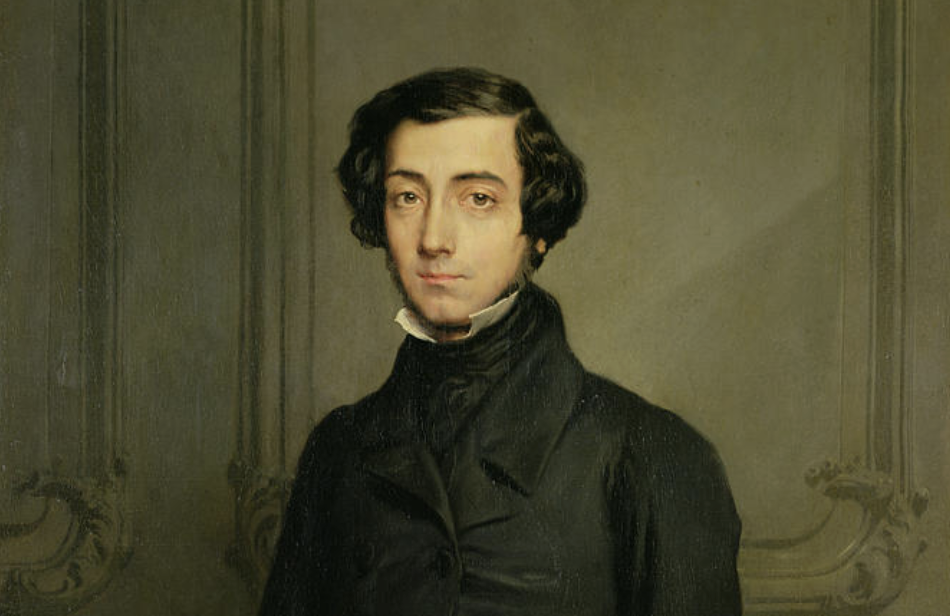 Alexis de Tocqueville by Théodore Chasseriau-Versailles/Wikipedia
July 3, 2026
As the United States celebrates its 250th anniversary, there is no better guide to understanding America than John Prideaux’s superb six-part Economist podcast, Tocqueville Road Trip, and no better time to revisit the book it is based on.
Prideaux, The Economist‘s executive editor, retraces the 1831 journey of French diplomat, parliamentarian, and philosopher Alexis de Tocqueville that produced his two-volume 1835/1840 masterwork, Democracy in America.
In doing so, he demonstrates that the surest way to understand the United States is not through social media, cable news or partisan rhetoric, but via a practice made famous by Tocqueville and revived by successors from Jack Kerouac to John Steinbeck — travelling the country, talking to its people, and observing its institutions.
Tocqueville, Prideaux says, was “a foreign correspondent and political analyst before either was really a thing.” Nearly two centuries later, his observations remain “not only true, but profoundly useful.”
Together, the podcast and Democracy in America offer perhaps the clearest lens through which Canadians can understand both the roots of Donald Trump’s America and the enduring resilience of American democracy.
I’d browsed Tocqueville at university but when I was posted to Canada’s Consulate General in New York, then deputy minister Allan Gotlieb told us it was required reading.
To expand our outreach with US legislators, Gotlieb, who later became Canada’s longest-serving ambassador to the U.S., instructed Canadian diplomats to spend more time understanding America where Americans actually lived—in congressional districts, state capitals, boardrooms, universities and town halls.
As Gotlieb would remind me, the United States is more than a county, it is a civilization, that we must understand.
Tocqueville explained something every Canadian diplomat eventually learns: America cannot be understood from Washington alone.
Published in two volumes in 1835 and 1840 after a remarkable nine-month, 3,000-mile journey through seventeen states, Democracy in America is not really a book about America. It is a book about democracy itself.
Tocqueville’s great insight was that democracy is far more than constitutions, elections or institutions. It is, above all, “a social condition”—a set of habits, beliefs, voluntary associations and moral practices that teach citizens how to govern themselves.
If America often appears simultaneously resilient and unstable, optimistic yet polarized, decentralized yet increasingly dominated by presidential power, Tocqueville explains why.
He was equally struck by what Americans did between elections as during them. “Americans of all ages, all stations in life, and all types of disposition,” he wrote, “are forever forming associations.” Churches, volunteer fire departments, charities, newspapers, civic clubs, neighbourhood committees and professional organizations all taught habits of cooperation, compromise and responsibility.
Democracy, he concluded, depended less on constitutions than on citizens learning to work together. Today’s political scientists call this “civil society.” Tocqueville simply called it the foundation of liberty.
Tocqueville celebrated independent courts, decentralized government, civic organizations, a free press and the rule of law. Constitutions alone cannot preserve democracy if civic habits have weakened.
Prideaux structures Tocqueville Road Trip around six enduring Tocquevillian themes.
Beginning in New York, he explores the American Dream and the country’s remarkable capacity for reinvention. In Boston and Cambridge, he examines education, meritocracy and the emergence of a new elite. Travelling through the industrial Midwest, he considers technology, manufacturing and widening inequality.
He revisits slavery and the enduring divide between North and South, showing how America’s original sin continues to shape race, politics and national identity.
If America often appears simultaneously resilient and unstable, optimistic yet polarized, decentralized yet increasingly dominated by presidential power, Tocqueville explains why.
Other episodes explore immigration, religion, local democracy and, finally, the dramatic expansion of presidential power. Throughout, Prideaux asks a deceptively simple question: how much of the America Tocqueville admired still survives?
His answer is both unsettling and hopeful.
One of Tocqueville’s most prescient observations concerned the presidency. He wrote that the American president possessed “almost royal prerogatives” but rarely had the opportunity to exercise them fully. Prideaux argues that circumstances have changed dramatically.
While producing the series, he watched President Trump exempt members of his family from tax scrutiny, target major companies through executive authority, publicly attack the Chief Justice of the Supreme Court, propose placing his own image on American currency and passports, and pursue increasingly monarchical symbolism around the presidency.
Meanwhile, Congress has steadily surrendered influence as executive government has expanded.
“The president may not be about to become a full-blown dictator,” Prideaux concludes, “but he has demonstrated, beyond all doubt, the power and scope of his office’s almost royal prerogatives.” America at 250, he suggests provocatively and ironically, increasingly resembles “the rule of King George III.”
Yet Prideaux’s most important conclusion points in the opposite direction. Travelling through the America that rarely appears on cable television or social media, he encountered a country that Tocqueville would instantly recognize. “The America I encountered,” he writes, “was starkly different from the crisis-riven country you learn about on social media, talk radio, or cable news.”
He found generous, welcoming citizens who disagreed less than popular narratives suggest and who remained deeply attached to the values upon which their republic was founded.
Most importantly, he concluded that democracy was still evident “as a social condition”—not merely an electoral system, but a set of habits woven into everyday American life.
Tocqueville also anticipated the crisis of fragmentation, isolation, and weakening institutions that once formed civic character in his discussion of democratic individualism. Politics cannot repair a society that has forgotten how to associate, trust and compromise. Good government ultimately depends upon good citizens.
There is an important lesson here for Canadians. We often reassure ourselves that “we are not America.” That is true, but it can also encourage complacency.
Canada shares many of America’s democratic strengths—and many of its vulnerabilities. We face declining trust in institutions, weakening journalism, increasing executive centralization, reduced civic participation and growing political polarization.
Tocqueville’s prescription remains remarkably contemporary: strong local government, an independent judiciary, a free press, vibrant voluntary associations, healthy political parties and civic institutions capable of forming responsible citizens.
Nearly two centuries after his remarkable journey, Tocqueville remains America’s greatest foreign interpreter because he understood that democracy is never finished. It is not self-sustaining. It depends upon habits that every generation must renew.
That is why Democracy in America remains essential reading—not only for Americans confronting an era of extraordinary political change, but for Canadians whose prosperity, security and future remain inseparable from the fate of the republic next door.
The daily headlines tempt us to judge America by its political drama. Tocqueville — and now Prideaux — invite us to look deeper.
Beneath the noise, beneath the partisanship and beneath the presidential spectacle, democratic habits still endure. The question confronting Americans is the same one Tocqueville posed nearly two centuries ago: can those habits remain strong enough to restrain power, renew trust and preserve liberty?
Canada has every interest in hoping the answer is yes — and every reason to remember Tocqueville’s timeless warning that democracy survives not because institutions are perfect, but because citizens continually choose to sustain them.
Contributing Writer Colin Robertson,C.M., C.D, a former career diplomat, is a fellow and host of the Global Exchange podcast with the Canadian Global Affairs Institute in Ottawa.