
‘This Was Always Yours’: Seeking the Canada Beyond Words in its National Parks
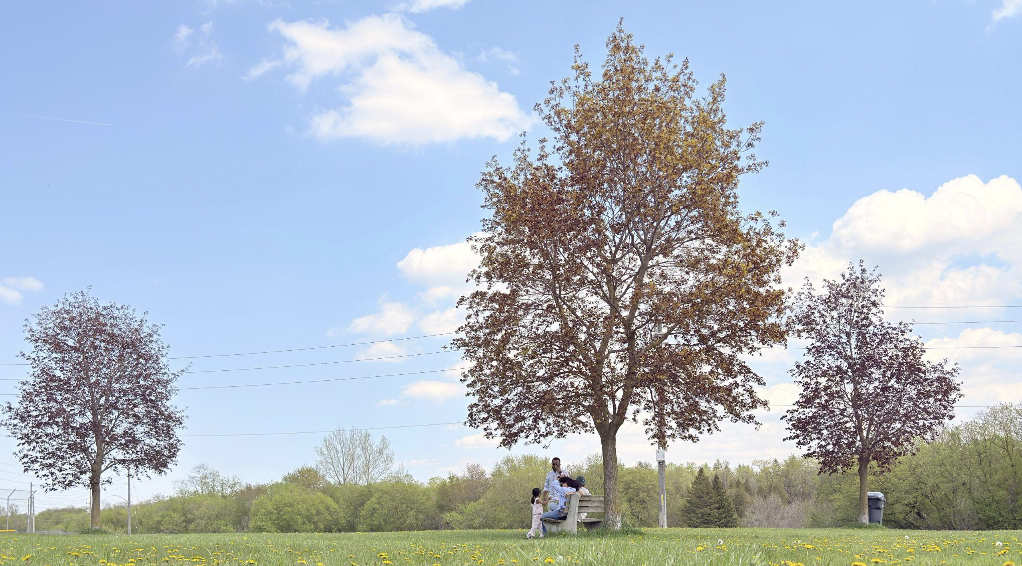 Eramosa River Trail, Guelph, Ontario/Anil Wasif
By Anil Wasif
June 3, 2026
There is a Tagore song my grandmother sang that begins with the sky full of sun and stars and the world full of life, and then turns, almost shyly, to the singer’s own small place inside all of it. Akash bhora surjo tara.
The refrain keeps coming back to one word, wonder; in wonder my song awakens. I did not understand it as a child. I just knew the feeling, which I inducted in a Bangladesh village one long-ago summer, when nothing was scheduled and nothing was charged.
I walked because walking was what there was. I threw stones into the lake to watch the rings widen and vanish, and I dug in my grandmother’s garden until my hands smelled of soil and tomato leaves.
Tagore wrote that song late, having spent his most alive years on a houseboat on the Padma, among the river villages, learning the water by heart. For him, nature was never scenery to be looked at. It was the thing you lived inside until it lived inside you, until it woke the song.
That is the oldest and simplest joy there is: a child opens a door and the whole world is waiting. This summer, I decided to go looking for that door again, as many times as I can find it.
There have been so many arguments about what this country might be, should be, I’m going to explore what it is beyond words. I am trying to reach 50 national parks before September, the famous ones and the small ones and the parkettes nobody slows down for, and the plan has turned into a tour of just how much Canada there is to love.
Mark Carney’s Canada Strong Pass, which is back from June 19 to September 7, does something quietly generous. It throws the gates open. Free admission at every national park, every historic site, every marine conservation area Parks Canada keeps, a quarter off the campsite, a discount on the train that takes you there.
Nothing to buy, nothing to print. You show up, and the country says, “Welcome, this was always yours.”
People have answered the invitation in numbers that gladden the heart. Last year, Parks Canada welcomed 26.2 million visitors from more than a hundred countries, and they spent 6.5 billion dollars in the towns around the gates — money that becomes a baker’s morning and a guide’s good season and a kid’s first summer job at the trailhead.
As an economist, I know about supply and demand. As a tourist, I know this: Drop the price of getting in and people come, and they bring their delight with them — families who had half-decided the wild places were for other people suddenly finding the door open after all.
What strikes me, mapping my route, is how many countries fit inside this one. The system was built to hold a piece of every kind of land we have, with 37 national parks and 11 national park reserves that represent 31 of Canada’s 39 terrestrial natural regions and protect approximately 343,377 square kilometres of land.
A single summer pass is a key that fits all of them. In Newfoundland, Gros Morne lets you walk on rock the earth pushed up from its own mantle, older than almost anything you will ever stand on, then glides you under cliffs on a freshwater fjord where the waterfalls turn to mist before they reach the water. Down the Cabot Trail, the highlands fall straight into the sea.
We have a whole country of water and rock and forest with the gates swung wide for one warm season, and the light left on for anyone heading out.
In Grasslands, the grass runs to the horizon and the Saskatchewan sky does all the work. In the Yukon, Kluane holds seventeen of the country’s twenty tallest peaks. Off the James Bay coast, the belugas stay all year, and out on the Manitoba barrens the seals swim two hundred kilometres up a river named for them. East to west to far north, it is all ours.
The loveliest part is who is drawing the next chapters of the map. The newest parks, the Seal River Watershed in Manitoba and the Wiinipaakw protected area in James Bay, are being created hand-in-hand with the Indigenous nations whose territory they have always been, designed and cared for by the people who know the land best. That is what a shared country is supposed to be: A map being drawn together.
An accounting revolution is tucked neatly inside this signature policy, too, and it tickles me that a central banker is leading it.
For as long as anyone has kept the country’s books, a forest that was never bought or sold has counted as worth nothing, so a marsh that filters a city’s water or a watershed that holds back a flood has shown up on the ledger as a zero, right up until someone proposes to pave it.
Mark Carney, who has spent his life counting things, has set out to teach the country to count nature, too. His nature strategy launches a task force on what economists call “natural capital accounting“, a dry name for a lovely idea, putting a real number on what the living land already does for us so the marsh and the watershed stop being worthless.
He talks about nature as a force that pulls in private investment rather than repelling it, the trick he chased as the United Nations climate finance envoy. Strip away the vocabulary and it comes to something a child in a garden already knows. The living world is worth a great deal, and it is past time the spreadsheet caught up.
There is a particular happiness in reaching these places by train. The line that first carried travellers into the Rockies still runs, and you can give a child the window seat and watch the mountains do the thing they do, not building up gradually but simply appearing all at once, the way wonder is supposed to arrive.
Farther north, the line to Churchill doubles as a marvel, two nights through the spruce and the muskeg to a town at the edge of the polar bears, reachable by a railway and a sense of adventure and not much else. Getting there, it turns out, really can be half the gift.
So that is the summer I am giving myself, and the one the country is offering anyone who wants it.
From the Atlantic fjords to the prairie sky to the Yukon peaks, fifty open doors, or as near to fifty as I can manage. A free pass in the pocket, a train ticket if you like, a lake at the end of the road with room on the shore for one more person to throw one more stone.
Tagore stood in the middle of all that sun and stars and life and felt his song wake up out of sheer wonder. We have a whole country of water and rock and forest with the gates swung wide for one warm season, and the light left on for anyone heading out.
The wonder is still there for the taking. I intend to find mine. I hope you will too.
Policy Columnist Anil Wasif is a public servant in the Ontario government. He serves on the University of Toronto’s Governing Council and the Advisory Board of McGill’s Max Bell School. Internationally, he serves on the OECD’s Infrastructure Delivery Committee and the Board of Trustees at BacharLorai Global. The views expressed are his own.