
‘Through the Roof’: Housing Policy Deconstructed
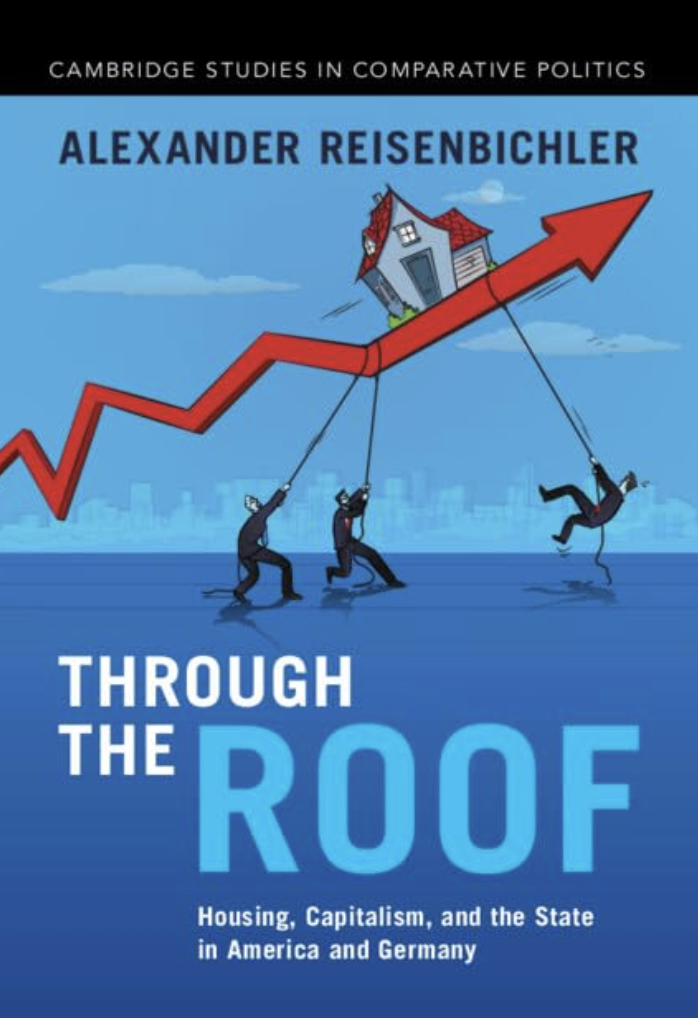
Through the Roof: Housing, Capitalism, and the State in America and Germany
By Alexander Reisenbichler
Cambridge University Press, August 2025/296 pages
Reviewed by Daniel Béland
June 21, 2026
A few days ago in Heidelberg, where I am spending time this month, I spoke to a local graduate student who told me how much she struggled to find a new apartment in that iconic university town (Universitätsstadt).
Because she cannot afford to live on her own, she had to meet with a large number of potential roommates through an exhausting process that lasted several weeks. In the end, she did find a place to live but that exhausting process points to the housing crisis facing parts of Germany, especially large urban centres and university towns such as Heidelberg.
In Germany as in Canada, limited housing supply is an issue and prices have soared, even if the situation varies greatly from one part of the country to another.
In his recent book Through the Roof: Housing, Capitalism, and the State in America and Germany, Alexander Reisenbichler, an associate professor of political science at the University of Toronto, shows that turning to comparative and historical analysis is most helpful in grasping the policy issues, such as supply and affordability, that are central to contemporary housing debates.
According to Reisenbichler, housing as a policy area is closely intertwined with broader economic forces and institutions, referred to in his book as “growth regimes”. To explore the impact of these regimes on housing policy, Reisenbichler turns to two contrasted cases, the United States and Germany, which he studies through a comparative and historical analysis that covers most of the 20th century and the first two and a half decades of the 21st century.
Based on archival research and expert interviews, his work suggests “that the different natures of American and German capitalism — demand-led in the United States and export-led in Germany — created different housing policymaking trajectories over the past century.”
In the demand-led U.S. growth regime, public policies and institutions work together to stimulate credit and consumption. Within that American growth regime, as Reisenbichler suggests, “housing is the key sector” at hand. This is especially the case with policies designed to stimulate homeownership.
“Since the Great Depression, American policymakers have concluded that housing programs subsidizing mortgage debt fuel housing demand, house prices, and housing wealth, and thereby consumer lending and spending,” the author writes. “Rising house prices are central to the functioning of this virtual cycle, where American homes effectively serve as credit cards.”
Over time, housing finance became so important for American capitalism that, in response to the Great Recession, itself largely the product of the gaming of the mortgage-debt market, the U.S. government “doubled down on government support for housing to rescue and reinforce America’s housing market and demand-led growth regime.”
In such a context, the Federal Reserve Bank played a direct role in supporting the housing sector, notably by “purchasing large amounts of mortgage-backed securities issues by Fannie Mae and Freddie Mac”, two large government-sponsored enterprises (GSEs) that guarantee most American mortgages.
The book makes a convincing case that looking at how capitalism works in two major economies is absolutely essential to understanding housing policy.
In late 2008, the U.S. government took over these two companies, effectively nationalizing them. As Reisenbichler notes, this dramatic move, which points to the crucial and enduring role of the government in housing, has not been reversed yet, despite the fact it was meant to be a temporary measure. This points to the importance of housing within the American economy, a situation that pushes Washington to remain so directly involved in homeownership policy, a reality that contrasts sharply with the chronic neglect of public housing in the United States.
Reisenbichler shows that, in Germany, just as in the United States, economic imperatives have shaped housing policy over time. In the context of Germany’s export-oriented growth regime, however, such imperatives gradually weakened political support for existing housing policies, leading to a dramatic shift that took place a couple of decades ago.
Initially, after World War II, “German policymakers established generous housing programs for both owner-occupied (favored by right-leaning parties) and rental housing (favored by the left) to address postwar housing shortages” in ways that were consistent with the country’s growth regime, which emphasised the need to control inflation and labour costs.
Starting in the 1970s, however, existing housing policies increasingly became seen as out of sync with the basic economic imperatives of Germany’s export oriented-growth regime. This led to gradual cuts to federal housing programs, especially those in the rental sector and, later on, in the mid-2000s, to the retrenchment of all such programs with the objective of repairing “the fundamentals of the export-led growth regime by reducing fiscal deficits, eliminating capital misallocations, and shifting government resources into what policymakers considered growth-generating sectors such as technology and education.”
In contrast with what happened in the Unites States at the time, in Germany the federal government strongly reduced its role in the housing sector in the name of macro-economic imperatives. Yet, as Reisenbichler shows, this was a shortsighted decision, as housing shortages reemerged in Germany not long later in a new policy context in which the federal government no longer had the tools to address that problem: “Ironically, the German government thus contributed to the very conditions it had historically worked to avoid: A housing-cost explosion that jeopardized affordable housing and low wages”, two outstanding and enduring priorities within the country’s growth regime.
Through the Roof is a clearly written and well-researched book that both scholars and informed, policy-engaged readers outside of academia will find most relevant. The book makes a convincing case that looking at how capitalism works in two major economies is absolutely essential to understanding housing policy.
While the analysis of the specific mechanisms that drive policy stability and change is not always systematic enough, especially with regard to the impact of the changing ideas held by government officials, the book does stress the negative role of blind spots in policy design, which has been especially obvious with regard to the German case.
From an economic and housing policy standpoint, as Reisenbichler notes, Canada has much more in common with the United States.
This is the case because, as its neighbour, Canada is an “example of a demand-led economy that is dependent on real estate for economic growth.” Even if Canada’s mortgage regulation system is stronger than the American one, we share with our southern neighbour a lack of emphasis on “supply-side affordable rental programs,” which is especially problematic considering today’s affordability crisis.
Although it does not focus on Canada, Through the Roof provides tremendous comparative and historical insight into the changing nature and economic underpinnings of housing for anyone seeking to add to their body of policy intelligence.
A Fellow of the Royal Society of Canada, Daniel Béland is professor of political science and director of the McGill Institute for the Study of Canada at McGill University.