
Tony Keller’s ‘Borderline Chaos’ and Canada’s Immigration Crisis: The Max Bell Lectures
 Max Bell lecturer Tony Keller with Martha Hall Findlay, October 28, at the National Music Centre/Anil Wasif
By Anil Wasif
October 30, 2025
CALGARY — “Canada needs better policies… and that starts with bold discourse.”
This was the opening call from Jennifer Welsh, Director of McGill’s Max Bell School of Public Policy, as she introduced the 2025 McGill Max Bell Lectures Tuesday at the National Music Centre’s Studio Bell in Calgary.
The subject of the discourse for Globe and Mail columnist Tony Keller’s three-lecture series is Canada’s immigration system or, as Welsh put it, the “immigration secret sauce,” and how our government “ignored the recipe and broke the system.”
The thesis of Keller‘s new book, Borderline Chaos: How Canada Got Immigration Right, and Then Wrong, is that our while our current immigration failure may have been “inadvertent” it was the product of a systematic policy failure that combined the eschewing of expert advice and, to quote Keller: the government insisting that the answer to Canada’s economic problems was much higher immigration.
Keller’s most potent argument began by painting a picture of what Canada had achieved. He contrasted Canada with the United States during the 2016 Trump election. As the U.S. roiled with anti-immigrant backlash, its foreign-born population sat at 14%. Canada, at that same moment, was at 22% foreign-born and enjoyed a “boring, all-party consensus.”
The public trust in Canada’s immigration policy was so high, Keller argued, that the topic was “usually as newsworthy as functioning plumbing.”
He backed this with data from a Gallup poll in the late 2010s, which found Canada had the “world’s most welcoming and positive attitude towards immigrants.” In fact, Keller noted, “Canadian seniors” were found to be more pro-immigration than “pro-immigration Americans in their teens and 20s.”
This system — the one I came through — was based on public trust. That trust started to build over fifteen years ago from chasing academic excellence in high school back in Bangladesh, to managing the anxiety of perfecting IS-LM curves at the University of Toronto, to my early oath of public service to Queen Elizabeth II, through understanding the legal basis of our Charter of Rights and Freedoms at McGill University to my oath of Citizenship to King Charles III.
This trust was the bedrock of my own integration. It was built on the “secret sauce” Welsh mentioned: the 1960s-point system. Keller cited its architect, Tom Kent, whose contributions to the Pearson Government’s 1966 White Paper on Immigration, fundamentally shifted Canada’s focus. Kent’s insight was that Canada was no longer a “country of virgin lands… waiting to be settled by anyone with a strong back.” Instead, Keller quoted the paper, “We need people who will, by their skill and adaptability, complement… the training, employment and movement of workers who are already here.”
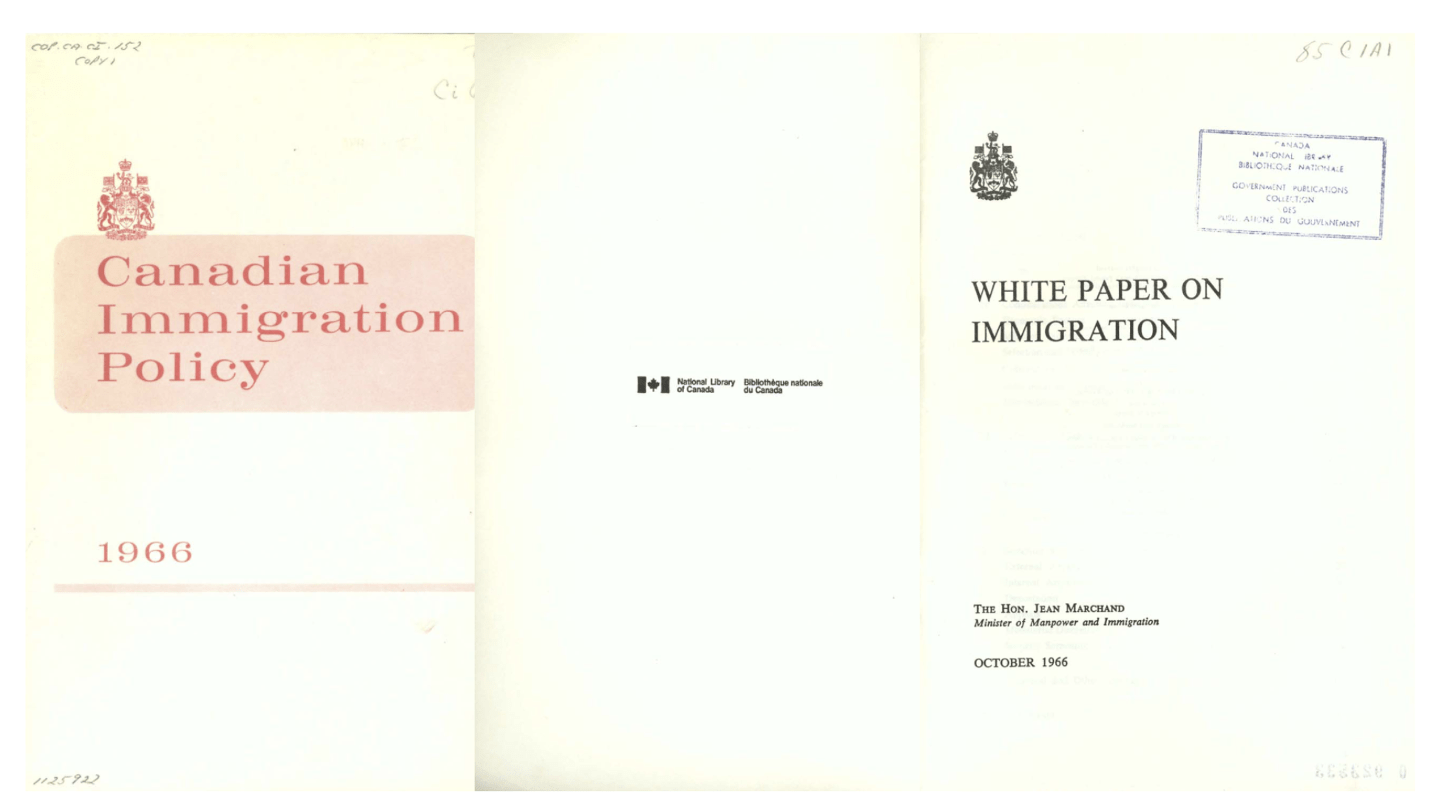 White Paper on Immigration, 1966 – Lester B. Pearson Government. Source: National Library of Canada
This was our “enlightened self-interest.” It was a system built to select high-skilled, educated, permanent residents who were likely to succeed and contribute.
That system is gone. The pivot, Keller detailed, came when the government embraced a “new, but also a very old Canadian idea”: that simple population growth would be a panacea for the economy.
In 2023, Keller stated, Canada took in “five times as many immigrants as in 2015.” But the core of the “Wrong” wasn’t just the number. It was the type and status of the new arrivals. The system was repurposed, he argued, to “fill low-wage, entry-level jobs.” The focus shifted from “permanent residents” to “temporary status” arrivals, primarily temporary foreign workers and international students.
Martha Hall Findlay, a former Liberal MP who, as director of the University of Calgary School of Public Policy was conducting the post-lecture fireside chat with Keller, asked “Who was on the watch?”, adding, “We can all blame politicians, we can blame bureaucrats, we can blame all sorts of people. But there was good, thoughtful advice, and it was not only not listened to, it was actively avoided.”
The answer, detailed by Keller and Hall Findlay, helps us go beyond headline-driven rhetoric and understand this policy failure. It was not a miscalculation. It was the culmination of failure of governance, driven by stakeholder capture and federal-provincial incoherence. Most importantly, this new, broken system was built by a powerful consensus of stakeholders who all benefited. “All the stakeholders said, ‘we want more immigration, we want easier immigration,'” Keller said in the Q&A.
First, business lobbies, who successfully agitated to repurpose the system to “fill low-wage, entry-level jobs.” Keller explained that this group, facing a “labour shortage” almost entirely at the bottom end of the market, saw a massive pool of temporary workers as a way to avoid raising wages or investing in productivity. This directly inverted the Tom Kent model, shifting the system’s focus from acquiring human capital to acquiring cheap labour.
Second, the federal government itself, which ignored sound advice from its own economists in 2016. It was convinced—urged on by progressive activists and lobby groups like the Century Initiative—that a “bigger Canada” was an inherent good. Keller’s data showed this was a catastrophic miscalculation: this new model did not make Canada richer, it has done the precise opposite, driving GDP per capita into a protracted decline.
Third, and most critically, the provinces. The international student file is the smoking gun. Ottawa holds the lever for visas; the provinces oversee the colleges. For provincial governments—with Ontario leading the charge—the “diploma mill” loophole became a shadow funding mechanism for post-secondary education. Keller noted that while university numbers were stable, colleges, “especially in Ontario… went crazy,” allowing Queen’s Park to reap the tuition fees without raising taxes.
The federal government issued the visas, the provinces cashed the cheques, and the diploma mills provided the pretext. “The sum of all these special interests,” Keller noted, “did not add up to the national interest.”
For an immigrant who came to Canada believing in the promise of that “secret sauce,” a coalition of stakeholder interest trumping national interest feels like a fundamental betrayal. This means that the “functioning plumbing” has burst, and the public has lost faith in the plumbers.
The new, chaotic system doesn’t just hurt the exploited new arrivals. It retroactively damages the public trust that my generation of immigrants relies on. As Keller’s tour moves to Halifax and Toronto, the question—”Who was on the watch?”—will linger, especially for those of us who believed we were joining a system built to last. And are actively participating in difficult conversations to make this policy better for all of us.
Policy Columnist Anil Wasif is a public servant in the Ontario government. He serves on the University of Toronto’s Governing Council and the Advisory Board of McGill’s Max Bell School. Internationally, he serves on the OECD’s Infrastructure Delivery Committee. He co-owns and manages the Canada-born global non-profit BacharLorai. The views expressed are his own.